By Rahul Dhakate · PMP & PSM I Certified · 31 May 2026 · learnxyz.in
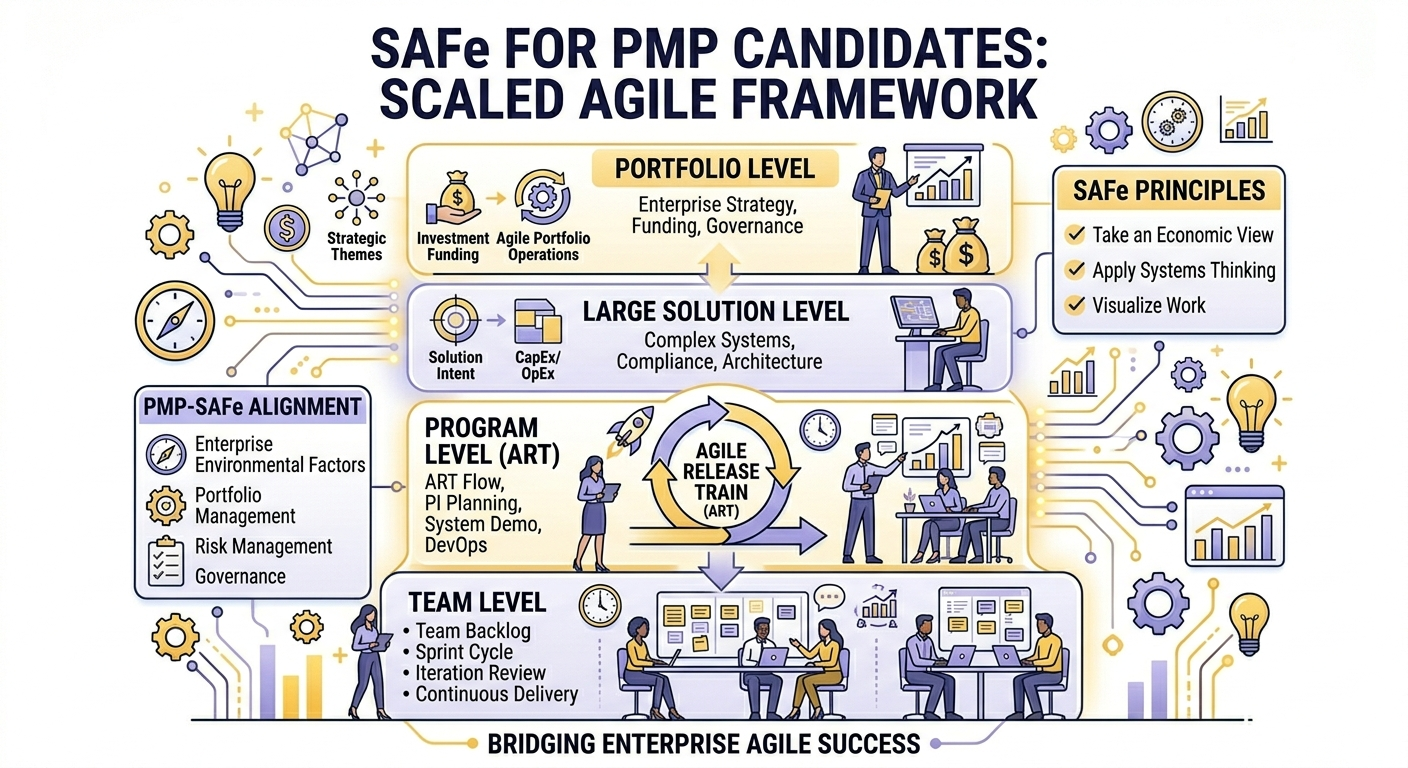
SAFe appears in PMP exam preparation materials and candidates frequently ask how deeply they need to study it. The short answer: you need to understand the concept and the key terminology, but you do not need to become a SAFe practitioner to pass the PMP exam.
This article gives you exactly what you need — a clear explanation of what SAFe is, why it exists, the key concepts and roles that appear on the exam, and an honest assessment of how much study time to allocate to it relative to the other Agile topics you are covering.
Contents
The Core Idea: Aligning Multiple Agile Teams.
Key SAFe Concepts the PMP Exam References
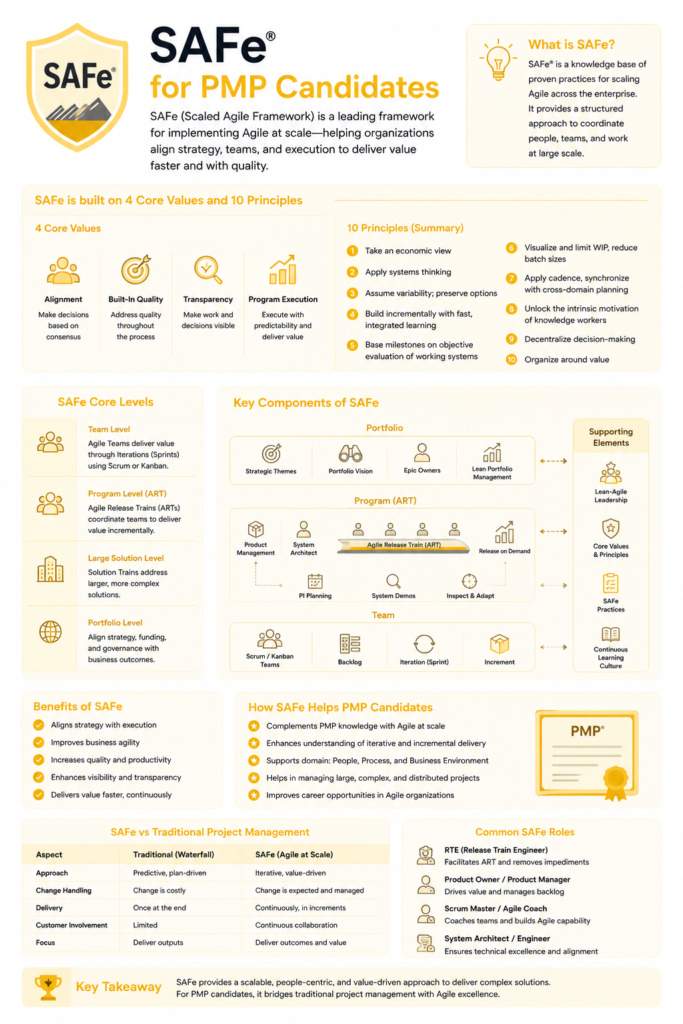
The Four Configurations of SAFe
SAFe vs Standard Scrum — Key Differences.
How Much Should You Study SAFe for the PMP Exam?
SAFe’s Honest Real-World Reputation
I have not worked in a SAFe environment personally — my Agile experience has been in Scrum and hybrid delivery contexts. What I can give you is the exam preparation perspective: what SAFe is, how it differs from standard Scrum, and what PMI expects you to know about it.
What is SAFe?
SAFe stands for the Scaled Agile Framework. It is a set of organisational and workflow patterns designed to help large organisations implement Agile practices at scale — across multiple teams, departments, and programmes simultaneously.
The core problem SAFe solves: Scrum works beautifully for one team of 5–9 people delivering one product. But what happens when you have 50 teams, 500 developers, and 10 interdependent products that all need to deliver together? Standard Scrum gives you no guidance on how to coordinate across teams, align priorities at an organisational level, or manage shared dependencies. SAFe was created to fill that gap.
SAFe was developed by Dean Leffingwell and first published in 2011. It is now in version 6.0 and is one of the most widely adopted enterprise Agile frameworks, particularly in large US technology companies, government agencies, and regulated industries.
The Core Idea: Aligning Multiple Agile Teams
Think of SAFe as Scrum scaled up by a factor of 10 to 100. Individual Scrum teams still exist and still run their two-week sprints. But those teams are organised into a higher-level structure that coordinates their work, aligns their priorities, and manages dependencies between them.
The fundamental unit of SAFe above the individual team is the Agile Release Train (ART). An ART is a long-lived group of 50–125 people — typically 8 to 12 Scrum teams — who collaborate to deliver a significant product or solution. The ART runs on a Programme Increment (PI) cadence — a planning horizon of 8 to 12 weeks containing 4 to 6 sprints.
Think of the Agile Release Train as a bus that all the Scrum teams board together. The bus runs on a fixed schedule — the PI — and all teams on the bus align their work to the same destination. Individual teams can vary their speed and approach within their sprints, but everyone is heading to the same stop at the same time.
Key SAFe Concepts the PMP Exam References
Programme Increment (PI)
A Programme Increment is a fixed timebox — typically 8 to 12 weeks — during which all teams on an Agile Release Train deliver incremental value. Each PI contains 4 to 5 development sprints followed by one Innovation and Planning (IP) sprint used for testing, fixing, and planning the next PI.
At the end of each PI, the ART delivers a potentially releasable integrated solution from all participating teams. This is SAFe’s equivalent of Scrum’s Sprint Goal — but applied across an entire programme.
PI Planning
PI Planning is SAFe’s signature event — a two-day, face-to-face planning session at the start of each Programme Increment where all teams on the ART plan their work together. All team members attend — typically in a large room or via video for distributed programmes.
During PI Planning, the Business Owners and Product Management present the programme vision and top features. Teams plan their sprints for the PI, identify cross-team dependencies, and negotiate commitments. The outcome is a set of PI Objectives — committed goals for the Programme Increment — and a visible, coordinated plan across all teams.
PI Planning is the single most commonly tested SAFe concept on the PMP exam because it represents the most visible difference between SAFe and standard Scrum. If you see a question describing a large-scale planning event involving multiple teams, business owners, and a two-day format, the answer is PI Planning.
Release Train Engineer (RTE)
The Release Train Engineer is the servant leader for the entire Agile Release Train — analogous to a Scrum Master but operating at the programme level rather than the team level. The RTE facilitates PI Planning, coordinates with team Scrum Masters, removes programme-level impediments, and manages cross-team dependencies.
Product Management
In SAFe, Product Management is a programme-level role responsible for the programme backlog — the prioritised list of features for the entire ART. Product Management works with multiple Product Owners (one per Scrum team) to align priorities and ensure team-level backlogs reflect programme priorities.
This is a key distinction from standard Scrum: in SAFe, there is a hierarchy of product roles. Product Management owns the programme backlog (features). Product Owners own their team’s iteration backlog (stories). This hierarchy enables alignment across teams in a way that single-Product-Owner Scrum cannot manage at scale.
System Architect
The System Architect is a technical leadership role that works across all teams on the ART to maintain architectural integrity. They ensure that individual team decisions are consistent with the overall system architecture — preventing the situation where independently-made technical choices by different teams create integration problems at the end of the PI.
The Four Configurations of SAFe
SAFe comes in four configurations of increasing complexity, designed for organisations of different sizes:
| Configuration | For | Key Addition |
| Essential SAFe | Most teams starting with SAFe — the minimum viable SAFe | ART, PI Planning, RTE, Product Management — the core elements |
| Large Solution SAFe | Organisations building large, complex solutions requiring multiple ARTs | Solution Train, Solution Architect, Value Stream Coordination |
| Portfolio SAFe | Organisations managing multiple ARTs at the enterprise strategy level | Portfolio Kanban, Lean Budgeting, Strategic Themes |
| Full SAFe | Largest enterprises with multiple ARTs and Value Streams | All levels: Team, Programme, Large Solution, Portfolio |
For the PMP exam, you only need familiarity with Essential SAFe — the core elements. The Large Solution, Portfolio, and Full configurations are enterprise architecture topics well beyond what the PMP exam tests. Do not spend time studying them in detail.
SAFe vs Standard Scrum — Key Differences
| Factor | Standard Scrum | SAFe |
| Team size | 1 team of 3–9 people | Multiple teams (ART of 50–125 people) |
| Planning cadence | Sprint planning every sprint (2 weeks) | PI Planning every 8–12 weeks + sprint planning |
| Product backlog owner | One Product Owner per team | Product Management (programme) + Product Owners (team) |
| Servant leader role | Scrum Master (team level) | Scrum Master (team) + RTE (programme level) |
| Dependency management | Handled within team scope | Cross-team dependencies managed at PI Planning |
| Release cadence | Potentially releasable each sprint | Integrated solution released each PI (8–12 weeks) |
| Architecture | Team-owned technical decisions | System Architect ensures cross-team consistency |
How Much Should You Study SAFe for the PMP Exam?
This is the question every PMP candidate asks — and the honest answer is: less than you think.
SAFe questions on the PMP exam are a small fraction of the total. They typically appear in the context of scaling Agile — questions about what happens when multiple teams need to coordinate, or how large organisations implement Agile practices. The level of detail tested is conceptual, not practitioner-level.
What you need to know for the exam:
- What SAFe is and why it exists — scaling Agile across multiple teams
- What an Agile Release Train is — a group of 50–125 people on a shared PI cadence
- What a Programme Increment is — an 8–12 week timebox containing 4–5 sprints
- What PI Planning is — a two-day planning event for all ART teams
- What the Release Train Engineer does — Scrum Master at programme scale
- The difference between Product Management (programme backlog) and Product Owner (team backlog)
What you do not need to study for the exam:
- The full SAFe configuration hierarchy (Essential, Large Solution, Portfolio, Full)
- Lean Portfolio Management in detail
- Value Stream mapping and management
- SAFe certification-level content on Business Agility or Continuous Delivery Pipeline
Study allocation advice: if you are allocating 100 hours to PMP preparation, spend approximately 3–5 hours on SAFe. Spend significantly more on Scrum (ceremonies, roles, artefacts), Agile values and principles, and the PMI mindset for Agile situational questions. SAFe will appear on your exam — but it will not be the reason you pass or fail.
SAFe’s Honest Real-World Reputation
SAFe is widely used at enterprise scale — but it is also genuinely controversial among Agile practitioners. Critics argue that SAFe reintroduces the heavyweight process and governance structures that Agile was designed to escape, simply wrapped in Agile terminology. The two-day PI Planning event, the ART-level hierarchy, and the prescriptive role structure can feel more like Waterfall at scale than genuine Agile.
Proponents argue that for organisations of 500+ engineers working on interdependent products, some form of structured coordination is necessary — and SAFe provides a tested, documented approach that organisations can implement consistently.
The realistic assessment: SAFe works best when the alternative is poorly-coordinated independent Scrum teams creating integration nightmares at every release boundary. For those organisations, SAFe provides genuine value. For smaller organisations, it is almost certainly more process than is needed.
For the PMP exam, PMI’s stance is neutral — it presents SAFe as one of several frameworks for scaling Agile, without advocating for or against it. Your job in the exam is to demonstrate that you understand what it is and when it is applied, not to take a philosophical position on its merits.
About the Author
Rahul Dhakate is a PMP and PSM I certified project manager and product management leader based in Nagpur, India, with 20 years of experience managing software projects across BFSI, eCommerce, and enterprise software. While he has not worked directly in a SAFe environment, his programme management experience at Wipro — coordinating delivery across 70+ team members and multiple client workstreams — gave him direct exposure to the coordination challenges that frameworks like SAFe are designed to address at enterprise scale. He writes at LearnXYZ.in to help working professionals understand both the theory and the real-world practice of project management.
Next Article:

I’ve been surfing on-line more than 3 hours as of late, yet I by no means discovered any attention-grabbing article
like yours. It’s beautiful value sufficient for me.
In my view, if all webmasters and bloggers made excellent content as you probably
did, the net will be much more helpful than ever before.
Those words me a lot. Thank you!