By Rahul Dhakate · PMP & PSM I Certified · 24 May 2026 · learnxyz.in
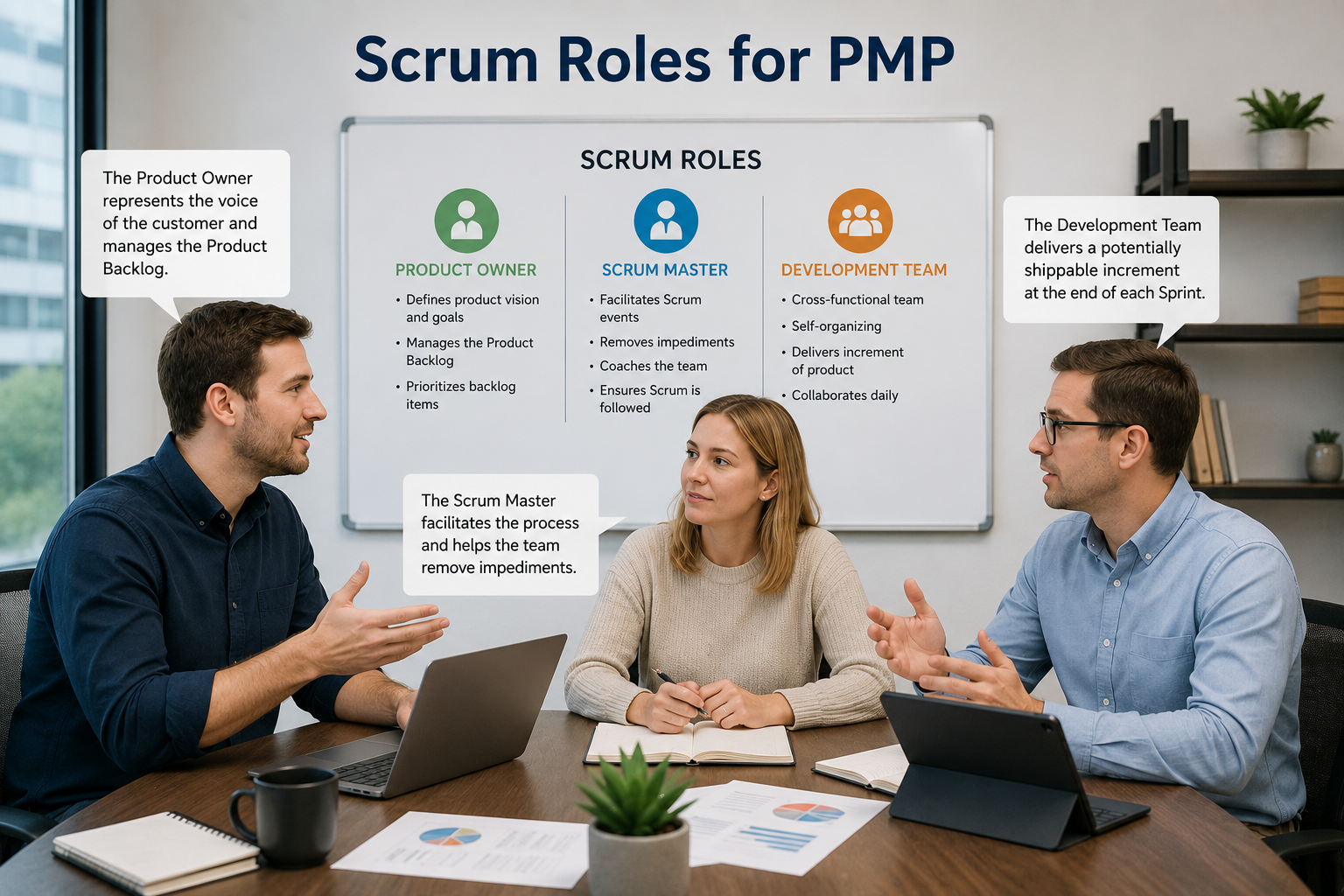
One of the most fundamental aspects of the Scrum framework — and one that the PMP exam tests in detail — is the three-role structure. Unlike traditional project management, where roles like Project Manager, Team Lead, and Business Analyst carry well-understood meanings, Scrum defines three very specific roles with carefully delineated responsibilities.
Understanding these roles precisely matters for two reasons: first, the exam tests the boundaries between them closely. Second, and more practically, the most common source of friction in Scrum implementations is role confusion — people performing work that belongs to a different role, or one person attempting to fill multiple roles simultaneously.
Table of Contents
Scrum Roles for PMP: Product Owner, Scrum Master, Dev Team Explained.
The Three Scrum Roles — Overview..
Key Product Owner Responsibilities.
Key Scrum Master Responsibilities.
The Developers (Development Team)
Key Characteristics of the Development Team..
What Happens When Roles Overlap — A Real Pattern.
The Scrum Master vs the Project Manager
How Scrum Roles Are Tested on the PMP Exam..
I have seen both work well and fail badly. Let me explain the roles as they are defined, and then share the real patterns I observed across different organisations.
The Three Scrum Roles — Overview
The Scrum Guide defines the Scrum Team as consisting of exactly three roles:
| Role | Core Responsibility | Answers the Question |
| Product Owner | Maximise the value of the product by managing the product backlog | WHAT should be built and in what order? |
| Scrum Master | Ensure the Scrum framework is understood and enacted — serve and protect the team | HOW should the team work together effectively? |
| Developers (Dev Team) | Deliver a potentially releasable increment of the product each sprint | CAN we build it, and HOW will we build it? |
The Product Owner
The Product Owner is responsible for maximising the value of the product and the work of the Development Team. They are the single voice of the business — translating stakeholder needs, market requirements, and business strategy into a prioritised product backlog that the Development Team can work from.
Key Product Owner Responsibilities
- Owns and manages the product backlog — the ordered list of all work to be done on the product
- Writes or collaborates on user stories and acceptance criteria — defining what ‘done’ looks like for each backlog item
- Prioritises backlog items based on business value — the highest-value work is always at the top
- Is the final decision-maker on scope — no one else can override the Product Owner’s backlog priorities
- Attends Sprint Planning, Sprint Review, and is available to the team throughout the sprint for clarification
- Accepts or rejects completed work at the Sprint Review — determines whether a backlog item meets its acceptance criteria
A critical PMP exam rule: the Product Owner is one person, not a committee. Multiple stakeholders may provide input, but only one person has the authority to prioritise the backlog. When stakeholders have conflicting priorities, the Product Owner resolves that conflict — not the Scrum Master or the Development Team.
At Valethi Technologies and Amla Commerce, the Product Owner role was filled by a person from the onsite team — a client-side representative who had the business knowledge and the authority to make product decisions. This is the ideal Product Owner profile: someone close enough to the business to understand priorities, and senior enough to make calls when stakeholders disagree.
The Product Owner’s proximity to both the business and the development team is what makes Scrum’s value delivery mechanism work. A Product Owner who is unavailable to the team or who cannot make decisions is one of the most common reasons Scrum implementations fail in practice.
The Scrum Master
The Scrum Master is responsible for ensuring the Scrum framework is understood and enacted. They serve the Scrum Team in several ways — coaching team members on Scrum practices, facilitating Scrum events, and removing impediments that block the team’s progress.
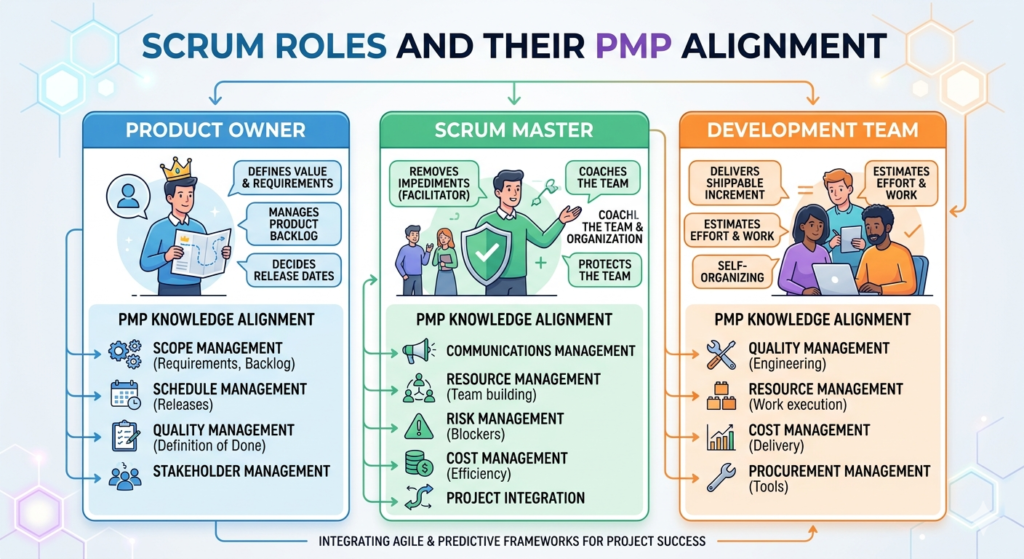
The Scrum Master is often misunderstood as a project manager with a new title. This is incorrect and it is specifically tested on the PMP exam. The Scrum Master does not manage the team, assign tasks, or make product decisions. They serve the team — enabling it to perform at its best by clearing obstacles and protecting it from external disruptions.
Key Scrum Master Responsibilities
- Facilitates all four Scrum ceremonies — ensures they happen, stay time-boxed, and achieve their purpose
- Removes impediments — any obstacle blocking the Development Team’s progress is the Scrum Master’s responsibility to resolve or escalate
- Coaches the team on Scrum values and practices — especially important when the team is new to Scrum
- Shields the team from external interruptions — protects the Development Team from unplanned requests, scope additions, and organisational distractions during the sprint
- Serves the Product Owner — helps with backlog management, facilitates stakeholder communication, and ensures the PO understands Agile practices
- Serves the organisation — leads Scrum adoption beyond the immediate team
PMP exam trap: The Scrum Master is a servant-leader, not an authority figure. They do not have authority over the Development Team’s technical decisions. They do not assign work. They do not represent the team to management as a reporting relationship. When an exam question asks who should make a technical architecture decision, the answer is the Development Team — not the Scrum Master.
The Developers (Development Team)
In the Scrum Guide, the third role is called Developers — a deliberate choice that reflects the broadening of what ‘developer’ means in modern software teams. The Developers are the professionals who do the work of creating the product increment each sprint. This includes software engineers, but also designers, QA engineers, database administrators, and any other specialist whose contribution is needed to deliver a potentially releasable increment.
Key Characteristics of the Development Team
- Self-organising: the team decides how to accomplish the work — no one outside the team directs the technical approach
- Cross-functional: the team collectively has all the skills needed to complete a sprint without external dependencies
- Collectively accountable: the team as a whole is responsible for delivering the sprint goal — not individual members for individual tasks
- No sub-teams or titles: within the Development Team, there are no hierarchies or specialisation silos — everyone is a Developer
- Optimal size: 3 to 9 members — small enough to remain agile, large enough to deliver meaningful work each sprint
The ‘no titles within the Development Team’ rule is tested on the exam. A question may describe a ‘Senior Developer’ directing the work of junior developers within a Scrum Team. This violates Scrum’s self-organising principle — in Scrum, all Developers are peers within the team, regardless of their organisational seniority outside the team.
What Happens When Roles Overlap — A Real Pattern
In theory, the three Scrum roles are cleanly separated. In practice, especially in smaller organisations or early-stage Scrum adoptions, one person frequently wears multiple hats.
I experienced both patterns across different organisations. In some companies, the roles were blurred — a project manager served as both Scrum Master and de facto Product Owner, backlog prioritisation happened informally, and the ceremonies were facilitated by whoever was available. In others, each role was filled by a dedicated, experienced person. The difference in outcomes was significant.
When roles were clearly separated and filled by dedicated people, the team worked better. The Product Owner made faster, more consistent prioritisation decisions because they were not simultaneously managing team dynamics. The Scrum Master gave more effective ceremony facilitation and impediment removal because they were not also responsible for managing client relationships. The Developers worked with greater autonomy because the Scrum Master was protecting them rather than redirecting them.
The pattern I observed consistently: role confusion is most damaging when it sits at the Product Owner level. A Scrum Master who also does some development work is a pragmatic compromise. A Product Owner who is also trying to manage the team creates a fundamental conflict of interest — the person deciding what gets built should not also be directing how it gets built.
The PMP exam’s Agile content reflects this real-world pattern. Many situational questions describe role violations and ask what the Scrum Master or Product Owner should do. The correct answer almost always involves restoring clarity to the role boundaries — the Scrum Master redirecting Product Owner overreach into the Development Team’s work, or the team pushing back on scope additions that bypass the Product Owner.
The Scrum Master vs the Project Manager
This comparison appears on the PMP exam and confuses many candidates who are transitioning from traditional PM backgrounds.
| Dimension | Project Manager | Scrum Master |
| Authority | Direct authority over team and resources within project scope | No direct authority — servant-leader role |
| Work assignment | Assigns tasks to team members | Team self-organises — Scrum Master does not assign |
| Scope decisions | Manages scope via change control | Product Owner controls scope — Scrum Master enforces the process |
| Accountability | Accountable for project outcomes (time, cost, scope) | Accountable for Scrum process health, not product outcomes |
| Team relationship | Manages team performance | Coaches and serves the team |
| External interface | Primary interface with stakeholders and sponsors | Shields team from external interference; PO manages stakeholders |
| Exists in | Predictive and hybrid project environments | Scrum teams — may not exist in predictive projects |
In hybrid environments — which are how most real projects actually run — both roles may coexist. A project manager handles the programme-level governance, contractual commitments, and senior stakeholder management. A Scrum Master handles the team-level Agile facilitation and coaching. This is a legitimate and common structure that the PMP exam acknowledges.
How Scrum Roles Are Tested on the PMP Exam
- Role boundary questions: Who prioritises the backlog? Product Owner only. Who assigns tasks to Developers? Nobody — the team self-organises. Who removes impediments? The Scrum Master.
- Role violation scenarios: A stakeholder goes directly to the Development Team with new requirements. What should happen? The Scrum Master redirects to the Product Owner, who evaluates the request and adds it to the backlog if appropriate.
- Product Owner authority questions: Two stakeholders disagree about a backlog priority. Who decides? The Product Owner — and only the Product Owner.
- Team size questions: What is the optimal Development Team size in Scrum? Three to nine members. Outside this range, either coordination costs rise (too large) or the team lacks capability (too small).
- Self-organisation questions: A Scrum Master is assigning specific tasks to developers before Daily Scrum. Is this correct? No — the Development Team decides how to accomplish the Sprint Goal. Task assignment is the team’s decision, not the Scrum Master’s.
About the Author

Rahul Dhakate is a PMP and PSM I certified project manager and product management leader based in Nagpur, India, with 20 years of experience managing software projects across BFSI, eCommerce, and enterprise software. He held combined project management and Scrum facilitation responsibilities across multiple organisations, and has observed firsthand how clean role separation between Product Owner, Scrum Master, and Development Team produces better outcomes than role overlap. He writes at LearnXYZ.in to help working professionals understand both the theory and the real-world practice of project management.
Read Next: