
By Rahul Dhakate · PMP & PSM I Certified · 02 Aug 2026 · learnxyz.in
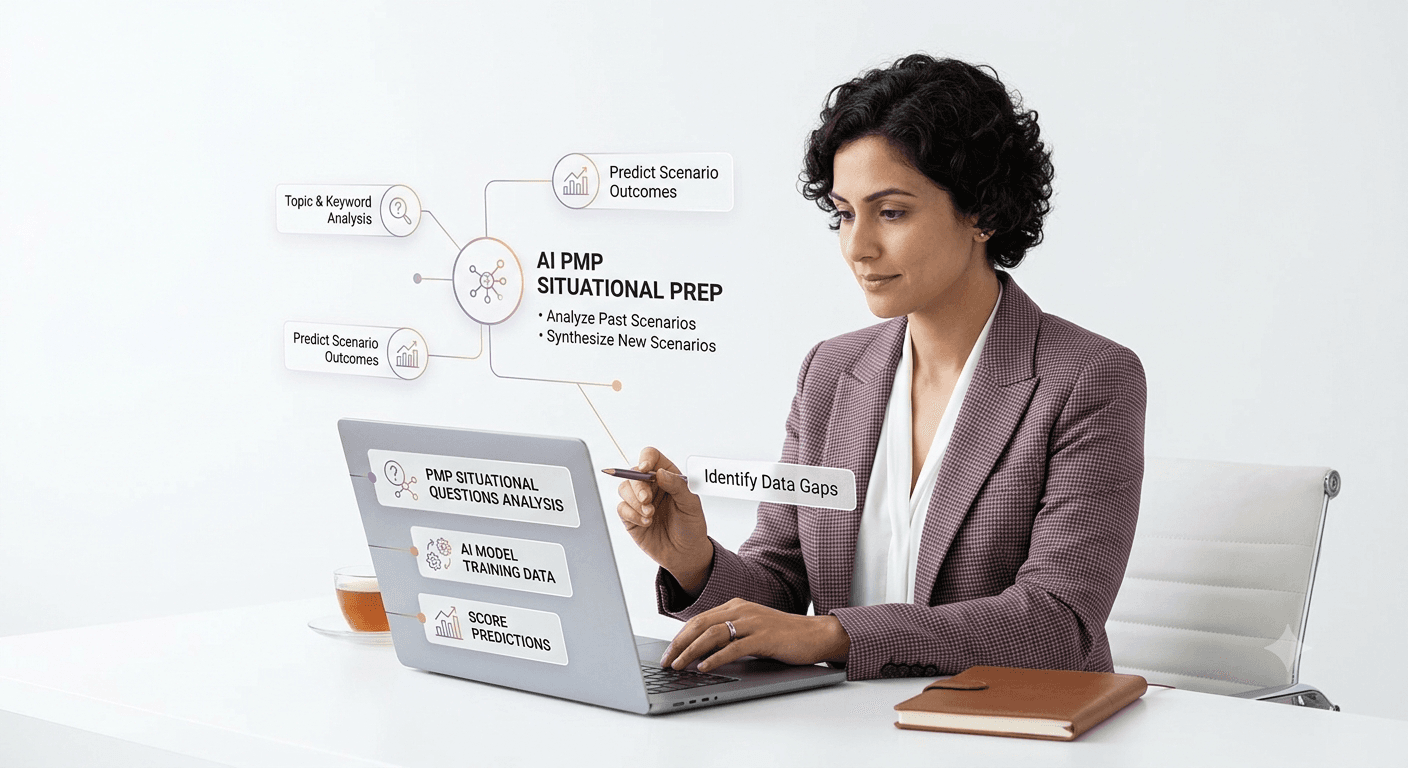
This article bridges the two pillars of this site — PMP exam preparation and AI tools for project managers — in the most direct way possible. Because the question it answers is genuinely new: how do you use AI to prepare for the hardest category of PMP exam question?
When I prepared for and passed the PMP exam in 2022, ChatGPT did not yet exist. My situational question practice came from mentor-provided materials and working through every wrong answer carefully. If I were preparing today, I would use Claude or ChatGPT as a practice partner for situational questions — not as a replacement for a quality simulator, but as a supplement that offers something unique: unlimited, customised scenarios targeting exactly my weak areas, with detailed explanations of the PMI reasoning behind every answer.
I would use Claude — which is what you are reading right now — for situational question practice. The conversational format allows you to ask follow-up questions about why a specific answer is correct, request variations of the same scenario, and get explanations of the PMI principle being tested in plain language that textbooks often make unnecessarily complex.
Why AI is Uniquely Suited for Situational Question Practice
Standard practice simulators give you a fixed bank of questions. Once you have seen a question, you remember the answer — and you might remember the answer without understanding the principle behind it. This is one of the most common failure modes in PMP preparation.
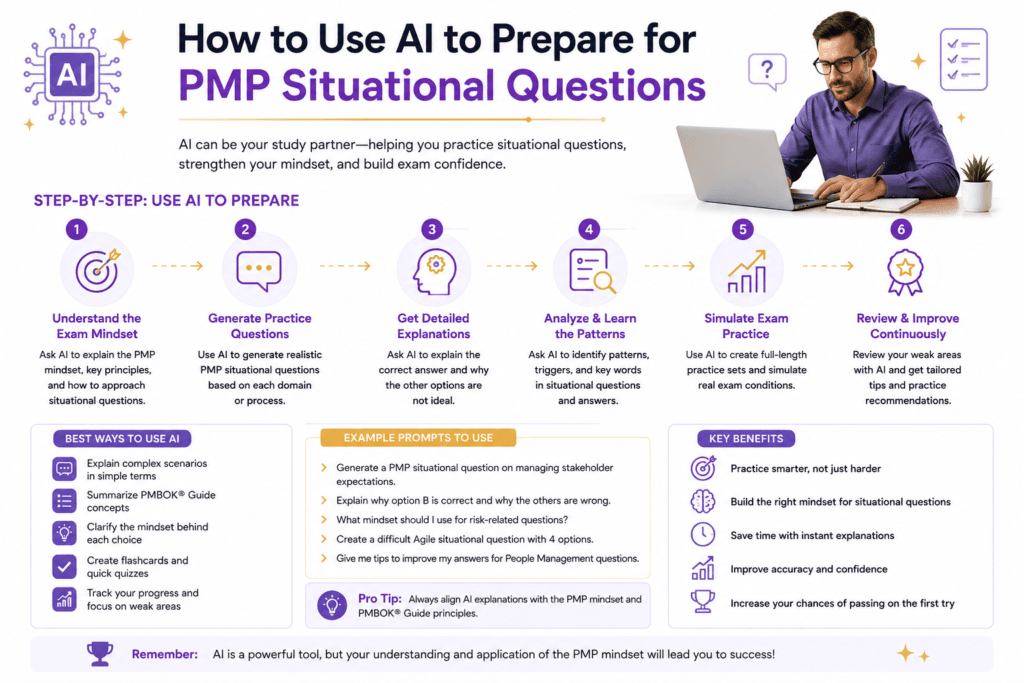
AI generates novel scenarios on demand. You can ask for a new Agile situational question on stakeholder management in a sprint context, get one you have never seen before, work through it, and then ask the AI to explain the PMI reasoning in depth. The infinite variation eliminates the memorisation shortcut.
The Three-Level Practice Method
Level 1: Concept Clarification
Start here when you encounter a concept that feels unclear. Ask AI to explain it in plain language with a real-world example before you practice questions on it.
| LEVEL 1 PROMPT — Concept Clarification I am preparing for the PMP exam. I am confused about [CONCEPT]. Please explain it in plain language, then give me a real-world project scenario that illustrates how this concept applies in practice. Finally, tell me the most common way this concept is tested in PMP exam questions and what the typical wrong answer looks like. |
Level 2: Question Generation
Once you understand the concept, ask AI to generate practice questions targeting that specific area.
| LEVEL 2 PROMPT — Situational Question Generation Generate 5 PMP-style situational questions about [TOPIC/DOMAIN]. Requirements for each question: – Present a realistic project scenario (2-3 paragraphs) – Provide 4 answer options (A, B, C, D) – All 4 options should seem plausible to an experienced PM – The correct answer should reflect PMI best practice, not real-world expediency – Do NOT reveal which answer is correct yet — I will answer first Topic: [e.g., Agile stakeholder management / Risk response / Sprint retrospective facilitation / Change control in hybrid projects] |
Level 3: Deep Explanation After Answering
After you select your answer, ask for the full explanation.
| LEVEL 3 PROMPT — Deep Explanation My answer to question [N] was [YOUR ANSWER]. Please tell me: 1. Is my answer correct? 2. What is the correct answer and exactly why is it correct? 3. Why are each of the wrong answer options incorrect? 4. Which specific PMI principle or framework element does this question test? 5. Generate one more question testing the same principle but in a different scenario context. |
Domain-Specific Practice Prompts
Use these targeted prompts for each of the three PMP exam domains:
| PEOPLE DOMAIN (42% of exam) — Targeted Prompt Generate 3 PMP situational questions specifically testing the People domain. Include scenarios covering: – Conflict resolution within a Scrum team – A team member performing below expectations – Managing stakeholder resistance to project changes All scenarios should require PMI-style judgment, not just process recall. |
| PROCESS DOMAIN (50% of exam) — Targeted Prompt Generate 3 PMP situational questions testing the Process domain. Cover: – A hybrid project where both Agile and predictive processes apply – An EVM scenario requiring both calculation and interpretation – A change control situation where scope, schedule, and cost are affected Make the answer choices genuinely difficult to distinguish. |
| AGILE SCENARIOS — Targeted Prompt (most commonly failed) Generate 3 Agile-specific PMP situational questions. Each scenario must: – Present a real Scrum team situation – Require knowledge of correct Scrum role boundaries (PO vs SM vs Dev Team) – Have at least one wrong answer that sounds correct to a traditional project manager – Test whether I understand the PMI mindset vs real-world compromise |
What AI Cannot Replace
Using AI for situational question practice is powerful — but it is a supplement, not a replacement for:
- A quality dedicated simulator like PM PrepCast, which provides exam-realistic question format and detailed performance analytics
- Full timed mock exams that build the stamina and time management skills the real exam requires
- Systematic coverage of all domains — AI responds to what you ask, so undisciplined use can over-practice favourite topics and under-practice weak ones
The optimal preparation stack: use AI for concept clarification and unlimited situational question practice targeting your specific weak areas. Use PM PrepCast or a similar simulator for realistic full-length timed practice sessions. The combination covers what neither does alone.
Tracking Your Progress With AI Practice
One practical approach: keep a running log of every AI practice question you attempt, your answer, and whether you were correct. Review this log weekly. Patterns will emerge — the same principle appearing in multiple wrong answers tells you where to focus additional practice. This self-directed analytics approach approximates what a simulator provides through automated tracking.
About the Author

Rahul Dhakate is a PMP and PSM I certified project manager and product management leader based in Nagpur, India, with 20 years of experience managing software projects across BFSI, eCommerce, and enterprise software. He passed the PMP exam in 2022 before AI practice tools were available. If preparing today he would use Claude for situational question practice, particularly for the Agile domain questions that require nuanced understanding of PMI role boundaries and team empowerment principles. He writes at LearnXYZ.in about PMP exam prep and AI tools for modern project managers.
Upcoming Important Article: Will AI Replace Project Managers? What the Data Says in 2026 (Stay Tuned, You do not want to miss this one 😉 )
Dont forget to read curated articles like this –

Somebody essentially lend a hand to make significantly posts I might state That is the very first time I frequented your web page and up to now I surprised with the research you made to create this particular put up amazing Excellent job
This article gave me a simple explanation of a complex idea during my research and I look forward to reading more from you
The discussion shared valuable insight into this subject while browsing online and I look forward to reading more from you
This is my first time pay a quick visit at here and i am really happy to read everthing at one place