By Rahul Dhakate · PMP & PSM I Certified · 30 May 2026 · learnxyz.in
Hybrid project management is not a new idea invented by consultants — it is the honest description of how most projects are actually run. If you have managed projects in the real world for more than a few years, you have almost certainly been doing hybrid project management without calling it that.
The PMP exam now explicitly recognises hybrid approaches as a core methodology alongside predictive and Agile. Understanding what hybrid means, how it is structured in practice, and how PMI expects you to think about it is essential for both the exam and for your credibility as a modern project manager.
Table of Contents
What is Hybrid Project Management?.
A Real Hybrid Example: Ebix Software.
The Waterfall Layer in Hybrid.
Common Hybrid Patterns in Practice.
Why Pure Agile Often Cannot Work in Enterprise Environments.
How PMI Tests Hybrid on the PMP Exam.
What is Hybrid Project Management?
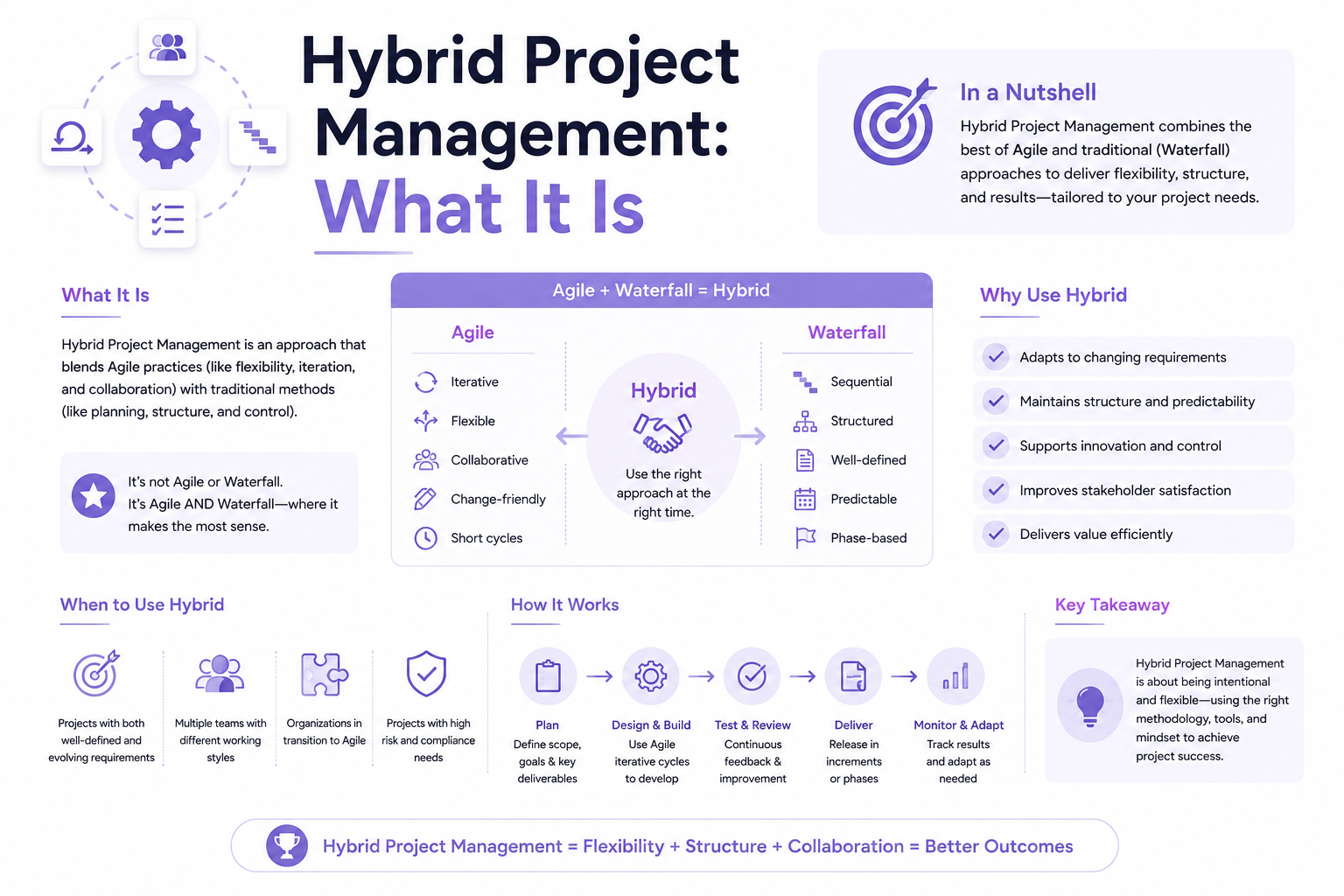
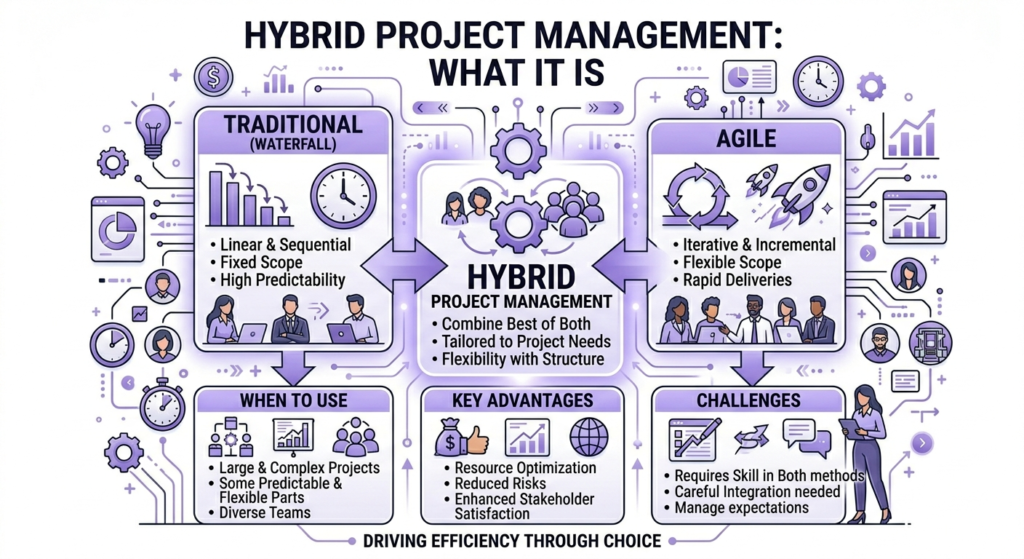
Hybrid project management is an approach that combines elements of predictive (Waterfall) and Agile methodologies, applied to different aspects of the same project based on what works best for each.
The key insight is that hybrid is not a compromise or a halfway measure — it is a deliberate, contextual application of the right tool for the right purpose within a single project. Some aspects of a project benefit from predictive planning and governance. Others benefit from Agile iteration and flexibility. Hybrid project management applies both where they are most appropriate.
A Real Hybrid Example: Ebix Software
The clearest hybrid example from my own career is the evolution of delivery methodology at Ebix Software, where I spent a decade managing SmartOffice CRM releases for BFSI clients.
In the early years of the project, we followed a pure Waterfall model. The project lifecycle was structured in sequential phases: requirements gathering, system design, development, testing, user acceptance testing, and release. Each phase had formal entry and exit criteria. Documentation was comprehensive. Changes went through a formal change control process. The release cycle was long — major releases took months from specification to production.
Over time, the business pressure shifted. Clients wanted features delivered faster. Competitors were releasing more frequently. The development team was capable of delivering incremental improvements that did not require the full release cycle. We began introducing Agile practices into the development phase — iterative sprints delivering features piecemeal, with clients able to test and provide feedback on each increment rather than waiting for the full release.
The result was a hybrid: the Waterfall elements remained for the overall project governance. Major release planning, formal requirements documentation for regulatory features, change control for anything affecting the audit trail, and structured UAT with formal sign-off — all of this stayed in the Waterfall framework. The Agile elements were introduced into the delivery mechanism — iterative development sprints that allowed features to reach clients and testers faster, with feedback incorporated before the final release.
This is the pattern that emerges naturally in most mature software organisations. The governance layer needs the predictability and auditability of Waterfall. The delivery layer needs the speed and adaptability of Agile. The hybrid lives at the intersection of these two requirements.
The Waterfall Layer in Hybrid
In a hybrid approach, the predictive elements typically govern:
- Programme-level planning — the overall project timeline, major milestones, and budget are planned predictively
- Formal governance — steering committee reporting, budget approvals, and contractual commitments follow predictive schedules
- Regulatory and compliance requirements — anything requiring formal documentation, audit trails, or regulatory sign-off follows predictive processes
- Architecture and design — high-level system architecture decisions that have long-term implications are made upfront, not iteratively
- Change control — major scope changes follow a formal change control process even if sprint-level changes are handled flexibly
The Agile Layer in Hybrid
The Agile elements typically govern:
- Feature delivery — individual features are developed and delivered in iterative sprints
- Daily execution — standups, sprint planning, retrospectives, and backlog management
- Stakeholder feedback — sprint reviews give clients and users regular opportunities to validate and redirect
- Team self-organisation — within the sprint, the team decides how to accomplish the work
- Continuous improvement — retrospectives drive ongoing process improvement within the governance constraints
Common Hybrid Patterns in Practice
| Hybrid Pattern | Waterfall Element | Agile Element | Common In |
| Agile delivery within Waterfall programme | Phase gates, budget approvals, formal reporting | Sprints, daily standups, iterative delivery | Enterprise IT, BFSI, regulated industries |
| Waterfall planning with Agile execution | Upfront requirements and architecture | Sprint-based development and testing | Product companies transitioning from Waterfall |
| Kanban operations alongside Scrum development | Fixed release schedule and governance | Scrum sprints for new features, Kanban for maintenance | SaaS products with ongoing operations |
| Sequential phases with internal Agile | Phase-gated project lifecycle | Agile within the development phase only | Large system integrations, ERP implementations |
Why Pure Agile Often Cannot Work in Enterprise Environments
Pure Agile requires a level of flexibility that many enterprise organisations genuinely cannot provide. Annual budgeting cycles mean financial resources are allocated 12 months in advance — which conflicts with Agile’s principle of adapting scope based on emerging priorities. Contractual commitments to clients often specify deliverables and timelines that cannot change mid-project. Regulatory requirements demand documented evidence of what was specified, developed, and tested — in a format that pure Agile’s minimal documentation philosophy resists.
This is not an argument against Agile. It is an honest description of the organisational reality that hybrid project management is designed to address. The framework acknowledges that different parts of a project exist in different contexts, and that the right methodology is the one that fits those contexts — not the one that is philosophically pure.
The single most important thing to remember about hybrid project management: it is not about compromising between Agile and Waterfall. It is about applying each where it is strongest. Governance and compliance benefit from predictive discipline. Feature delivery benefits from Agile iteration. Hybrid combines both intentionally.
How PMI Tests Hybrid on the PMP Exam
The PMP exam’s 50/50 Agile and predictive content weighting is itself a reflection of hybrid reality. Many exam questions present scenarios that require you to apply both frameworks within a single context — knowing when to use change control (predictive) and when to adapt the backlog (Agile).
- Context-reading questions: A project has fixed contractual milestones but delivers features in two-week sprints. What approach is this? Hybrid.
- Governance questions: A sponsor requests a formal change to the project scope. Even in an Agile project, significant scope changes should go through formal change control — a predictive process.
- Methodology selection: Given a scenario with mixed characteristics — regulated environment, evolving requirements — the correct answer is a hybrid approach, not purely one or the other.
- Agile within phases: A project uses Waterfall for overall planning but Agile for the development phase. Is this acceptable? Yes — this is a valid and common hybrid pattern.
For hybrid exam questions, ask two questions: what is the governance context (tends toward predictive), and what is the delivery context (tends toward Agile)? Apply the right methodology to each layer and you will answer correctly.
About the Author
Rahul Dhakate is a PMP and PSM I certified project manager and product management leader based in Nagpur, India, with 20 years of experience managing software projects across BFSI, eCommerce, and enterprise software. He ran hybrid project delivery for a decade at Ebix Software — maintaining Waterfall governance for BFSI regulatory compliance while introducing Agile sprints to accelerate feature delivery and stakeholder feedback cycles. He writes at LearnXYZ.in to help working professionals understand both the theory and the real-world practice of project management.
Next Article: If you are new to this site you can Start Here