By Rahul Dhakate · PMP & PSM I Certified · 25 July 2026 · learnxyz.in
This comparison is personal for me in a specific way. Early in my career, at Bizsense Solutions, I built and led a C# and Selenium-based test automation framework — over 1,100 automated test cases that reduced regression testing effort by 40%. That work sits squarely in SDET territory: Software Development Engineer in Test, the role that combines software engineering skill with quality assurance focus.
From there, my career moved toward project management and eventually product management leadership. Having genuinely worked on both sides of this comparison — not as an outside observer comparing two unfamiliar paths, but as someone who built automation frameworks before moving into PM and PMO-level leadership — I can give you a comparison grounded in lived experience rather than just market research.
What Each Role Actually Involves
An SDET is a hybrid role: part software engineer, part quality engineer. SDETs write code — building and maintaining automated test frameworks, writing test scripts in languages like Java, Python, or C#, and often contributing to CI/CD pipeline configuration. The role requires genuine programming competency, not just QA process knowledge.
A Project Manager owns delivery — coordinating people, managing scope and schedule, navigating stakeholder relationships, and ensuring a project reaches its objectives. The PM role in software environments increasingly also requires technical literacy, but the core skill set is leadership, communication, and process management rather than hands-on coding.
Salary Comparison — The Data
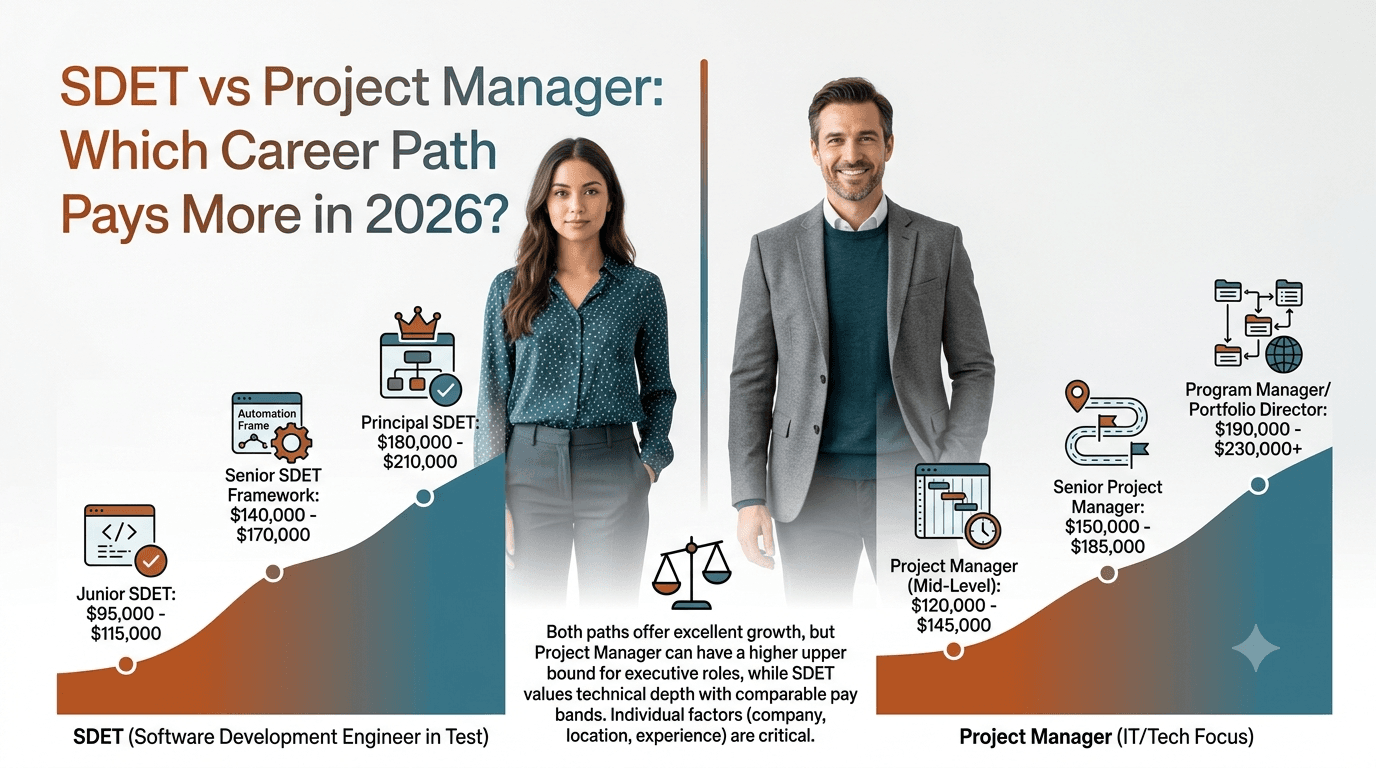
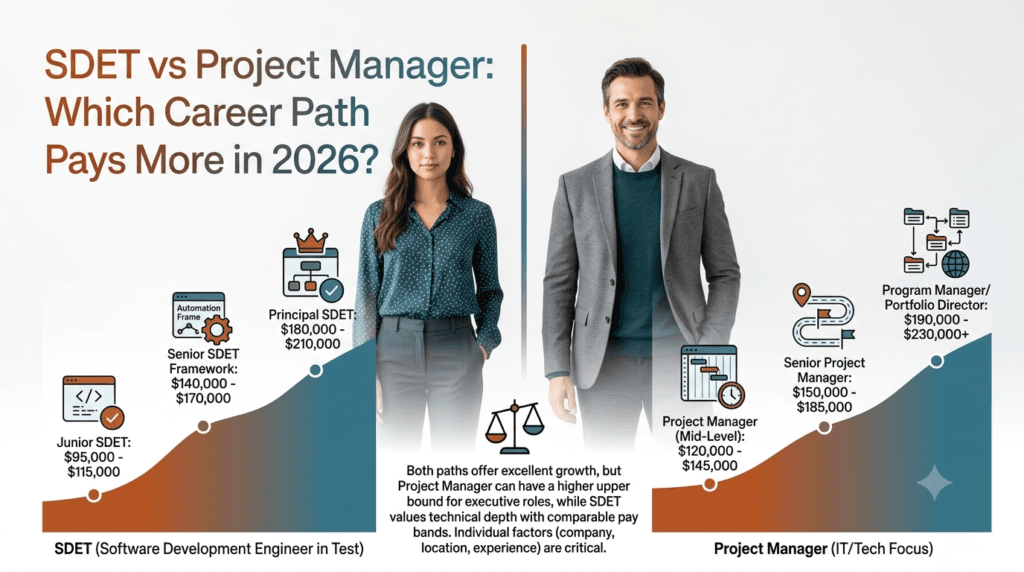
| Level | SDET (US, approx) | Project Manager (US, approx) | SDET (India, approx) | PM (India, approx) |
| Entry (0-3 yrs) | $75,000-95,000 | $65,000-85,000 | ₹6-10 LPA | ₹5-9 LPA |
| Mid (3-7 yrs) | $95,000-130,000 | $90,000-125,000 | ₹12-20 LPA | ₹10-18 LPA |
| Senior (7-12 yrs) | $130,000-165,000 | $120,000-160,000 | ₹20-32 LPA | ₹18-30 LPA |
| Principal / Director | $165,000-210,000+ | $150,000-220,000+ (Program Mgr/Director) | ₹32-50 LPA | ₹30-55 LPA |
At entry and mid-career levels, SDET roles often pay slightly more than equivalent-experience PM roles, reflecting the technical skill premium. This gap narrows and frequently reverses at senior levels, where Project and Program Manager roles open into Director and VP-level positions with significantly higher compensation ceilings than most individual contributor SDET tracks.
The Honest Career Trajectory Comparison
| Factor | SDET Path | Project Manager Path |
| Ceiling without role change | Principal SDET / Test Architect — strong but capped relative to management tracks | Director, VP of Program Management, COO-track in some organisations |
| Skills required | Deep technical: programming, test architecture, CI/CD, automation frameworks | Leadership, communication, stakeholder management, business acumen |
| Market demand | Strong and growing, especially with AI-assisted testing creating new specialisations | Consistently strong — PMP-certified PMs remain in demand across nearly every industry |
| Transferability across industries | High — automation skills transfer across most software domains | Very high — PM skills transfer across software, construction, manufacturing, any project-based work |
| Path to executive leadership | Less direct — typically requires a deliberate pivot into engineering management | More direct — natural progression through program and portfolio management |
| Vulnerability to AI automation | Moderate — AI is automating significant portions of test case generation and execution | Lower for senior judgment-heavy roles — higher for purely administrative PM tasks |
My Honest Assessment From Having Done Both
Having built test automation frameworks and later led project and programme management at scale, my honest view is this: SDET offers a faster initial salary trajectory and deep technical satisfaction for those who genuinely enjoy engineering work. Project management offers a longer runway toward senior leadership roles and organisational influence, with PMP certification serving as a significant credential multiplier along that path.
The work I did building the automation framework at Bizsense was technically satisfying and immediately valuable — the 40% regression testing reduction was a clear, measurable contribution. But the ceiling on that kind of individual technical contribution role, without pivoting into engineering management, is lower than the ceiling I found available through project and product management leadership, where I eventually managed a 70-member programme at Wipro and now operate at a product leadership level.
If your genuine passion is deep technical work — building systems, solving engineering problems, staying close to code — SDET is a strong, well-compensated path with growing demand, especially as AI changes what testing looks like. If you find yourself more energised by leading people, navigating organisational complexity, and driving outcomes across teams rather than within your own code — project and program management offers a longer runway and a more direct path to senior leadership.
The AI Factor — A 2026 Consideration
Both paths face AI-driven change, but differently. AI tools are increasingly capable of generating test cases, executing automated tests, and even identifying which test scenarios matter most — directly touching core SDET responsibilities. SDETs who evolve toward test strategy, AI-assisted testing oversight, and complex system-level test architecture will remain valuable. Those focused purely on writing routine test scripts face more disruption.
Project managers face AI automating status reporting, risk flagging, and scheduling — the administrative layer of the role, as I discussed in detail in our AI tools coverage on this site. The judgment, stakeholder management, and accountability dimensions of PM work remain more resistant to automation, at least in the near term.
My Recommendation
If you are early in your career and choosing between these paths: choose based on genuine interest and aptitude first, salary second — the salary difference at entry level is not dramatic enough to outweigh years spent in a role that does not suit your strengths. If you are mid-career and deciding whether to pivot from one to the other, as I did, recognise that SDET experience is a genuine asset in project management — your technical credibility, as I discussed in the previous article, becomes one of your strongest differentiators as a PM.
Both paths can lead to strong six-figure careers. The deeper question is not which pays more on a salary chart — it is which kind of daily work and long-term trajectory genuinely fits how you want to spend your career.
About the Author

Rahul Dhakate is a PMP and PSM I certified project manager and product management leader based in Nagpur, India, with 20 years of experience managing software projects across BFSI, eCommerce, and enterprise software. He built and led a C# and Selenium test automation framework at Bizsense Solutions before transitioning into project and product management leadership, giving him direct comparative experience across both career paths discussed in this article. He writes at LearnXYZ.in to help working professionals pass the PMP exam and build modern project management careers.
Fantastic Reads