
By Rahul Dhakate · PMP & PSM I Certified · 8 August 2026 · learnxyz.in
Before I sat the PMP exam, I asked myself the same question you are probably asking right now: what are my real chances of passing? I had prepared to approximately 95% of what felt possible — the PMBOK Guide thoroughly read, practice questions completed, mentor materials worked through. And I was still scared going in.
That combination — 95% prepared and still nervous — is more normal than most PMP content acknowledges. The exam is serious. The investment is real. And the pass rate question is one that PMI has historically been reluctant to answer clearly, which makes the anxiety worse for candidates who just want an honest number.
This article gives you the most accurate current data on PMP pass rates, what the numbers actually mean for your preparation strategy, and the honest perspective of someone who has been through it.
Table of Contents
What PMI Says — And What They Don’t
The Honest Numbers — What Research Shows.
Why the Exam Feels Harder Than the Numbers Suggest
What the Pass Rate Means for You Specifically.
How to Put Yourself in the Upper Pass Rate Range.
If You Do Not Pass on the First Attempt
What PMI Says — And What They Don’t
PMI does not publish an official PMP pass rate. This is a deliberate policy — PMI’s position is that publishing a pass rate would encourage candidates to focus on beating a statistic rather than genuinely mastering project management competency. Whether you agree with that reasoning or not, it means the widely cited pass rate figures are estimates derived from candidate surveys and third-party research rather than official data.
The most consistently cited estimate across multiple independent studies and candidate surveys: the PMP first-attempt pass rate is approximately 60% to 65% for candidates who have completed adequate preparation, and significantly lower for those who sit the exam underprepared.
The pass rate figure that matters most is not the overall average — it is the pass rate for well-prepared candidates. Research consistently shows that candidates who complete 1,200 or more practice questions and consistently score above 70% on timed mock exams have a substantially higher pass rate than the average. The exam is hard for underprepared candidates. It is manageable for well-prepared ones.
The Honest Numbers — What Research Shows
| Preparation Level | Estimated Pass Rate | Key Characteristic |
| Minimal preparation (under 50 hours study) | 30-40% | Passed basic knowledge questions but failed situational judgment sections |
| Moderate preparation (50-100 hours) | 50-60% | Knew the content but struggled with PMI mindset on scenario questions |
| Thorough preparation (100-150 hours) | 65-75% | Consistent mock exam scores above 65%, covered all domains |
| Comprehensive preparation (150+ hours) | 75-85% | Multiple full mock exams, reviewed all wrong answers, strong Agile fluency |
| Mentor-guided or classroom preparation | 70-80% | Structured study with experienced guidance, as I used through Vinsys IT Services |
Why the Exam Feels Harder Than the Numbers Suggest
The PMP exam’s difficulty is not primarily about content knowledge. Most candidates who fail have adequate knowledge of project management concepts. What catches them out is the judgment layer — the situational questions where two or three answers all seem reasonable, and the correct one requires you to think like PMI rather than like your real-world experience.
When I entered the exam room, I was wondering if I would clear it — even with 95% preparation completed. That uncertainty is not a sign of inadequate preparation. It is a sign that the exam is genuinely testing judgment, not just recall. A candidate who feels completely certain going in is either extraordinarily well prepared or has underestimated what the exam is actually testing.

What the Pass Rate Means for You Specifically
The overall pass rate average is less useful than understanding where failures actually occur. Based on candidate feedback and study patterns, the three most common failure points are:
- Agile and hybrid scenario questions — candidates from Waterfall backgrounds consistently struggle with the 50% Agile content, especially the nuanced role-boundary questions
- Time management — running out of time on question 150 because too long was spent on hard questions early
- Insufficient practice volume — fewer than 800 practice questions before the exam, meaning PMI’s question style and language had not become familiar enough
How to Put Yourself in the Upper Pass Rate Range
- Complete at least 1,200 practice questions before sitting the exam — more than most candidates do
- Achieve consistent scores above 70% on full timed 180-question mock exams — not just topic-by-topic practice
- Study the Agile Practice Guide as seriously as the PMBOK — the 50% Agile content is where many candidates lose marks
- Review every wrong answer thoroughly — understanding why you were wrong matters more than the volume of questions you attempt
- Practice time management deliberately — 76 seconds per question average, flag and move on when uncertain
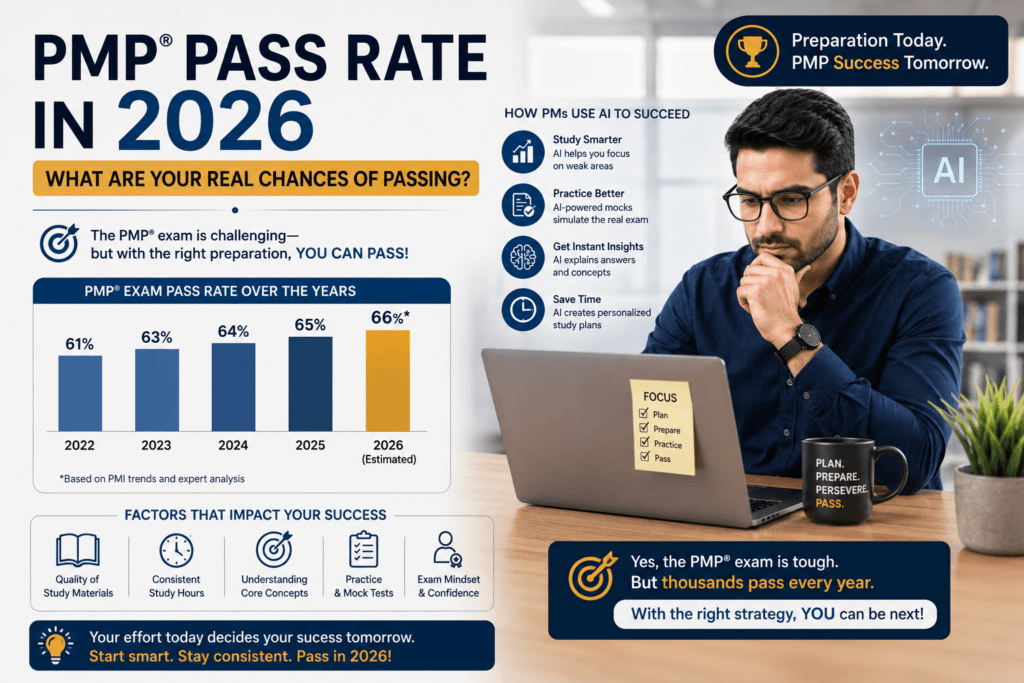
The most honest predictor of your pass probability is your full mock exam score under real timed conditions. If you are consistently above 72-75% on 180-question timed mocks, your pass probability is high. If you are below 65%, more preparation is needed before you sit the real exam.
If You Do Not Pass on the First Attempt
PMI allows three attempts within your one-year eligibility window. The retake fee is $275 for PMI members. Failing the first attempt is not the end — but it is important to understand why you failed before retaking. PMI provides domain-level performance feedback after the exam that tells you which areas performed below target. Use that feedback to direct your additional preparation rather than simply repeating the same study approach.
The candidates who pass on the second attempt consistently report one change in their preparation: they spent significantly more time on the question types that caught them out the first time, with deeper focus on understanding the PMI reasoning rather than just accumulating more question volume.
About the Author
Rahul Dhakate is a PMP and PSM I certified project manager and product management leader based in Nagpur, India, with 20 years of experience managing software projects across BFSI, eCommerce, and enterprise software. He sat the PMP exam feeling approximately 95% prepared and still experienced genuine uncertainty about the outcome — finding that this combination of thorough preparation and healthy respect for the exam’s difficulty is the correct mental state going in. He writes at LearnXYZ.in to help working professionals pass the PMP exam and build modern project management careers.
Next Article: PMP vs PRINCE2 — Which Certification Should You Choose in 2026?
Good Reads: