The PMBOK 7 principles are one of the biggest changes in how PMI describes project management. Older editions gave you processes to memorise. The seventh edition gives you twelve principles to think with. If you are preparing for the PMP, that shift matters, because the exam now asks what a good project manager would do, not just what the next process is.
“The more that you read, the more things you will know.”
— Dr. Seuss, I Can Read With My Eyes Shut!
Reading is a fine start. But for the PMP, knowing the principles is not enough. You have to use them on scenario questions, and that is what the rest of this guide is for.
What are the PMBOK 7 principles?
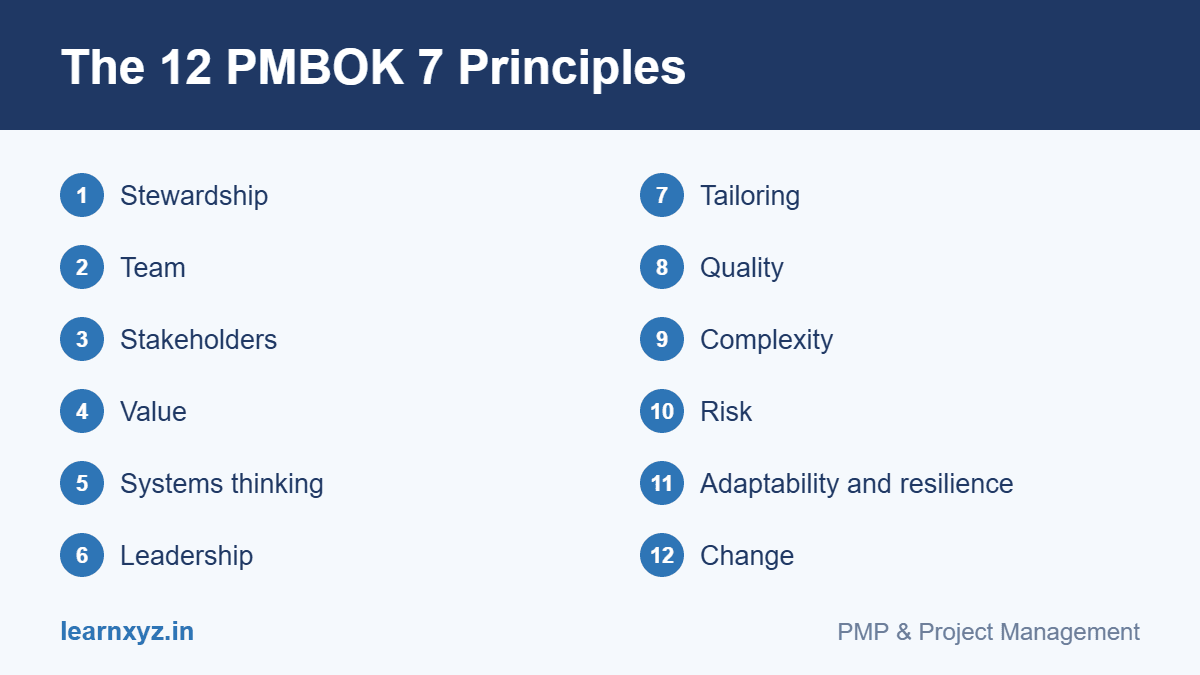
The PMBOK Guide, 7th Edition came out in 2021. It lists twelve principles that guide how projects should be run, whatever the industry or method. They are not step-by-step rules. Think of them as the values behind every good decision on a project.
One thing worth knowing: PMI says the exam is built on its Exam Content Outline, not on a single book. That outline groups questions into three domains: People (42%), Process (50%) and Business Environment (8%). The principles sit underneath all three. For the official details, see PMI’s PMP certification page.
The 12 principles in plain English
| Principle | What it means | How it shows up in a question |
|---|---|---|
| 1. Stewardship | Act with care, honesty and respect for people, money and the environment | Ethical choices; protecting the organisation, not just the schedule |
| 2. Team | Build a team that shares ownership and works together | Answers that involve the team instead of giving orders |
| 3. Stakeholders | Engage the right people early and keep engaging them | Talk to the stakeholder; do not ignore them |
| 4. Value | Aim for outcomes that matter to the business, not just outputs | Pick the option that delivers benefit, even if the plan has to change |
| 5. Systems thinking | See the project as part of a bigger system | A change in one place affects others, so check the impact |
| 6. Leadership | Lead by example, adapt your style, motivate people | Coach and support instead of micromanaging |
| 7. Tailoring | Fit the approach to the project | No one-size-fits-all; choose what suits the context |
| 8. Quality | Build quality in rather than inspecting it at the end | Prevent defects early |
| 9. Complexity | Expect complexity and keep watching for it | Step back and look for patterns when things get messy |
| 10. Risk | Respond to risks in a way that fits the threat or opportunity | Plan responses; do not ignore opportunities |
| 11. Adaptability and resilience | Be ready to change course and to recover | Adjust the plan calmly instead of panicking |
| 12. Change | Help people move to the future state | Prepare people for change, not only the technical side |
One way to remember them
Twelve items is a lot to hold in your head, so try grouping them. This grouping is just a memory aid, not something PMI publishes.
- People: stewardship, team, stakeholders, leadership
- Work and results: value, quality, risk, tailoring
- Thinking and change: systems thinking, complexity, adaptability and resilience, change
How the exam uses the principles
You will not see a question that says, “Name principle number seven.” You will get a short scenario and four answers that all look reasonable. The principles help you pick the best one.
- Read the last sentence first. What is the question actually asking?
- Ask which principle the scenario is about. Is it a stakeholder problem, a team problem, a value problem?
- Cross out answers that skip people or skip the plan, such as ignoring a stakeholder, blaming a team member or making a change without checking its impact.
- Choose the answer that is proactive, respectful and fits the context.
Example. A key stakeholder keeps changing priorities in the middle of a sprint and the team is frustrated. A good answer is to talk to the stakeholder about the effect of the changes, bring in the product owner and agree how new requests will be handled. It involves the stakeholder, protects the team and keeps the focus on value. Compare that with “tell the team to work faster” or “refuse all changes”. Neither fits the principles.
Mistakes to avoid when studying them
- Memorising the list without examples. You will forget it within a week.
- Treating principles as rules. They guide judgment; they do not replace it.
- Dropping the older process material. Parts of the exam still lean on ideas such as change control and risk, so keep both in your plan.
- Skipping the Agile side. Team, adaptability and value show up all the time in Agile scenarios.
Study tip: for each principle, write down one real situation from your own work where it applied, or where ignoring it caused trouble. A story sticks far better than a definition.
Final thoughts
The principles are less about facts and more about habits of thought. Learn them one at a time, attach a scenario to each and test them on practice questions. After a few weeks, you will start to spot them in the wording of a question without trying.
Related reading
- Agile vs Predictive vs Hybrid in the PMP Exam — What’s the Difference?
- PMP Situational Questions: How to Think the Way PMI Wants You To
- PMP Exam 2026: What Has Changed and What You Actually Need to Know
About the author: Rahul Dhakate is a PMP and PSM I certified project manager based in Nagpur, India, with 20 years of experience in software delivery. He writes at LearnXYZ.in about PMP exam prep and AI tools for project managers.