By Rahul Dhakate · PMP Certified · May 2026 · learnxyz.in
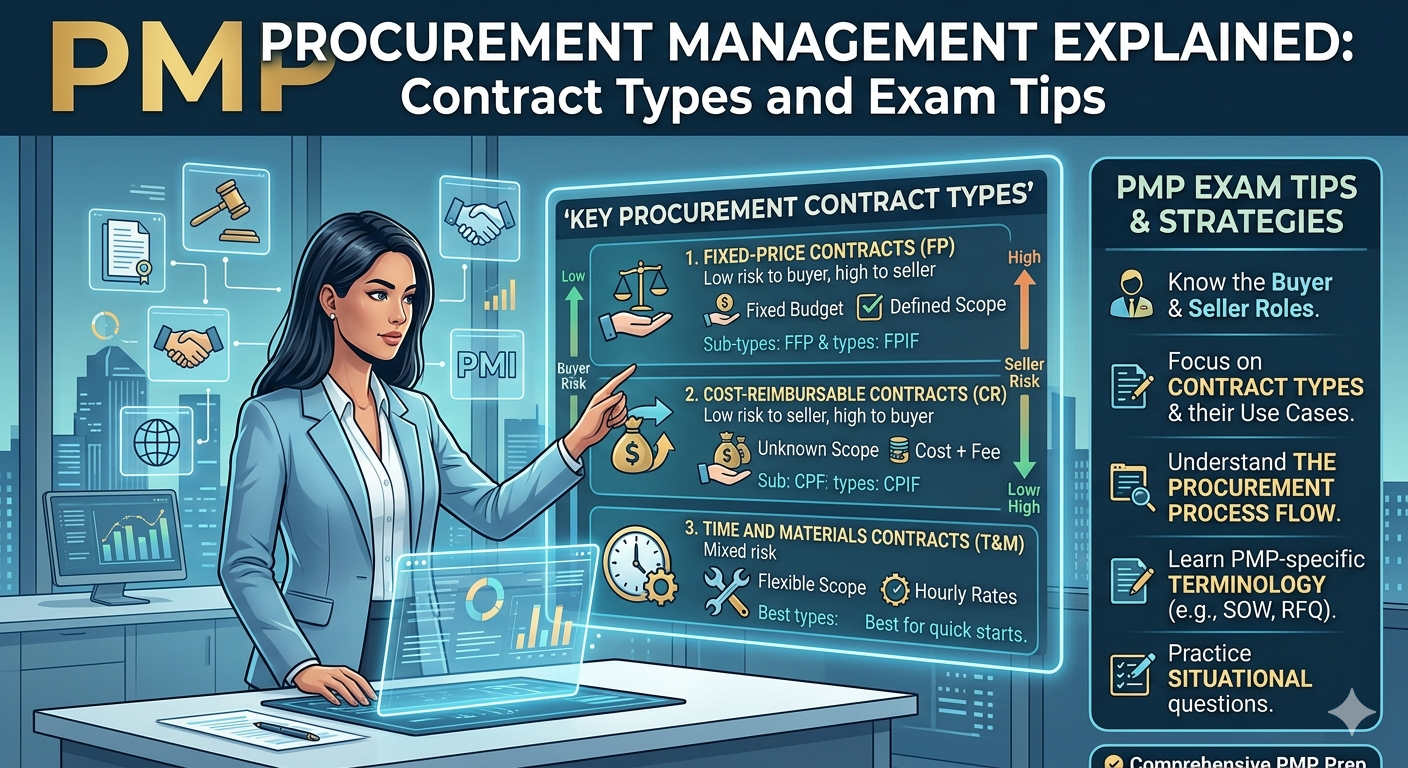
Procurement management is one of the knowledge areas that many PMP candidates underestimate. It can seem dry and administrative compared to topics like risk management or stakeholder engagement — but it is consistently tested on the PMP exam, and the contract type questions in particular are ones that unprepared candidates get wrong because the distinctions are subtle.
I want to approach this topic from a real angle first, because it makes the theory stick better than definitions alone.
Contents
PMP Procurement Management Explained: Contract Types and Exam Tips
A Real Procurement Context: Price Align at Bizsense.
What is Procurement Management in PMP?.
Contract Types — The Most Tested Procurement Topic.
Procurement Documents — What They Are Called.
How Procurement Is Tested on the PMP Exam.
A Real Procurement Context: Price Align at Bizsense
At Bizsense Solutions, one of the products I worked on was called Price Align — a healthcare procurement management platform. The software was used by hospital management to compare prices for medical materials and supplies from multiple vendors simultaneously.
The concept was straightforward but powerful: a hospital administrator needed to procure a specific item — surgical supplies, medical equipment components, pharmaceutical materials. Price Align displayed the same item from multiple vendors side by side, with current pricing, delivery terms, and vendor ratings. The administrator could choose the best price and terms and place the order directly through the platform.
This was procurement management made visible in software. Every feature we built in Price Align reflected a real procurement management principle: transparency of options, comparative evaluation, documented vendor selection, and contract management. Building this system gave me a deep appreciation for what procurement management actually involves in practice — it is not just purchasing, it is a structured process for making the best sourcing decisions under defined constraints.
What is Procurement Management in PMP?
In PMI’s framework, procurement management covers the processes required to purchase or acquire products, services, or results needed from outside the project team. It includes everything from deciding whether to make or buy something, through to managing vendor contracts and closing procurement when work is complete.
The four procurement management processes in PMBOK are:
- Plan Procurement Management: Decide what to procure, how to procure it, and document the procurement strategy
- Conduct Procurements: Obtain seller responses, select vendors, and award contracts
- Control Procurements: Manage procurement relationships, monitor contract performance, and manage changes
- Close Procurements: Complete and settle all procurement activities and resolve any open items
Contract Types — The Most Tested Procurement Topic
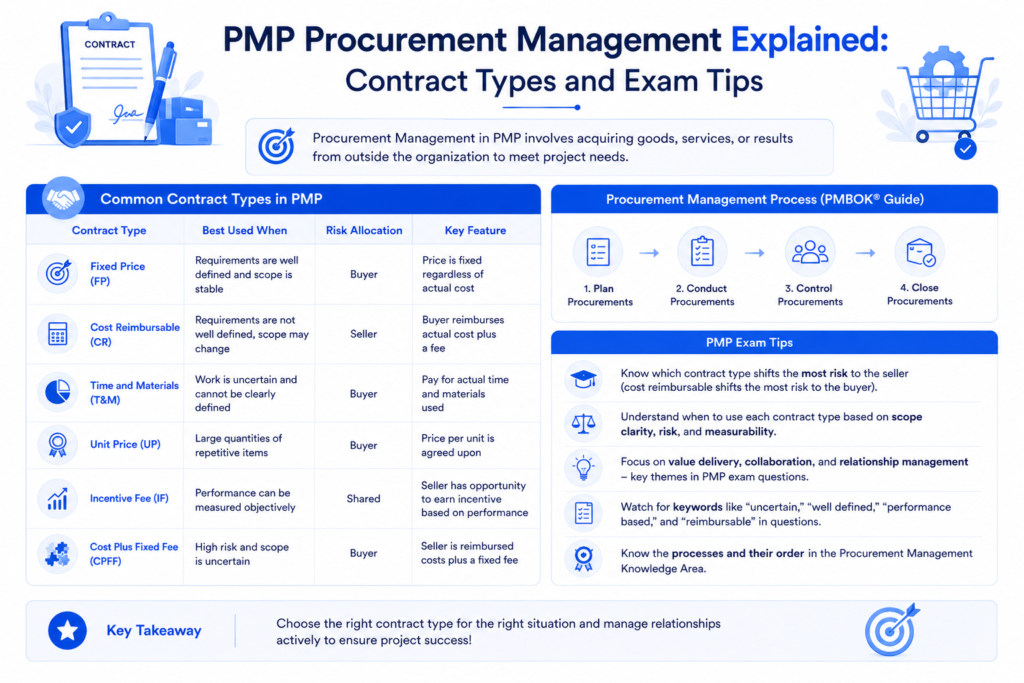
The PMP exam focuses heavily on contract types — specifically on understanding which contract type allocates risk to the buyer versus the seller, and when each type is appropriate. This is the area where most candidates need to focus their study.
In my project work, I have worked with all three main contract types — fixed price, time and material, and cost reimbursable — across different engagements. Understanding when each is appropriate is both a practical skill and an exam requirement.
1. Fixed Price Contracts (FP)
In a Fixed Price contract, the seller agrees to deliver the agreed scope for a predetermined price. The buyer knows exactly what they will pay. The seller assumes the cost risk — if the work takes longer or costs more than estimated, the seller absorbs the difference.
| Type | Description | Risk Owner | Best For |
| FFP — Firm Fixed Price | One fixed price for all work. No adjustment for any reason. | Seller bears all cost risk | Well-defined scope with stable requirements |
| FP-EPA — Fixed Price with Economic Price Adjustment | Fixed price but allows adjustment for inflation or cost indices over long contracts | Shared — inflation risk to buyer, other cost risk to seller | Long-duration contracts where inflation is a real factor |
| FPIF — Fixed Price Incentive Fee | Fixed price plus bonus if seller meets or beats performance targets (cost, schedule, quality) | Primarily seller, buyer shares upside | When you want to motivate seller performance beyond minimum requirements |
2. Cost Reimbursable Contracts (CR)
In Cost Reimbursable contracts, the buyer pays the seller’s actual costs plus an additional fee representing the seller’s profit. The buyer assumes the cost risk — if the work costs more than estimated, the buyer pays more.
| Type | Description | Risk Owner | Best For |
| CPFF — Cost Plus Fixed Fee | Buyer pays actual costs plus a fixed fee agreed upfront. Fee does not change based on performance. | Buyer bears all cost risk | Research and development, early-stage work with uncertain scope |
| CPIF — Cost Plus Incentive Fee | Buyer pays actual costs plus a fee that increases if seller beats cost targets | Buyer bears cost risk, seller has incentive to reduce costs | When scope is uncertain but cost efficiency is important |
| CPAF — Cost Plus Award Fee | Buyer pays actual costs plus a subjectively determined award fee based on performance rating | Buyer bears cost risk | Service contracts where quality is difficult to measure objectively |
3. Time and Material Contracts (T&M)
Time and Material contracts are a hybrid — they have characteristics of both Fixed Price (fixed rates per unit of time or material) and Cost Reimbursable (actual quantities are unknown and paid as incurred). The buyer pays an agreed hourly or daily rate for labour and the actual cost of materials used.
| Factor | Time and Material (T&M) |
| Payment basis | Fixed rate per unit time × actual hours worked + actual material costs |
| Scope definition | Not fully defined upfront — T&M is used when scope is uncertain |
| Risk owner | Shared — rate is fixed (seller risk) but quantity is open (buyer risk) |
| Best for | Staff augmentation, IT support, consulting, small or evolving work packages |
| Risk to buyer | Open-ended cost if work takes much longer than estimated |
| Control measure | Not-to-exceed clauses limit buyer’s maximum exposure |
The key risk insight: Fixed Price contracts shift cost risk to the seller. Cost Reimbursable contracts shift cost risk to the buyer. T&M is in between. On the PMP exam, when a question asks which contract type puts the buyer at most risk — the answer is Cost Reimbursable. When it asks which puts the seller at most risk — the answer is Firm Fixed Price.
The Make-or-Buy Decision
Before any procurement begins, the project team must answer a fundamental question: should we produce this internally or procure it from an external vendor?
The Make-or-Buy Analysis considers:
- Cost: Is it cheaper to develop internally or purchase externally, considering both direct and opportunity costs?
- Capacity: Does the internal team have the skills and availability to deliver this?
- Control: How important is it to maintain direct control over how this is developed?
- Risk: Does internal development or external procurement carry more delivery risk?
- Strategic value: Is this capability something the organisation should own long-term?
The Price Align system we built at Bizsense was itself a make decision — the organisation chose to build a custom procurement platform rather than buy a commercial solution, because the specific requirements of hospital procurement transparency needed a tailored solution. The make-or-buy analysis for that product was the business justification for the project itself.
Procurement Documents — What They Are Called
The PMP exam tests the specific names of procurement documents used at different stages. Candidates frequently confuse these:
| Document | Used When | Buyer or Seller? |
| RFP — Request for Proposal | Buyer needs detailed proposals including methodology, team, and price | Issued by Buyer |
| RFQ — Request for Quotation | Buyer needs price quotes for well-defined goods or services | Issued by Buyer |
| RFI — Request for Information | Buyer wants general market information before deciding to procure | Issued by Buyer |
| IFB — Invitation for Bid | Buyer wants sealed bids for a clearly defined scope — lowest price wins | Issued by Buyer |
| Proposal / Bid / Quote | Seller’s response to the buyer’s procurement document | Issued by Seller |
| Contract | The final signed agreement between buyer and seller | Signed by Both |
How Procurement Is Tested on the PMP Exam
- Contract type selection: Given a scenario, which contract type is most appropriate? Match the scenario’s scope certainty and risk tolerance to the right contract type.
- Risk allocation questions: Which contract type puts the buyer/seller at most risk? Fixed Price = seller risk. Cost Reimbursable = buyer risk. T&M = shared.
- Document naming questions: What document does the buyer issue when seeking detailed proposals? RFP. When seeking price quotes only? RFQ.
- Procurement process questions: At which stage is the contract awarded? During Conduct Procurements. When is it formally closed? During Close Procurements.
- Make-or-buy questions: A scenario describes a choice between building internally versus outsourcing. The answer involves make-or-buy analysis considering cost, capacity, control, and risk.
For contract type questions, build this mental model: the more uncertain the scope, the more you move toward Cost Reimbursable (buyer absorbs uncertainty). The more defined the scope, the more you can use Fixed Price (seller absorbs the risk of delivery).
About the Author

Rahul Dhakate is a PMP-certified project manager and product management leader based in Nagpur, India, with 20 years of experience managing software projects across BFSI, eCommerce, and enterprise software. He worked with all three major contract types across multiple engagements, including building a healthcare procurement platform (Price Align) at Bizsense Solutions that digitised the vendor comparison and selection process for hospital clients. He writes at LearnXYZ.in to help working professionals understand both the theory and the real-world practice of project management.
Next Article:
Good Reads: https://learnxyz.in/risk-register-vs-risk-report-in-pmp-whats-the-difference

Excellent post however , I was wondering if you could write a litte more on this topic?
I’d be very thankful if you could elaborate a little bit more.
Appreciate it!