Most people study for the PMP the way they studied at school. They read a chapter, highlight a few lines and tell themselves they will remember it. A week later, most of it is gone. If you want to know how to study for the PMP in a way that sticks, the fix is not more hours. It is a different kind of effort.
This guide keeps things simple. You will get four methods that work, a weekly routine you can fit around a job, and a short list of habits to drop.
Why re-reading does not work
Re-reading feels productive because the words look familiar. But familiar is not the same as known. You recognise the page, so your brain relaxes, and very little gets stored.
“Learning without thought is labor lost; thought without learning is perilous.”
— Confucius, Analects (James Legge translation)
Confucius got the balance right more than two thousand years ago. Reading is the learning part. The thinking part is where you test yourself, explain ideas in your own words and apply them. Most PMP candidates do plenty of the first and very little of the second.
Researchers say much the same. A well-known 2013 review by Dunlosky and colleagues compared ten common study techniques. Practice testing and spreading your study over time were rated high-utility. Highlighting and re-reading were rated low-utility.
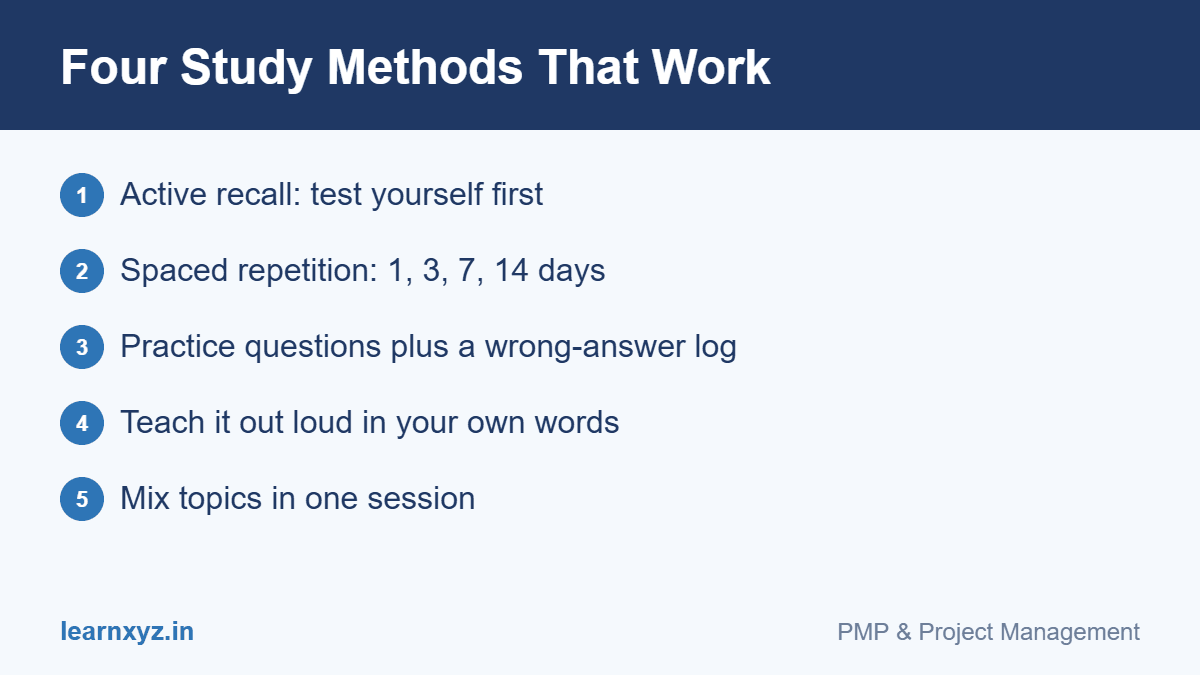
Four methods that work
1. Active recall
Close the book and write down everything you remember about a topic. Then check. The gaps show you what to study next. Even a poor attempt helps more than reading the page a third time.
2. Spaced repetition
Review a topic again just before you would forget it. One common pattern is to revisit new material after 1 day, 3 days, 7 days and 14 days. A simple notebook or a flashcard app is enough. Short, repeated reviews beat one long session.
3. Practice questions, then review every wrong answer
Questions teach you how PMI words things. The real learning happens afterwards. For each miss, write one line: what the question tested, why your answer was wrong and which rule would have got it right. Keep these lines in one document and read it every week.
4. Teach it
Explain a concept out loud to a friend, a family member or an empty room. The Roman philosopher Seneca made the point that we learn while we teach. If you cannot explain earned value in two minutes without notes, you do not know it yet.
Watch out for the feeling that you already know a topic. Epictetus put it bluntly:
“It is impossible for a man to learn what he thinks he already knows.”
— Epictetus, Discourses
A weekly routine that fits a full-time job
| When | How long | What to do |
|---|---|---|
| Monday to Thursday | 45 to 60 minutes | One topic a day. Read it, then write a short summary from memory. Do 10 practice questions. |
| Friday | 30 minutes | Go through the week’s wrong answers. Redo your flashcards. |
| Saturday | 2 to 3 hours | Learn one new knowledge area. Do 40 to 60 questions and review each one. |
| Sunday | 1 to 2 hours | Test last week’s topics from memory. Plan the coming week. Then rest. |
Change the times to suit your life. Consistency beats intensity. Four calm weeks will do more than one frantic weekend.
Habits to drop
- Highlighting whole pages. It feels like work, but it teaches very little.
- Cramming. Long late-night sessions fade by morning.
- Collecting more resources instead of using the ones you have.
- Skipping wrong answers because your score looks fine.
- Studying only the topics you enjoy.
Mix it up: switch between topics in one session, for example risk, stakeholders and scheduling. It feels harder, but it trains you to pick the right idea for the question, which is exactly what the exam asks you to do.
How to know you are ready
Look at trends, not single scores. If your full-length timed mock exams stay above roughly 70 percent over several attempts, and your wrong-answer log keeps getting shorter, you are in good shape. For official exam details, check PMI’s PMP certification page.
Related reading
- PMP Study Schedule: The Complete 90-Day Plan for Working Professionals
- How Many Practice Questions Do You Need Before the PMP Exam?
- PMP Mnemonics – Memory Tricks for Formulas, Processes and Concepts
- The 50 Most Important PMP Formulas With Practice Problems
About the author: Rahul Dhakate is a PMP and PSM I certified project manager based in Nagpur, India, with 20 years of experience in software delivery. He writes at LearnXYZ.in about PMP exam prep and AI tools for project managers.