By Rahul Dhakate | PMP Certified | Software Project Manager | India
LastUpdated: May 2026 | Reading Time: ~11 minutes
One of the first questions every aspiring PMP candidate asks is also one of the most anxiety-inducing: Am I actually eligible to sit this exam? It’s a fair question. The PMI eligibility requirements are not complicated, but the way they’re
written on the official PMI website can feel that way — full of conditional clauses, percentage thresholds, and vague guidance on what counts as “project management experience.” I went through this process myself. With the help of a mentor, the application was manageable — but there were a few specific points where I needed guidance to understand exactly what PMI was looking for. In this article, I’m going to give you the clear, plainlanguage explanation I wish I’d had from the start.
By the end, you’ll know definitively whether you’re eligible, what you need to gather before starting your application, and how to handle the parts of the requirements that trip most people up.
The Two Eligibility Paths: Which One Are You?
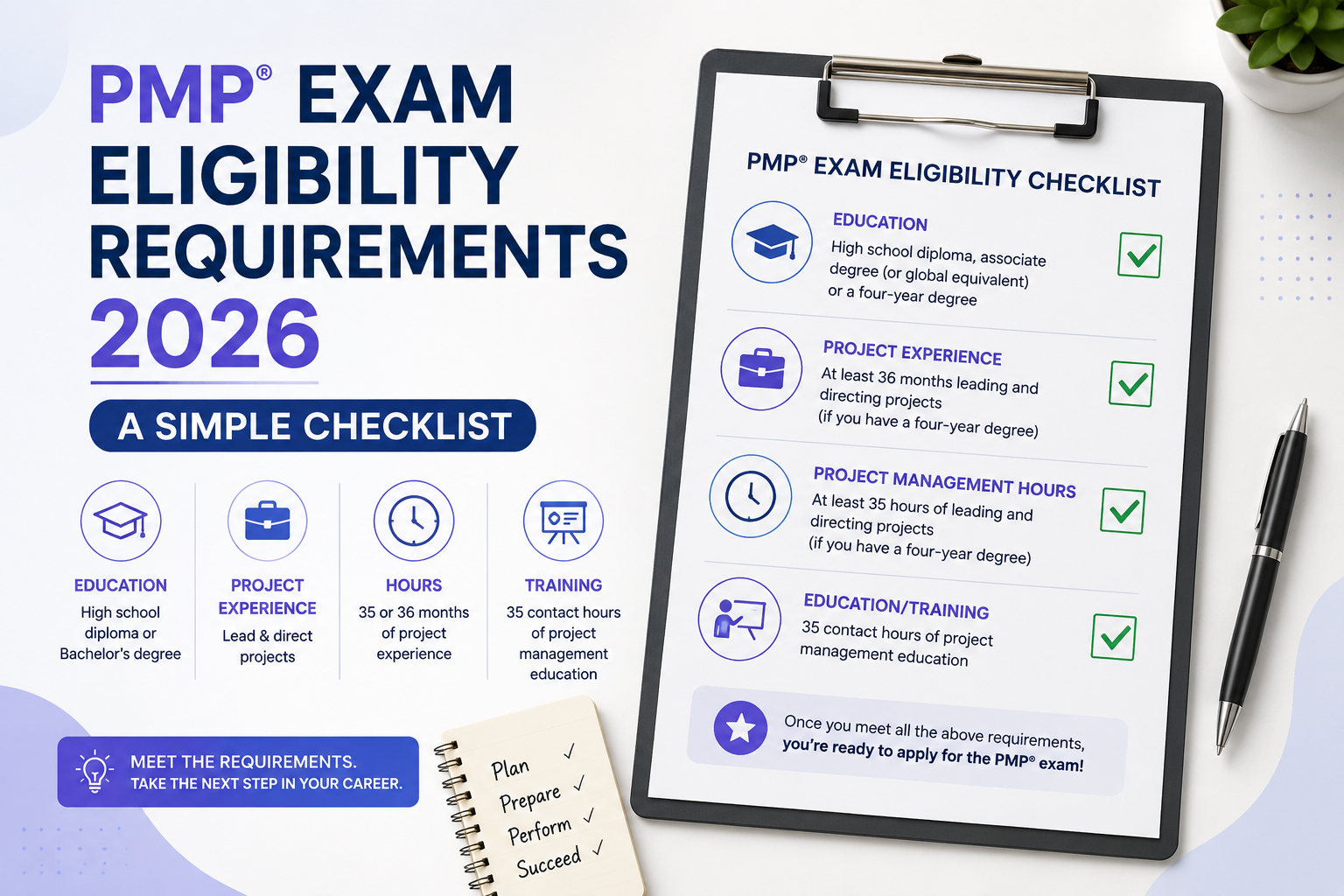
PMI offers two different eligibility paths depending on your educational background. The requirements differ on one key factor: how many months of project management experience you need.
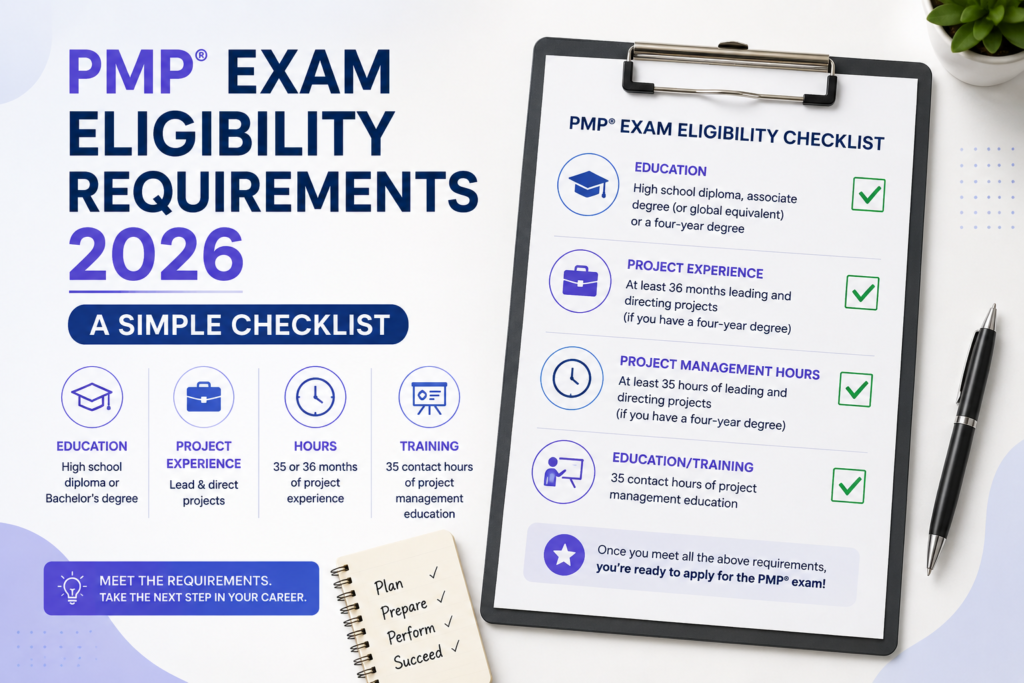
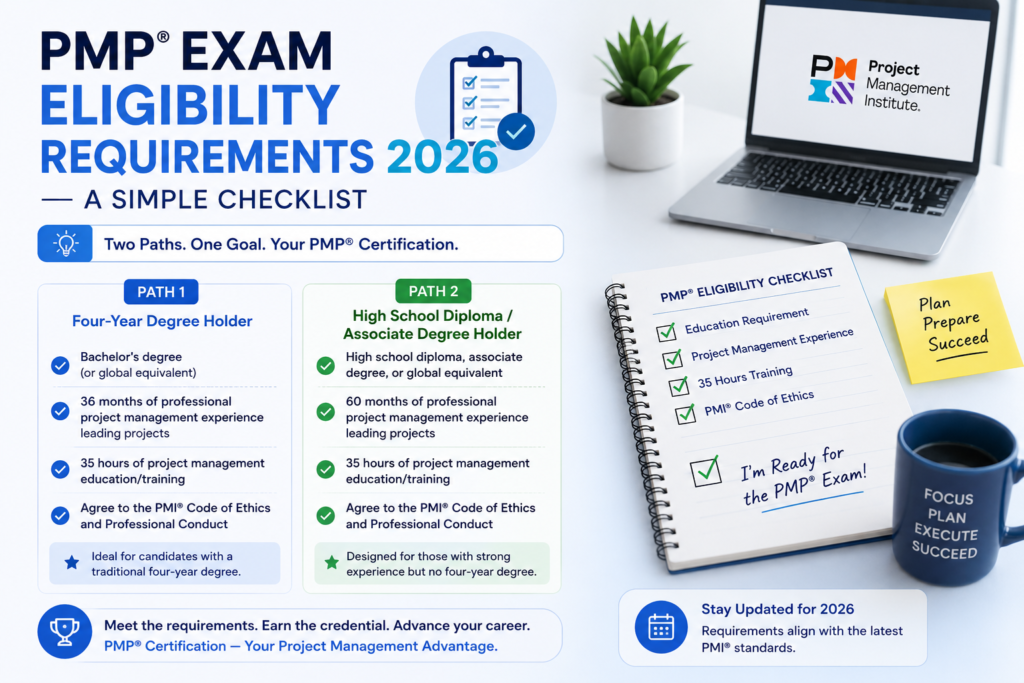
Path A — Four-Year Degree (Bachelor’s or Higher)
If you hold a four-year university degree — a bachelor’s degree, master’s degree, or any
equivalent — you need:
- 36 months of project management experience leading projects
- 35 contact hours of formal project management education
Path B — High School Diploma or Secondary Degree
If your highest qualification is a high school diploma, secondary school certificate, or
associate degree (a two-year degree), you need:
60 months of project management experience leading projects 35 contact hours of formal project management education That’s the entire eligibility framework. Two paths, three requirements. Let’s unpack each one.
Requirement 1: Your Educational Qualification
This is the easiest requirement to verify. You either have a four-year degree or you don’t.
A few things worth noting:
Degrees from any country are accepted. PMI is a global organisation and recognises
educational qualifications from institutions worldwide. Your degree from an Indian university,
a European institution, or anywhere else is valid. You may need to provide documentation
during the audit process (covered below), but there is no requirement to have your degree
evaluated or converted. The degree does not need to be in project management or a related field. An
engineering degree, a commerce degree, an arts degree — all of these qualify. PMI cares
that you have a four-year degree, not what it’s in.
What if your degree is in progress? You cannot use a degree you haven’t yet completed. If
you’re still pursuing your bachelor’s degree, you would fall under Path B until it is conferred.
Requirement 2: Project Management Experience Hours
This is where most candidates spend the most time thinking — and where the most
confusion arises. Let me make this as clear as possible
What “Leading Projects” Actually Means
PMI specifies that your experience must be in leading and directing projects. This does
not mean you need to have held the official title of “Project Manager.” It means you need to
have been in a role where you were responsible for making project decisions, leading a team
toward project objectives, and managing at least some of the following: scope, schedule,
budget, risk, stakeholders, or resources.
This is broader than most people realise. Many software engineers, business analysts, team
leads, and functional managers have led projects in practice even if their job title never said
“Project Manager.” What matters is what you actually did, not what your business card said.
The 36-Month (or 60-Month) Requirement
The experience must be gained within the last eight years. Experience older than eight
years does not count toward your eligibility.
The months are calendar months of project involvement, not the total number of hours. If
you worked on a project for three months, even if you also worked on other things during
those same three months, that counts as three months of project management experience.
Overlapping projects are handled this way — you cannot count the same month twice across
different projects, but each month you were actively leading at least one project counts
once.
This is a point where having a mentor or experienced colleague review your experience
calculation is genuinely useful. My own mentor helped me understand how to account for
periods where I was simultaneously managing multiple projects — something that’s
extremely common in software development environments.
Types of Experience That Count
Acceptable experience includes:
- Managing software development projects (very common for IT professionals)
- Leading infrastructure or implementation projects
- Managing internal business change projects
- Leading product development initiatives
- Running client-facing projects in a consulting capacity
- Heading cross-functional projects even without a formal PM title
Types of Experience That Do Not Count
- Purely operational or routine work with no project component
- Being a team member on a project without any leadership responsibility
- Experience in project support roles (scheduling, administration) without decisionmaking authority
How PMI Verifies Your Experience
PMI does not verify every application. However, a randomly selected percentage of
applicants are audited — meaning PMI will ask for documentation supporting your claimed
experience and education. During an audit, your listed supervisors or managers may be
contacted to confirm your project experience.
This is why accuracy matters. Don’t inflate your experience or claim months you can’t
substantiate. On the other hand, don’t undersell yourself either — many professionals
undercount their genuine project leadership experience because they didn’t have a formal
PM title.
Requirement 3: 35 Contact Hours of Formal Project Management Education
This requirement is more specific than it sounds, so let me be precise.
You need 35 contact hours of formal instruction in project management. A contact hour is
one hour of instruction — not self-study, not reading, not on-the-job learning. It must be
formal education delivered by a recognised provider.
What Counts as Formal Education
- In-person training courses from accredited providers
- Online courses from PMI Registered Education Providers (REPs)
- University courses in project management
- Corporate training programs with documented hour counts
- PMI chapter education programs
- Udemy, Coursera, LinkedIn Learning courses — if they are delivered by a PMIrecognised provider and issue a certificate with documented contact hours
- Many popular courses on Udemy explicitly state the number of contact hours in their description and provide certificates that are accepted by PMI. Joseph Phillips’s PMP exam prep course on Udemy, for example, provides the required 35 contact hours and is widely used for this purpose.
What Does NOT Count
- Self-study time reading the PMBOK Guide
- Practice question hours
- On-the-job learning or mentoring
- Reading articles or watching free YouTube tutorials
What if You Already Have Your Contact Hours?
If you completed a PMP preparation course years ago — as I did, nearly nine years before
sitting the exam — those contact hours are still valid. PMI does not have an expiry date on
contact hours. The certificate or transcript from your original training is still usable for your
application today.
This is one piece of good news for professionals who completed training long ago and
delayed their exam.
Your Complete Eligibility Checklist
Use this before you begin your PMI application.
Step 1 — Education
I have a four-year university degree (bachelor’s or higher) — Path A
☐ OR I have a secondary school diploma / high school certificate — Path B
Step 2 — Project Management Experience
I have at least 36 months of project leadership experience (Path A) ☐ OR I have at least 60 months of project leadership experience (Path B) ☐ This experience was gained within the last 8 years ☐ I can identify specific projects, dates, and supervisors for each role
Step 3 — Contact Hours
I have completed 35 contact hours of formal project management education ☐ I have a certificate, transcript, or course completion record as proof
Step 4 — Documentation Ready
I have my degree certificate or transcript available. I have contact details for supervisors who can verify my project experience. I have my contact hours certificate from my training provider. If you can check all the boxes in your relevant path, you are eligible. Start your application.
The PMI Application: What to Expect
Once you’ve confirmed your eligibility, the application itself is done through the PMI online
portal at pmi.org. Here’s a high-level overview of what happens.
Creating your PMI account: If you don’t already have one, you’ll need to create a free PMI
membership account. PMI membership costs $139/year but reduces your exam fee from
$555 to $405 — a saving of $150. For most candidates, membership pays for itself
immediately.
Filling in your experience: The most time-consuming part of the application is describing
your project management experience. For each project, you’ll need to provide: the project
name and organisation, your role and responsibilities, the approximate start and end dates,
and a brief description of the project and your PM responsibilities. You do not need to be
exhaustive — PMI doesn’t need a full project portfolio — but you do need to be accurate and
clear.
Describing your contact hours: You’ll enter the details of your training course(s), including
the provider name, course title, dates, and number of contact hours.
Submitting and waiting for approval: Once submitted, PMI typically reviews applications
within 5 business days. If approved, you’ll receive notification and can proceed to schedule
your exam. If selected for audit, you’ll receive separate instructions
The Part That Trips Most People Up: Writing the Experience Descriptions
In my experience — and from what I’ve heard from others who went through the process —
the experience description section is where most candidates struggle or spend the most
time. The temptation is to either write too little (“managed a software project for 6 months”) or
too much (a full project report). PMI wants something in between: a clear, concise
description of your role, your specific project management responsibilities, and the outcome
of the project.
A solid experience description for one project might look like this:
“Led a 12-member cross-functional team in the development and delivery of an enterprise
resource planning (ERP) integration project for a manufacturing client. Responsible for
project scope definition, schedule management, stakeholder communication, and risk
identification. Managed a project timeline of 8 months and coordinated between client
representatives and internal development teams to ensure on-time delivery within approved
scope. Applied both predictive planning and iterative delivery techniques to accommodate
evolving client requirements.”
Notice what that description does: it mentions team size, project type, your specific
responsibilities (scope, schedule, stakeholder, risk), the project duration, and the outcome.
It also subtly signals awareness of both predictive and Agile approaches — which is aligned
with current PMI thinking.
If you’re unsure how to frame your experience, working with a mentor or an experienced
PMP holder who has been through the application recently is genuinely worthwhile. That’s
exactly what helped me navigate the sections I wasn’t sure about, and it made the
difference between a confident submission and a stressful one.
A Note on the Audit Process
If your application is selected for audit — which is random and not a reflection of any
problem with your application — don’t panic. The audit simply asks you to submit:
- A copy of your degree or diploma
- Copies of your contact hours certificates
- Signed experience verification forms from the supervisors or managers you listed
PMI gives you 90 days to complete the audit documentation. As long as everything you
stated in your application is accurate, the audit is a straightforward administrative process.
The key, again, is to be accurate in your original application. Don’t list a supervisor you can’t
reach or a project you can’t document.
You’re Probably More Eligible Than You Think
One consistent pattern I’ve noticed among working professionals — especially those from
software engineering, IT, or technical backgrounds — is that they underestimate the breadth
of their project management experience.
If you’ve been working in software development, IT infrastructure, business analysis, or
consulting for more than three years, there’s a very good chance you’ve been leading
projects in practice. You may have been calling it something else — sprint lead, delivery
manager, tech lead, project coordinator — but if you were responsible for defining scope,
managing timelines, coordinating team members, and keeping stakeholders informed, that
is project management experience by PMI’s definition.
Before you conclude that you’re not eligible, list out every project you’ve been involved in
over the last eight years where you had any kind of leadership or decision-making role. You
may be surprised how much genuine experience you’ve accumulated.
And if you need help framing that experience in PMI’s language, that’s exactly the kind of
thing a mentor — or a well-chosen exam prep community — can help you with.
Your Next Step
If you’ve worked through the checklist and confirmed your eligibility, your immediate next
step is to create your PMI account at pmi.org and begin your application. Don’t wait until
you’ve finished studying. The application approval can take up to a week, and there’s no
reason to delay the administrative process while you continue preparing.
If you’re not yet eligible — perhaps you need a few more months of experience or you’re still
completing your contact hours — use that time to start studying. The PMBOK Guide and the
Agile Practice Guide are publicly available to PMI members, and building your content
knowledge now means you’ll be ready the moment you hit eligibility.
The PMP is well within reach. The eligibility requirements, while they look intimidating in
PMI’s official language, are straightforward once you see them clearly. Most working project
managers with three or more years of experience qualify.
The only question is whether you’re going to start today.
About the Author: Rahul Dhakate is a PMP-certified software project manager based in
Nagpur, India. He navigated the PMI application process with the help of a mentor and
passed the PMP exam after a decade of software project management experience. He
writes at LearnXYZ.in to help working professionals demystify the PMP journey from
eligibility through exam day
Next Article:
How to Apply for the PMP Exam Step by Step — 2026 PMI Portal Guide
Related Reading:
PMP Exam 2026: What Has Changed and What You Actually Need to Know