By Rahul Dhakate · PMP & PSM I Certified · 17 June 2026 · learnxyz.in
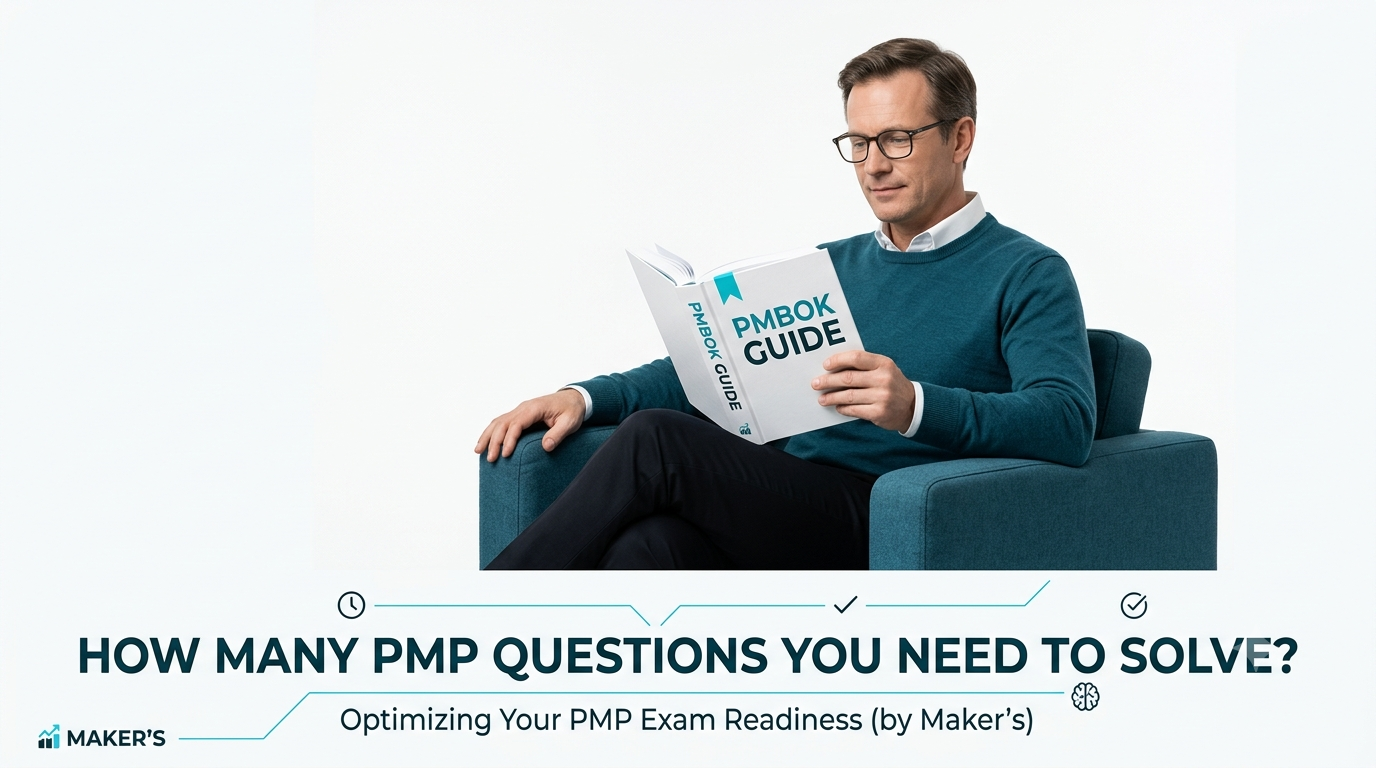
There is no magic number. That is the honest answer — and it is more useful than a specific figure because it redirects your focus to what actually matters.
Here is what I know from my own preparation and from observing how other candidates approach this question: the number of questions you complete matters far less than the quality of how you complete them. Rushing through 2,000 questions to hit a target number, without carefully reviewing each wrong answer, produces worse results than completing 1,000 questions with thorough review of every error.
That said — quantity does matter. You need enough practice questions to develop genuine familiarity with the exam format, the PMI mindset, and the specific language the exam uses to describe scenarios. And for the PMP specifically, time management is as critical as content knowledge. This is where most candidates underestimate the preparation required.
Table of Contents
How Many Practice Questions Do You Need Before the PMP Exam?
My Personal Approach: Close to 800 Questions Per Module.
The Right Way to Think About Question Volume.
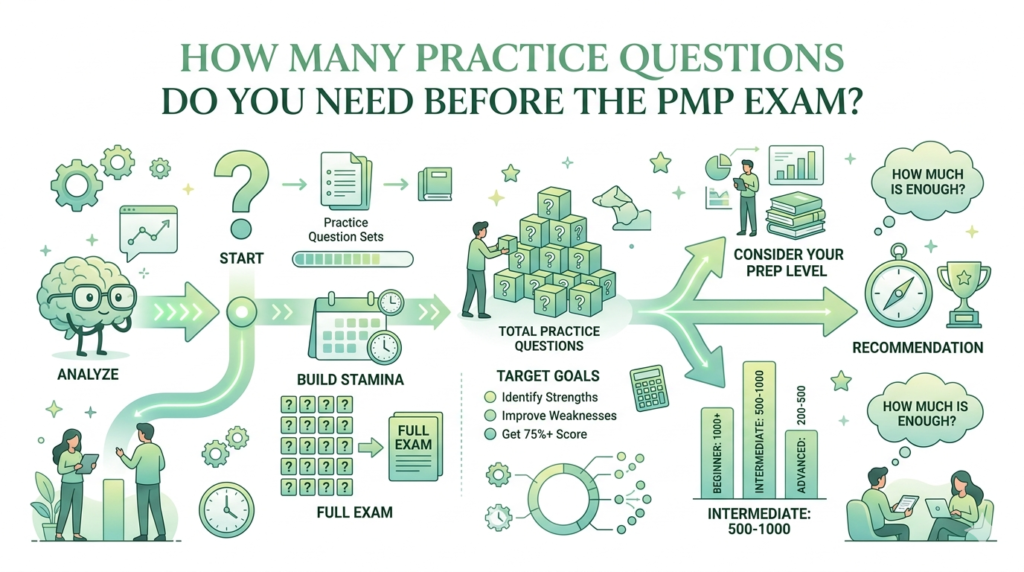
Minimum, Target, and Ideal Question Volume.
How to Structure Your Practice Question Sessions.
Early Preparation: Diagnostic Sessions (First 200 Questions)
Mid Preparation: Building Speed (Questions 200–800)
Late Preparation: Full Mock Exams (Questions 800 onward)
The Time Management Dimension — Often Underestimated.
My Personal Approach: Close to 800 Questions Per Module
Before sitting the exam, I worked through close to 800 practice questions in each module area. The emphasis was not just on getting through the questions — it was on timing. Every session I noted how long I was taking per question, with the goal of becoming faster while maintaining accuracy.
The PMP gives you 230 minutes for 180 questions — approximately 76 seconds per question. That sounds like plenty of time until you are 90 questions in, you have spent 3 minutes on a complex network diagram question, and you realise you have a deficit building up. Speed and accuracy together require practice. Neither alone is sufficient.
The time pressure of the PMP exam is real. You have to be quick while keeping your answers correct. Practising questions in silence on a comfortable afternoon is different from answering question 150 under exam conditions when your concentration is fading. Simulate time pressure from the start of your practice — not just in the final mock exams.
The Right Way to Think About Question Volume
Rather than asking how many questions you need, ask these three questions:
- Am I consistently above 65% on timed practice sessions? — Below this threshold, you need more practice before sitting the exam. Above 70% consistently is the target.
- Can I complete 60 questions in under 75 minutes without feeling rushed? — This is approximately the pace you need to maintain across the full 180-question exam.
- Do I understand why every wrong answer was wrong — not just that it was wrong? — This is the true measure of readiness. Pattern recognition from reviewed errors is what converts practice volume into exam performance.
Minimum, Target, and Ideal Question Volume
| Level | Total Questions | What This Achieves | Suitable For |
| Minimum | 800–1,000 | Baseline familiarity with exam format and question types | Candidates with very strong PM experience and limited study time |
| Target | 1,200–1,500 | Solid pattern recognition and reliable PMI mindset development | Most working professionals with 3–4 months preparation |
| Ideal | 1,500–2,000+ | Deep familiarity, high confidence, strong time management | Candidates who want maximum confidence and first-time pass certainty |
| Overkill (diminishing returns) | 2,500+ | Minimal additional benefit if lower volumes done with quality review | Only justified if simulator scores are not improving at lower volumes |
How to Structure Your Practice Question Sessions
Early Preparation: Diagnostic Sessions (First 200 Questions)
In the first two weeks, do practice questions in topic blocks — 30 to 40 questions per domain or knowledge area. The goal is diagnostic: identify which areas produce the most wrong answers. Do not worry about speed at this stage. Focus on understanding why each answer is correct or incorrect.
Mid Preparation: Building Speed (Questions 200–800)
From week 3 onward, introduce time tracking. Set a timer when you begin each session. Target 75 seconds per question. Review all wrong answers immediately after each session — not the next day. The connection between a wrong answer and the correct principle is strongest when reviewed immediately.
In this phase, mix question types: some topic-specific sessions, some mixed domain sessions. Mixed sessions simulate the real exam experience where questions jump between domains unpredictably.
Late Preparation: Full Mock Exams (Questions 800 onward)
From week 8 onward, introduce full 180-question timed mock exams. These are the most valuable preparation tool available — they simulate the actual exam experience including the fatigue of the later questions.
Rules for full mock exams:
- Take them under genuine exam conditions — quiet room, no interruptions, same time of day as your actual exam
- Do not pause or check answers mid-exam
- Review every wrong answer thoroughly after the exam — this review session is as important as the mock exam itself
- Track your score over time — improvement in mock exam scores is the most reliable predictor of exam readiness
The Time Management Dimension — Often Underestimated
Here is a dimension of practice questions that most preparation guides do not emphasise enough: the PMP exam is as much a time management test as a knowledge test.
180 questions in 230 minutes averages 76 seconds per question. But questions are not equal in difficulty or length. A straightforward knowledge recall question might take 30 seconds. A complex network diagram with calculations might take 3 to 4 minutes. If you do not have a time management strategy, you can find yourself with 30 questions remaining and 15 minutes left — not because you do not know the answers, but because you spent too long on hard questions early.
The time strategy that works for most candidates:
- Set a mental checkpoint at question 60: you should have approximately 155 minutes remaining.
- Set a second checkpoint at question 120: you should have approximately 77 minutes remaining.
- If you are behind pace at either checkpoint, flag difficult questions, move on, and return to flagged questions at the end.
- Never spend more than 3 minutes on any single question in the main pass. Flag it and move forward.
The most common reason candidates run out of time on the PMP exam is not slow reading — it is spending too long on questions they are not sure about, hoping the answer will come to them. It usually does not. Flag uncertain questions and return to them. Momentum is more valuable than certainty on individual questions.
Which Simulator to Use
The most widely recommended practice question simulator for the PMP is PM PrepCast. Its question style, difficulty level, and domain distribution closely match the real exam. Candidates consistently report that PM PrepCast questions feel similar in difficulty and structure to what they encountered on exam day.
Udemy courses from instructors like Andrew Ramdayal (TIA) and Joseph Phillips also include substantial question banks that are highly regarded — particularly for Agile and situational questions.
Whatever simulator you choose, the principle is the same: use it consistently, track your scores, and treat the review of wrong answers as seriously as the questions themselves.
About the Author
Rahul Dhakate is a PMP and PSM I certified project manager and product management leader based in Nagpur, India, with 20 years of experience managing software projects across BFSI, eCommerce, and enterprise software. He completed close to 800 practice questions per module area before sitting the PMP exam, emphasising time management alongside accuracy throughout his practice sessions. He writes at LearnXYZ.in to help working professionals pass the PMP exam and build modern project management careers.
Next Article: