By Rahul Dhakate · PMP & PSM I Certified · 16 June 2026 · learnxyz.in
I want to start with something honest about how I personally studied for the PMP exam: I did not use mnemonics in the traditional sense. My approach was to read deeply, understand the concepts thoroughly, and let that comprehension build retention naturally. When I sat the exam, the answers came from understanding — not from recalling a coded phrase.
However, I discovered something during my preparation that works better than any mnemonic I have encountered: keyword anchoring. When reading complex material, I looked for the one or two keywords in each concept that, once remembered, could be expanded to recall the full idea. Those keywords acted as mental hooks.
This article gives you the best mnemonics the PMP community has developed for the most tested topics — plus the keyword anchoring technique that complements them. Both approaches are valid. Use whichever works best for how your mind stores and retrieves information.
The Keyword Anchoring Technique
The principle is simple: for every complex concept you study, identify the single most distinctive word or phrase that uniquely belongs to it. When that keyword appears in an exam question or answer option, you know exactly what concept is being tested.
Examples of keyword anchoring in practice:
- Retrospective — keyword: IMPROVE. When you see retrospective in any question, the answer involves improving the team process. Not reporting to stakeholders. Not reviewing the product. Improving the process.
- Risk Register — keyword: DETAILS. The risk register contains full details of every risk. The Risk Report contains summaries. If a question describes someone reading full probability/impact/owner/response details — that is the risk register.
- Project Charter — keyword: AUTHORITY. The charter gives the PM authority. No charter = no authority. Questions about when the PM gains authority to use resources = when the charter is signed.
- TCPI — keyword: EFFICIENCY NEEDED. TCPI tells you the efficiency you need going forward. Above 1 means you need to work harder than you have been.
- Critical Path — keyword: ZERO FLOAT. Critical path activities have zero float. Any task with zero float is on the critical path. Any question about which tasks cannot be delayed = critical path tasks.
The keyword approach is especially powerful for situational questions where the scenario gives you a clue word. Train yourself to spot the clue word first — then expand from there to the full concept. This is faster and more reliable under exam pressure than trying to recall a full mnemonic phrase.
Traditional Mnemonics That Actually Work
For those who prefer traditional memory aids, here are the most widely used and effective PMP mnemonics — tested by thousands of candidates:
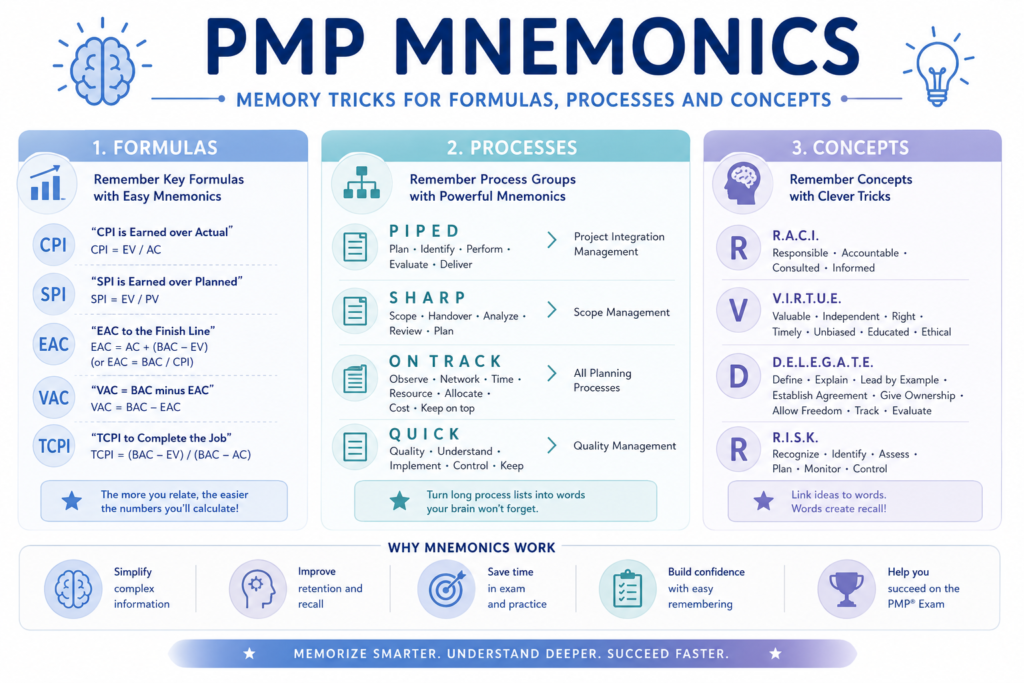
For EVM Variances — Negative is Bad
| SV = EV minus PV | CV = EV minus AC Both variances start with EV. Schedule subtracts Plan. Cost subtracts Actual. |
Think of it this way: EV is your starting point for both. To check your Schedule, compare against the Plan (PV). To check your Cost, compare against the Actual spend (AC). If either result is negative — you have a problem.
For Risk Response Strategies — Threats vs Opportunities
| Threats: ATMA | Opportunities: SEEA Avoid, Transfer, Mitigate, Accept | Share, Exploit, Enhance, Accept |
ATMA for threats — think of it as your defence mechanism against risks. SEEA for opportunities — think of it as seeing and capturing the upside. Accept is in both lists because passive acceptance applies to both threats and opportunities.
For Tuckman’s Team Development Stages
| Forming → Storming → Norming → Performing → Adjourning FSNPA — Form, Storm, Norm, Perform, Adjourn |
The story arc: teams Form (politely), Storm (conflict emerges), Norm (establish working patterns), Perform (high productivity), then Adjourn (project ends, team disbands). The sequence is always tested in order — and teams can regress backwards when membership changes.
For Contract Types — Who Bears the Risk
| Fixed Price = Seller Risk | Cost Reimbursable = Buyer Risk | T&M = Shared FP protects the Buyer. CR protects the Seller. T&M shares the exposure. |
Memory anchor: Fixed Price fixes the seller’s exposure — the seller takes the risk of cost overruns. Cost Reimbursable reimburses the seller’s actual costs — so the buyer absorbs whatever it costs. When the exam asks who bears more risk — match the contract type to who is protected.
For PERT Formula
| PERT = (O + 4M + P) ÷ 6 Optimistic + four times Most Likely + Pessimistic, divided by 6 |
Memory: the Most Likely gets four times the weight because it is — most likely. The formula is weighted toward the middle estimate. Divide by 6 because there are 6 units in the numerator (1+4+1).
For the Communications Channels Formula
| Channels = n(n-1) ÷ 2 Think: handshakes. Everyone shakes hands once with everyone else. |
Visualise a room of people. Each person shakes hands with every other person exactly once. Count the total handshakes — that is your communication channels. For 5 people: 5×4÷2 = 10 handshakes. The formula captures the same count mathematically.
For Procurement Documents
| RFP — Request for Proposal | RFQ — Request for Quotation | IFB — Invitation for Bid RFP = methodology + price. RFQ = price only. IFB = sealed bid, lowest wins. |
Mnemonics for the Three PMP Exam Domains
| Domain | Weighting | Keyword Anchor | What It Covers |
| People | 42% | LEAD — Lead, Empower, Align, Develop | Team management, conflict, stakeholders, emotional intelligence |
| Process | 50% | PLAN — Plan, Lead, Assess, Navigate | Technical PM knowledge, schedules, budgets, risks, quality, procurement |
| Business Environment | 8% | COMPLY — Connect, Link, Optimise, Measure, Protect, Yield | Strategy alignment, compliance, benefits realisation |
The Formula Wall Revisited — Why It Beats All Mnemonics
After going through PMP preparation, my genuine view is this: the formula wall technique I described in Article 35 outperforms mnemonics for formula retention. Writing all formulas on one sheet and reading them every morning for 60 seconds builds automatic recall through spaced repetition — not through a coded phrase you have to decode under pressure.
Mnemonics are most useful for concepts and sequences — the order of Tuckman’s stages, which contract type benefits the buyer, the risk response strategies. For numerical formulas, visual repetition beats verbal encoding.
Use both: keyword anchoring and mnemonics for conceptual material, formula wall for quantitative material. Together they cover every memory challenge the PMP exam presents.
About the Author

Rahul Dhakate is a PMP and PSM I certified project manager and product management leader based in Nagpur, India, with 20 years of experience managing software projects across BFSI, eCommerce, and enterprise software. He used keyword anchoring rather than traditional mnemonics during PMP preparation, finding that identifying distinctive keywords for each concept created faster and more reliable recall under exam time pressure than coded phrases. He writes at LearnXYZ.in to help working professionals pass the PMP exam and build modern project management careers.
Good Reads:


I couldn’t resist commenting. Very well written!
Thank you!