
By Rahul Dhakate · PMP Certified · 20 May 2026 · learnxyz.in
Quality management is one of those topics that every project manager deals with in practice but that the PMP exam frames in a way that can feel unfamiliar. The reason: PMI makes a very specific distinction between Quality Assurance and Quality Control — a distinction that matters enormously for exam questions but that many organisations blur in day-to-day work.
I want to start with how quality management actually worked on the projects I managed, because grounding the theory in real experience is what makes these concepts stick.
Table of Contents
Quality Management in Practice: How It Worked on Real Projects.
What is Quality Management in PMI’s Framework?
QA vs QC: The Distinction That the Exam Tests Directly
Cost of Quality — A Key Exam Concept
Key Quality Tools the Exam Tests.
Grade vs Quality — Another Exam Distinction.
Quality Management in Practice: How It Worked on Real Projects
Across multiple projects — at Ebix managing SmartOffice CRM releases, at Bizsense working on healthcare applications for clients like GHX and Hayes, and at Valethi Technologies delivering eCommerce platforms — our quality process followed a consistent pattern regardless of the organisation.
QA team members were included in daily grooming calls alongside the development team. This was a deliberate choice. By having QA present when requirements and changes were being discussed, they understood the intent of every feature and bug fix before a single line of code was written. They were not discovering what was built after the fact — they were part of the process from the start.
For every change — whether a new feature, a bug fix, or a configuration update — we wrote acceptance criteria. These were clear, testable statements defining what ‘done’ looked like for that specific item. Alongside the acceptance criteria, the QA team wrote test cases that mapped directly to those criteria. If a bug had a specific occurrence pattern — certain user actions in a certain sequence under certain conditions — the test cases captured that pattern explicitly, so that the fix could be verified against the exact scenario that caused the failure.
We maintained defect tracking sheets throughout the project lifecycle, logging every issue with its severity, status, assigned owner, and resolution. Before any release, we ran a formal quality gate — a review of open defect counts, severity distribution, and test case pass rates against defined exit criteria. No release went out if critical or high-severity defects were open.
Including QA team members in grooming calls from day one is one of the most effective quality practices I have seen across multiple organisations. It shifts quality left — catching misunderstandings before they become code — rather than discovering them during testing when fixes are more expensive and disruptive.
What is Quality Management in PMI’s Framework?
PMI defines project quality management as the processes and activities of the performing organisation that determine quality policies, objectives, and responsibilities so that the project will satisfy the needs for which it was undertaken.
Quality management in PMI’s framework has three components:
- Plan Quality Management — determining the quality standards relevant to the project and how to achieve them
- Manage Quality (Quality Assurance) — auditing quality requirements and the results of quality control measurements to ensure appropriate quality standards are being used
- Control Quality (Quality Control) — monitoring and recording results of quality activities to assess performance and recommend changes
QA vs QC: The Distinction That the Exam Tests Directly
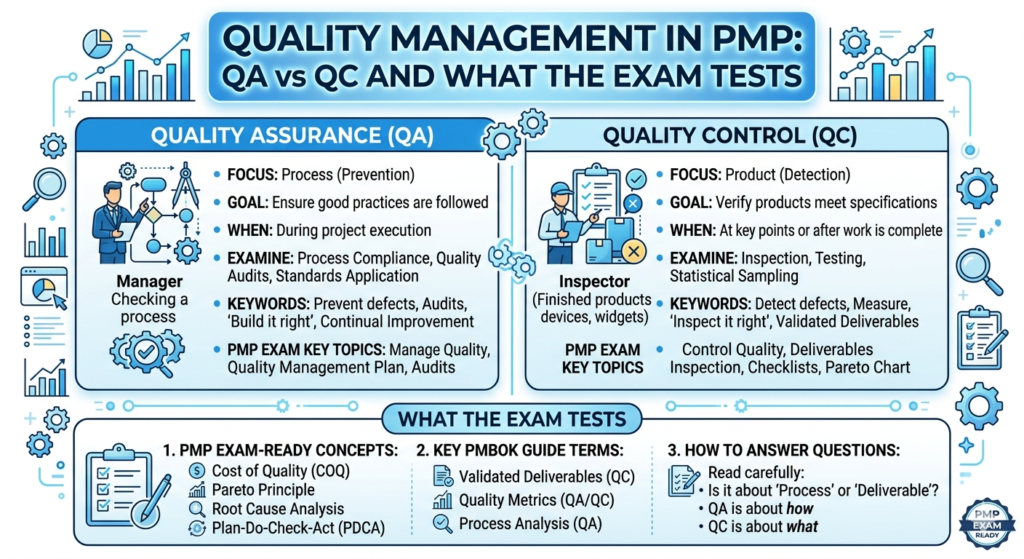
This is the most frequently tested quality management topic on the PMP exam — and the one where candidates most often lose marks by confusing the two.
| Factor | Quality Assurance (QA) | Quality Control (QC) |
| What it is | A process-level activity — checking that the right processes are being followed | A product-level activity — checking that the deliverables meet quality standards |
| Focus | Prevention — stop defects from entering the product | Detection — find defects that already exist |
| When it happens | Throughout the project — ongoing process audit | During and after execution — inspecting actual outputs |
| What it produces | Quality audit findings, process improvement recommendations | Quality measurements, verified deliverables, defect reports |
| Who performs it | Project manager, quality auditors, PMO | QA team, inspectors, testing team |
| PMI process name | Manage Quality | Control Quality |
| Analogy | Reviewing your cooking process to ensure you follow the recipe correctly | Tasting the dish to check if it meets the expected standard |
The exam rule: QA = process. QC = product. If a question describes someone checking whether the right testing procedures are being followed — that is QA. If it describes someone running tests on the actual software output — that is QC.
The Quality Management Plan
The Quality Management Plan is created during the Plan Quality Management process. It defines:
- Quality standards that apply to the project — industry standards, regulatory requirements, organisational standards
- Quality objectives — specific, measurable targets the project must achieve
- Quality roles and responsibilities — who is responsible for QA, who performs QC, who signs off on quality gates
- QA activities — what process audits, reviews, and quality assurance activities will be performed and when
- QC activities — what testing, inspection, and verification activities will be performed and when
- Quality tools to be used — testing frameworks, defect tracking systems, review checklists
- Non-conformance procedures — what happens when a deliverable fails to meet quality standards
Cost of Quality — A Key Exam Concept
Cost of Quality (CoQ) is a framework for understanding the financial implications of quality decisions. It divides quality-related costs into two categories:
| Category | Sub-category | Description | Examples |
| Cost of Conformance | Prevention Costs | Money spent to prevent defects from occurring | Training, process documentation, QA team in grooming calls, quality planning |
| Cost of Conformance | Appraisal Costs | Money spent to assess quality and find defects before delivery | Testing, inspections, test case execution, quality audits |
| Cost of Non-Conformance | Internal Failure Costs | Cost of defects found before delivery to the customer | Rework, bug fixing, regression testing after fixes |
| Cost of Non-Conformance | External Failure Costs | Cost of defects found after delivery to the customer | Client escalations, emergency patches, reputation damage, warranty claims |
PMI’s philosophy — and the correct answer on most quality exam questions — is that investing in prevention and appraisal costs is almost always cheaper than paying for internal and external failure costs. Fixing a bug found in grooming costs far less than fixing it after it reaches production and a client escalates.
Key Quality Tools the Exam Tests
Several quality tools appear regularly on the PMP exam. You need to know what each one is used for:
- Cause and Effect Diagram (Fishbone / Ishikawa): Identifies the root causes of a quality problem by mapping potential causes in categories (people, process, equipment, materials, environment, management). Used in QC — when investigating why a defect occurred.
- Control Chart: Monitors a process over time to determine whether it is within acceptable statistical control limits. Shows when a process is in control versus when variation indicates a problem requiring investigation.
- Pareto Chart: A bar chart that ranks defect types or quality issues by frequency, showing which problems account for the most impact. Based on the 80/20 principle — typically 80% of defects come from 20% of causes.
- Scatter Diagram: Shows the relationship between two variables — used to test whether a correlation exists between a potential cause and a quality outcome.
- Histogram: Shows the distribution of data across a range — used to understand patterns in quality measurements.
- Flowchart: Maps a process visually — used in QA to document and audit the steps of a quality-related process.
- Checklist: A structured list of items to verify — used in QC to ensure all required quality checks have been performed before a deliverable is approved.
PMP exam trap: The Fishbone diagram is used to find the ROOT CAUSE of a quality problem — not to track defects or monitor process performance. The Control Chart is used for process monitoring over time. These two are frequently confused in exam questions.
Grade vs Quality — Another Exam Distinction
PMI makes one more quality distinction that appears on the exam and that candidates frequently overlook:
- Quality is the degree to which a set of inherent characteristics fulfils requirements. A product that does what it is supposed to do, without defects, is a quality product.
- Grade is a category assigned to products with the same functional use but different technical characteristics. A basic smartphone and a flagship smartphone are different grades — but if the basic phone does everything it is supposed to do without defects, it is a quality product at a lower grade.
Low quality is always a problem. Low grade is not necessarily a problem — it depends on whether the grade is appropriate for the intended use. The exam may present a scenario where a product is low grade but high quality, and ask whether this is acceptable. The answer is yes — as long as the grade was agreed upon and the product performs as intended.
About the Author

Rahul Dhakate is a PMP-certified project manager and product management leader based in Nagpur, India, with 20 years of experience managing software projects across BFSI, eCommerce, and enterprise software. He managed quality processes across multiple software projects including SmartOffice CRM releases at Ebix and healthcare applications at Bizsense, maintaining defect tracking, acceptance criteria, and test case management as standard practice on every delivery. He writes at LearnXYZ.in to help working professionals understand both the theory and real-world practice of project management.
Next Article:

The way you write feels personal and authentic.