By Rahul Dhakate · PMP Certified · May 2026 · learnxyz.in
Stakeholder engagement is one of the most heavily weighted topics on the PMP exam — it sits within the People domain, which accounts for 42% of exam content. And unlike the formula-heavy topics like Earned Value Management or Critical Path, stakeholder questions are scenario-based and judgment-driven. You cannot memorise your way to a good score here. You need to understand how PMI expects a project manager to think about people.
The best way to develop that understanding — and to make it stick — is through real examples. I want to start with one of the most challenging stakeholder situations I have personally managed, because it captures the complexity that the PMP exam is trying to test.
Table of Contents
A Real Stakeholder Conflict: Two Equal Powers, One Product
What is Stakeholder Engagement in PMI’s Framework?
The Stakeholder Engagement Assessment Matrix.
The Stakeholder Engagement Plan.
Stakeholder Management with Fortune 500 Banking Clients.
What PMI Expects on Stakeholder Exam Questions.
A Real Stakeholder Conflict: Two Equal Powers, One Product
At Valethi Technologies, I was managing the delivery of a software product that was intended to serve global markets — different teams in different countries using the same platform. The project had two primary stakeholders of roughly equal authority: the India team manager, who led a large and experienced domestic team, and the global product manager, who oversaw requirements from international markets across different regions.
The conflict was fundamental. The India team manager had strong, specific opinions about what the product should do — and he pushed hard, consistently, to have every one of his requirements implemented as stated. The challenge was that his requirements reflected the India market’s priorities, which sometimes conflicted with the global product vision. He had significant influence over the India development team and was not inclined to compromise on requirements he felt were essential.
The global manager, meanwhile, was trying to build a product that could be configured and used across markets with different needs — a more modular, flexible architecture that could serve diverse customer segments without building market-specific features into the core product.
Both stakeholders were right from their own perspective. Both had legitimate authority. And they were in genuine disagreement about product direction.
The situation never fully resolved through negotiation — the disagreements were too fundamental and both parties were too firmly positioned. The solution we ultimately implemented was architectural: we developed the product in two phases and built a feature toggle system — the ability to turn features on and off for specific customers. This allowed the India-specific features to exist in the product without being imposed on global users. Both stakeholders got a version of what they needed, and the product remained globally viable.
The lesson from this experience: when stakeholder conflicts cannot be resolved through communication alone, sometimes the right answer is an architectural or process solution that makes the conflict irrelevant. Feature toggles, phased delivery, and configurable systems are real project management tools — not just technical decisions.
What is Stakeholder Engagement in PMI’s Framework?
PMI defines a stakeholder as any individual, group, or organisation that may affect, be affected by, or perceive itself to be affected by a decision, activity, or outcome of a project.
This is a deliberately broad definition. Stakeholders include obvious parties like the project sponsor and the client — but also the end users of the product, regulatory bodies, the project team itself, and even people who are negatively affected by the project (communities near a construction site, for example, or employees whose roles may be changed by a new system).
The key word in PMI’s definition is ‘perceive.’ A person who believes they are affected by a project is a stakeholder — even if their perception is incorrect. Managing that perception is part of stakeholder engagement.
The Stakeholder Register
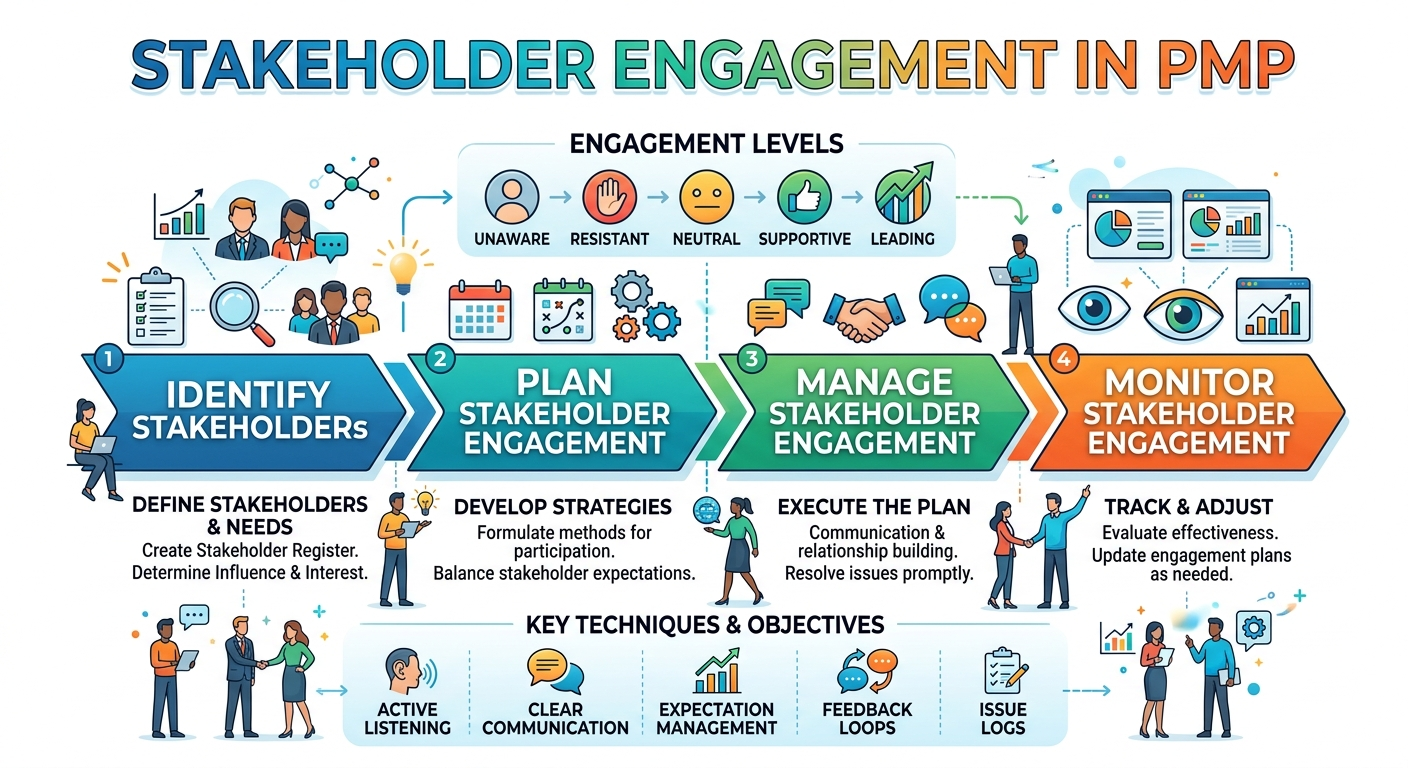
The Stakeholder Register is the primary document for recording stakeholder information. It is created during the Identify Stakeholders process and updated throughout the project.
For each stakeholder, the register typically contains:
- Name and organisational role
- Contact information
- Their interest in the project — what they care about and why
- Their level of influence — how much power they have to affect the project
- Their current engagement level (see the Engagement Assessment Matrix below)
- Their expectations and potential concerns
- Preferred communication style and frequency
The Stakeholder Register is a confidential document — it contains sensitive assessments of individuals’ power, influence, and potential resistance. It should not be shared with stakeholders themselves.
The Stakeholder Engagement Assessment Matrix
One of the most tested stakeholder tools on the PMP exam is the Stakeholder Engagement Assessment Matrix. It plots each stakeholder’s current engagement level against their desired engagement level, allowing the project manager to identify gaps and develop strategies to close them.
PMI defines five engagement levels:
| Engagement Level | Description | What It Means for the PM |
| Unaware | Stakeholder does not know about the project or its potential impact | Priority: inform them — unaware stakeholders can become resistors when they discover the project |
| Resistant | Stakeholder is aware but opposed to the project or its outcomes | Priority: understand their concerns and address them — resistance from powerful stakeholders is a major project risk |
| Neutral | Stakeholder is aware but neither supporting nor opposing | Priority: move toward supportive — neutral stakeholders are unreliable when the project needs active backing |
| Supportive | Stakeholder is aware and supportive of the project | Priority: maintain engagement — supportive stakeholders can become champions |
| Leading | Stakeholder is actively engaged and promoting the project’s success | Priority: leverage their support — leading stakeholders are your most valuable allies |
In the matrix, each stakeholder is marked with ‘C’ for their Current engagement level and ‘D’ for their Desired engagement level. Where C and D differ, the Stakeholder Engagement Plan defines the strategies to move the stakeholder from their current level to the desired level.
In the Valethi Technologies situation I described: the India team manager was in the Resistant category — aware, influential, and actively opposing the global product direction. The desired level was Supportive or at minimum Neutral. The feature toggle architecture was, in effect, our strategy for moving him from Resistant to Neutral by addressing the underlying concern rather than winning the argument.
The Stakeholder Engagement Plan
The Stakeholder Engagement Plan is the document that defines the strategies for engaging each stakeholder group throughout the project. It is a component of the Project Management Plan.
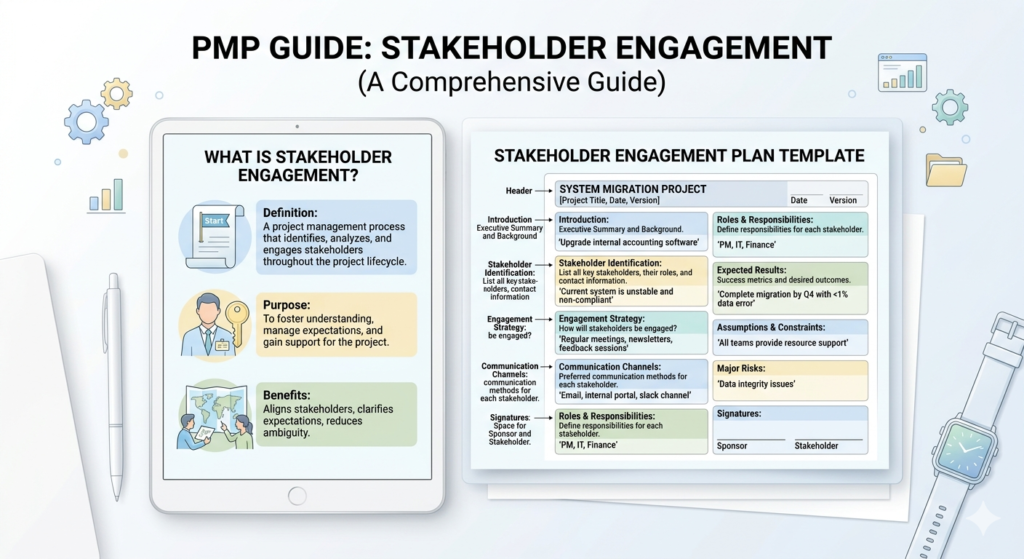
The plan defines:
- What information each stakeholder needs and when
- What communication method works best for each stakeholder
- What strategies are needed to move resistant stakeholders toward a supportive position
- How stakeholder engagement will be monitored and assessed throughout the project
An important distinction the exam tests: the Stakeholder Engagement Plan is different from the Communications Management Plan. The Communications Plan focuses on what information is distributed, to whom, through what channel, and at what frequency. The Stakeholder Engagement Plan focuses on the strategies for managing relationships and influencing engagement levels.
Stakeholder Management with Fortune 500 Banking Clients
My experience managing stakeholder relationships with clients like Wells Fargo, Standard Chartered, and Goldman Sachs at Wipro added a different dimension to this topic — one that the PMP exam captures in its high-stakes scenario questions.
Managing Fortune 500 banking clients is demanding at every stage. These are simultaneously high-value and high-risk relationships. The client is not just a stakeholder — they are the reason the project exists, and maintaining their confidence is as important as delivering the technical work. Every communication, every status update, every escalation carries weight because the commercial relationship is always in the background.
What I learned from those engagements: the most effective stakeholder management with demanding clients is proactive transparency. Do not wait for them to discover problems — bring issues forward with your assessment and your proposed response already prepared. Clients at that level do not want to be surprised. They want to know that you own the problems as completely as you own the solutions.
The PMI mindset on stakeholder management perfectly aligns with what actually works with demanding clients: communicate proactively, address concerns before they escalate, keep stakeholders informed at the level they need — not more, not less — and never let a problem become their discovery.
What PMI Expects on Stakeholder Exam Questions
Stakeholder questions on the PMP exam follow predictable patterns once you understand the PMI mindset:
Pattern 1: Identify Stakeholders Early
Stakeholder identification happens during Initiating — as early as possible. Exam questions that describe stakeholders being identified late in the project are describing a failure of process. The correct answer in those scenarios is always: stakeholder identification should have happened earlier.
Pattern 2: Engagement Over Information
The PMI mindset distinguishes between informing stakeholders and engaging them. Sending a status report is information. Having a conversation about concerns, addressing resistance, and building alignment is engagement. When exam questions ask what the PM should do about a resistant stakeholder, the answer is almost never ‘send them a report.’ It is to understand their concerns and address them directly.
Pattern 3: Confidentiality of the Stakeholder Register
The Stakeholder Register contains assessments of individual stakeholders’ power, resistance, and concerns. It is never shared with stakeholders. Exam questions occasionally test this directly.
Pattern 4: The PM Is Responsible for Engagement
Stakeholder engagement is not something the PM delegates entirely to the sponsor or the communications team. The PM owns the relationship management process. When stakeholders are disengaged, resistant, or uninformed, the correct exam answer holds the PM accountable for addressing it.
The single most useful thing you can do for stakeholder exam questions: adopt the PMI mantra — ‘proactive, transparent, respectful, and responsive.’ Every correct answer on stakeholder questions reflects one or more of these four qualities. When you see a scenario, ask which answer option best reflects a PM who is being proactive, transparent, respectful, and responsive to their stakeholders.
About the Author

Rahul Dhakate is a PMP-certified project manager and product management leader based in Nagpur, India, with 20 years of experience managing software projects across BFSI, eCommerce, and enterprise software. He has managed stakeholder relationships across distributed global teams and Fortune 500 banking clients, including a particularly complex stakeholder conflict requiring an architectural solution to resolve competing product visions across international markets. He writes at LearnXYZ.in to help working professionals understand both the theory and the real-world practice of project management.
Good Reads