
By Rahul Dhakate · PMP Certified · 20 May 2026 · learnxyz.in
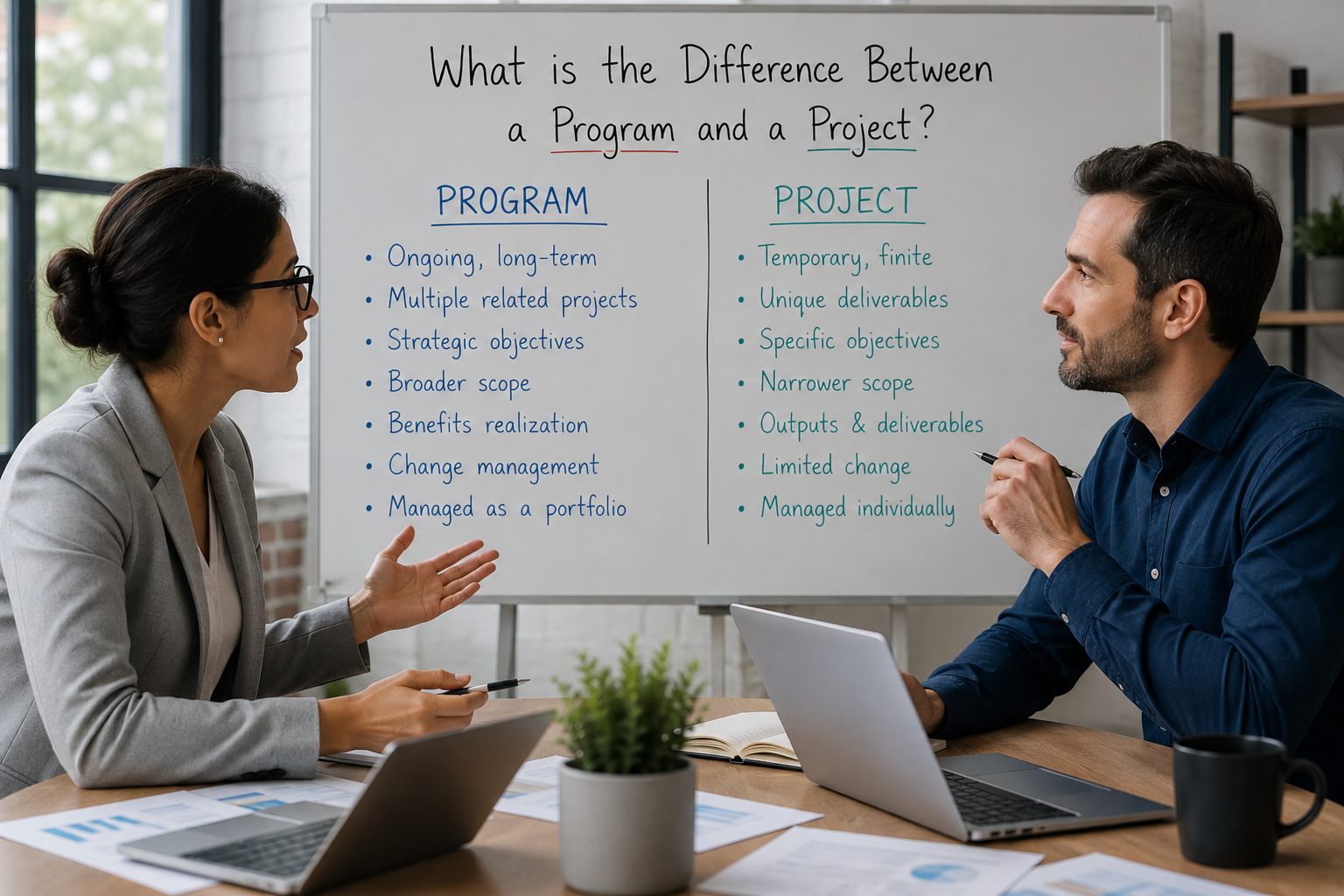
The terms project, program, and portfolio appear throughout PMI’s framework and on the PMP exam — and they are frequently confused, both by candidates and in real-world organisations where people use these words loosely.
Understanding the precise PMI definition of each — and more importantly, understanding why the distinctions matter for how you manage work — is essential for the exam and genuinely useful in practice.
I have worked at all three levels. Let me explain each one through the lens of real experience.
Contents
Real Example: The Wipro Banking Programme.
Related Projects vs a True Program — An Important Distinction
The Program Manager vs the Project Manager
How This Topic Is Tested on the PMP Exam.
What is a Project?
A project is a temporary endeavour undertaken to create a unique product, service, or result. Two words in that definition are critical:
- Temporary: every project has a defined beginning and a defined end. It is not ongoing operations. When the deliverable is produced and accepted, the project closes.
- Unique: the output of a project is not identical to what has been produced before. Even if a company builds similar software for multiple clients, each engagement has unique requirements, a unique team configuration, and unique constraints.
A project has a defined scope, a defined schedule, and a defined budget. Success is measured by whether the project delivered the agreed scope on time and within cost.
What is a Program?
A program is a group of related projects, subsidiary programs, and program activities managed in a coordinated manner to obtain benefits and control not available from managing them individually.
The key phrase is ‘benefits not available from managing them individually.’ A program is not just a collection of projects that happen to be in the same domain — it is a group of projects that are deliberately coordinated because managing them together produces better outcomes than managing each one separately.
Benefits realised through program management typically include: shared resources across projects, coordinated risk management, aligned stakeholder communication, shared infrastructure or technical components, and the ability to realise strategic benefits that no single project can deliver alone.
Real Example: The Wipro Banking Programme
My role as Delivery Manager at Wipro is the clearest example of programme management from my own career.
I was managing delivery for multiple Fortune 500 banking clients simultaneously — U.S. Bank, Wells Fargo, Standard Chartered, and Goldman Sachs. Each client was a separate project with its own scope, requirements, team, and delivery commitments. But together, they formed a programme.
Why a programme rather than just separate projects? Because managing them as a coordinated portfolio of related work produced benefits that individual project management could not. Shared team members could move between client projects based on priority and workload. Risk patterns identified on one client engagement informed the risk management approach on another. Reporting structures, governance frameworks, and quality standards were consistent across all clients — reducing setup time and increasing team capability across the board.
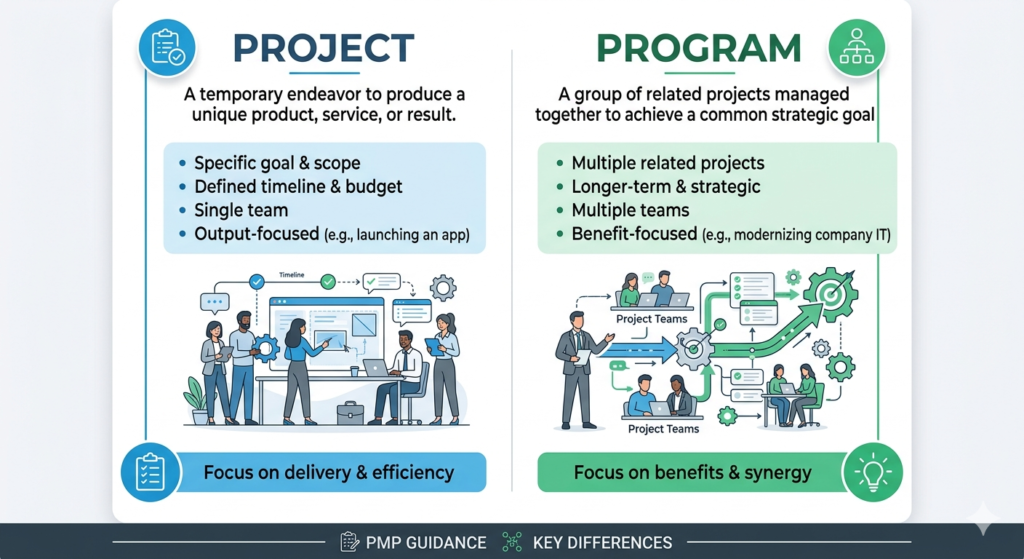
I had a team of more than 70 members working across these client engagements, each workstream headed by its own project manager. My role as Delivery Manager was not to manage the day-to-day tasks — that was the project managers’ responsibility. My role was to manage the programme: resource allocation across projects, escalation handling, client relationship governance, financial reporting across the portfolio, and ensuring that delivery standards were consistent and commitments were met.
This is precisely what PMI means by program management: the project managers ran their individual projects. I ran the programme — coordinating across them to achieve outcomes that none of them could achieve independently.
What is a Portfolio?
A portfolio is a collection of projects, programs, subsidiary portfolios, and operations managed as a group to achieve strategic objectives. Portfolio management sits at the highest level of PMI’s hierarchy.
Where program management focuses on coordinating related work to realise combined benefits, portfolio management focuses on selecting and prioritising the right work in the first place — ensuring that the organisation’s resources are invested in the projects and programs that best support strategic goals.
Portfolio management asks: are we doing the right projects? Program management asks: are we doing the projects right, together? Project management asks: are we doing this specific project right?
The Three-Level Hierarchy
| Level | Definition | Focus | Success Measured By |
| Portfolio | Collection of projects and programs aligned to strategic objectives | Are we investing in the right work? | Strategic value delivered, ROI across the portfolio |
| Program | Group of related projects managed together for combined benefits | Are we coordinating related work effectively? | Benefits realised that individual projects could not achieve alone |
| Project | Temporary endeavour to create a unique product, service, or result | Are we delivering this specific scope on time and within budget? | Scope delivered, schedule met, budget adhered to |
Related Projects vs a True Program — An Important Distinction
Not every group of related projects constitutes a program in PMI’s framework. The defining criterion is whether coordinated management produces benefits beyond what individual project management achieves.
In my experience at multiple companies, projects in the same domain often share similar architectures, common modules, and reusable components. We could build a core feature set and then customise it for different clients — turning features on and off, adapting workflows, configuring the system for different market requirements. This modular approach meant that delivering for one client created reusable assets that accelerated delivery for the next.
Whether this constitutes a programme depends on whether the projects are formally coordinated to capture those reuse benefits, or whether it happens informally. When coordination is intentional and managed — shared resource planning, formal lessons-learned transfer, coordinated dependency management — it is programme management. When it is informal and opportunistic, it is simply good reuse of existing assets.
For the PMP exam, the test for whether something is a program: would managing these projects together produce benefits that managing them separately would not? If yes — program. If they are merely similar projects with no meaningful interdependency or coordination benefit — they are separate projects, even if they are in the same domain.
The Program Manager vs the Project Manager
Understanding the difference in role between a program manager and a project manager clarifies how the two levels work together.
| Dimension | Project Manager | Program Manager |
| Primary focus | Delivering the defined project scope on time and within budget | Realising strategic benefits across coordinated projects |
| Time horizon | Project duration — temporary | Programme duration — longer, often multi-year |
| Scope management | Controls changes to the defined project scope | Manages interdependencies and scope across multiple projects |
| Success metric | Did the project deliver as committed? | Were the intended programme benefits realised? |
| Stakeholder level | Project-level stakeholders — team, sponsor, client | Senior executives, steering committees, portfolio owners |
| Typical decisions | Task sequencing, resource allocation within the project | Resource sharing across projects, priority trade-offs between projects |
How This Topic Is Tested on the PMP Exam
- Definition questions: What is a program? Answer always includes ‘related projects managed in a coordinated manner to obtain benefits not available from managing them individually.’
- Identification questions: A scenario describes multiple related projects with shared resources and interdependencies. Is this a project, program, or portfolio? The presence of coordination for combined benefit signals program.
- Role distinction questions: Who is responsible for ensuring strategic benefits are realised — the project manager or the program manager? Program manager.
- Portfolio questions: Who decides which projects receive funding and priority in an organisation? The portfolio manager or the PMO — not the project manager.
PMP exam trap: Operations are not projects. Ongoing, repetitive work that produces the same output repeatedly is operations — not a project. If a question describes recurring work with no defined end date, the correct classification is operational, not a project.
About the Author

Rahul Dhakate is a PMP-certified project manager and product management leader based in Nagpur, India, with 20 years of experience managing software projects across BFSI, eCommerce, and enterprise software. He served as Delivery Manager at Wipro managing a programme of over 70 team members across multiple Fortune 500 banking client projects, applying programme management principles to coordinate resources, governance, and delivery standards across related but distinct client engagements. He writes at LearnXYZ.in to help working professionals understand both the theory and real-world practice of project management.
Good Reads:

I am regular visitor, how are you everybody? This article
posted at this web site is really fastidious.