By Rahul Dhakate · PMP & PSM I Certified · learnxyz.in
Most PMP preparation articles tell you what to study. Very few tell you what the exam actually feels like from the inside — the physical environment, the mental state in those first minutes, and what genuinely surprised an experienced project manager when he finally sat down to take it.
I took the PMP exam online from home in January 2022, during the COVID pandemic. My experience of the exam environment was therefore different from candidates who sat at a Pearson VUE test centre — and in some ways more intense, because the proctoring was conducted entirely through my laptop camera with no physical invigilator present. What I can tell you is exactly what it was like, without filtering out the uncomfortable parts.
A note on exam versions: I sat the previous version of the exam (180 questions in 230 minutes). PMI updated the PMP exam on 9 July 2026. It is still 180 questions with two 10-minute breaks, but you now get 240 minutes, and the domain weighting has shifted to People 33%, Process 41% and Business Environment 26%. The environment, the proctoring and the mental experience I describe below have not changed. Always confirm the current format on PMI’s website before you book.
The Environment — Stricter Than You Expect
The PMP exam is conducted in a very strict, supervised environment. When you take it online, that strictness is enforced entirely through technology — and it is thorough. Before my exam began, the Pearson VUE proctor asked me to turn my camera slowly around the entire room, showing every corner, the ceiling, under the desk, and every surface. Notes, books, phones, second screens, headphones — none of these are permitted. Nothing can be in the room that was not there before the exam started.
Once the exam began, the camera remained on at all times. You are seated in a confined space. The only place you can look is at the screen in front of you. No fidgeting. No looking away repeatedly. No leaving the frame. The proctor monitors through the camera feed and can pause your exam or disqualify you if your behaviour raises flags — looking repeatedly to the side, talking to yourself, or leaving the desk without permission.
This is not designed to intimidate — it is designed to maintain the integrity of a credential that carries real professional weight. But knowing the environment in advance makes a significant difference. If you are planning to take the exam online, do a full room setup the day before. Sit in that room and practise sitting still and focused for 30 minutes. The physical stillness required is something most people underestimate.
The Online Exam Setup — What You Need Ready
| Item | Required? | Notes |
|---|---|---|
| Government photo ID | Mandatory | Must match your PMI registration name exactly |
| Laptop with working camera and microphone | Mandatory | Run the Pearson VUE OnVUE system test at least 48 hours before |
| Stable internet connection | Mandatory | Wired is more reliable than WiFi |
| Clean, quiet private room | Mandatory | No other people permitted in the room during the exam |
| Clear desk surface | Mandatory | No papers, notebooks, phones or extra monitors |
| Water | Check first | Rules on drinks can vary — confirm with Pearson VUE before exam day |
| Scratch paper and pen | Not allowed online | The online exam gives you a built-in virtual whiteboard instead |
For the full checklist, including what changes if you sit at a test centre, see my PMP exam day guide.
The First 30 Minutes — What It Actually Feels Like
Before I describe the exam itself, I want to be honest about the mental state I was in when it started. I had prepared to approximately 95% of what felt possible. And I was still scared. Not paralysed — but genuinely uncertain about whether I would clear it. That combination of thorough preparation and lingering doubt is more normal than most people admit publicly.
When the first question appeared on the screen, two things happened simultaneously. The first was a flash of recognition — I knew this type of question, I had seen this scenario structure in practice. The second was the realisation that the exam was now real and there was no more preparation time. Those two things together created a focused clarity that I had not quite expected. The anxiety that had been building for days narrowed into something useful — attention on the question in front of me.
The first 30 minutes set the pace for everything that followed. I answered questions I knew with confidence and moved quickly. Questions I was uncertain about, I flagged and moved past rather than sitting with the uncertainty for minutes at a time. Getting into a rhythm early — answering, flagging when needed, moving forward — was the most important mental discipline of the entire exam.
What Surprised Me Most
Two things genuinely surprised me on exam day. The first was how many answers I already knew. With sufficient preparation behind you, a meaningful proportion of the questions feel familiar — not because you have memorised the answers, but because the patterns, the PMI mindset, and the scenario structures have become part of how you think. That is what enough practice questions buys you. Seeing a question and having an immediate strong instinct about the answer, then verifying that instinct against the options — that feeling is both reassuring and energising.
The second surprise was the professionalism and smoothness of the entire process. Despite being conducted remotely through a laptop camera, the Pearson VUE process was well-designed, clearly explained, and staffed by coordinators who were genuinely helpful and professional. The exam experience itself, once it began, was clean and focused — nothing unnecessary, everything oriented toward letting you demonstrate what you know.
Managing the Psychological Dimension
The PMP exam is a four-hour mental marathon. The physical stillness required, combined with the sustained concentration across 180 questions, is more taxing than most candidates anticipate until they are in it. The final 60 questions require the same quality of thinking as the first 60 — but with significantly less mental energy available.
What I found worked for the psychological dimension:
- Accepting uncertainty on individual questions rather than fighting it — flagging and moving forward preserved energy and momentum
- Using the two breaks deliberately — even if you feel fine at question 60, take the 10 minutes, stand up, breathe, and reset your attention. Remember that once you start a break you cannot go back to the questions in the section you just finished
- Not tracking how many questions remained — looking at question 140 of 180 and thinking about how far you have to go is counterproductive; treat each question as its own complete task
- Trusting preparation over in-the-moment doubt — when your exam-day instinct and your anxiety conflict, the preparation is more reliable than the anxiety
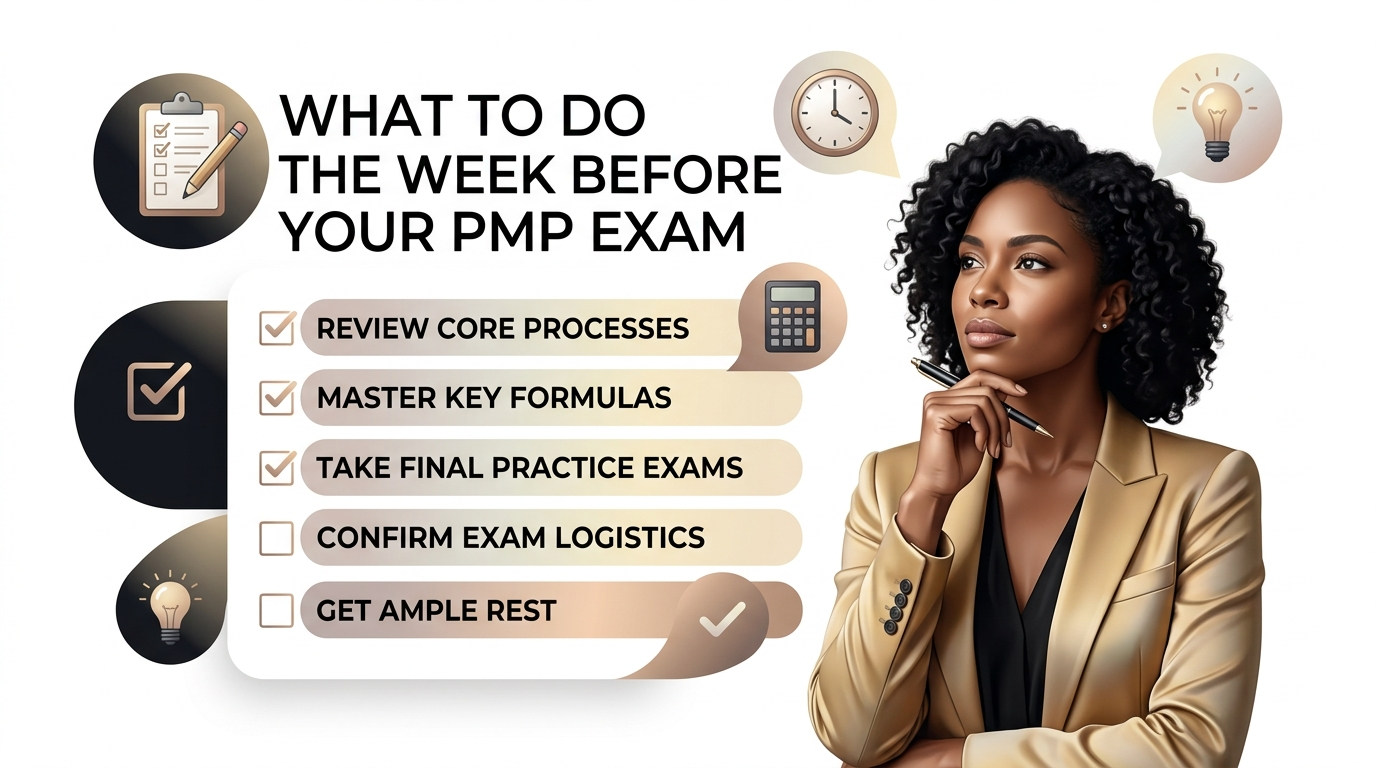
The most useful mental preparation for exam day is not more content review — it is visualising the environment and your response to it. Spend 10 minutes the evening before imagining sitting down, the proctor check completing, the first question appearing, and you answering it calmly and moving to the next. This mental rehearsal reduces the novelty shock of the actual experience. My guide to the week before your PMP exam covers the rest of that final stretch.
Test Centre vs Online — Which is Better?
| Factor | Test Centre | Online From Home |
|---|---|---|
| Environment control | Controlled by Pearson VUE — standardised | You control it — requires preparation |
| Technical risk | Minimal — equipment provided | Your internet and camera are your responsibility |
| Physical comfort | Fixed workstation, standard conditions | Your own chair and desk — potentially more comfortable |
| Strictness level | High — physical invigilator present | Very high — camera monitoring is thorough |
| Best for | Candidates who want zero technical variables | Candidates with a reliable connection and a private room who prefer their own space |
If you are still building your preparation, start with the 90-day PMP study plan and work backwards from your exam date.
About the author: Rahul Dhakate is a PMP and PSM I certified project manager based in Nagpur, India, with 20 years of experience managing software projects across BFSI, eCommerce and enterprise software. He took the PMP exam online from home in January 2022, experiencing the full Pearson VUE remote proctoring process and passing on his first attempt. He writes at LearnXYZ.in to help working professionals pass the PMP exam on their first attempt.