By Rahul Dhakate · PMP & PSM I Certified · 7 June 2026 · learnxyz.in
Of all the question types on the PMP exam, Agile situational questions are the ones that catch the most candidates off guard — particularly those coming from traditional project management backgrounds. The challenge is not a lack of knowledge. It is a collision between how you instinctively react to project situations and how PMI expects a project manager to respond.
Contents
How to Answer Agile Situational Questions on the PMP Exam.
Why Agile Situational Questions Are Different
The Five Core Agile Principles Behind Every Situational Answer
The Most Common Agile Situational Question Patterns.
Pattern 1: A Stakeholder Goes Directly to the Development Team..
Pattern 2: The Team is Behind on the Sprint
Pattern 3: The Product Owner Keeps Changing Requirements.
Pattern 4: A Team Member is Not Participating in Ceremonies.
Pattern 5: Technical Debt is Accumulating.
The Three-Step Framework for Any Agile Situational Question.
A Real Judgment Call: When the Exam and Reality Diverge.
I found situational questions genuinely dicey when preparing for my exam. The answers can look very similar on the surface. Two options may both seem reasonable. The key is understanding the exact intent of the question and the specific PMI principle being tested — and once you identify that, the correct answer usually becomes clear.
This article gives you the thinking framework you need for Agile situational questions specifically — the category that represents 50% of the exam and where the PMI mindset diverges most sharply from real-world instinct.
Why Agile Situational Questions Are Different
Agile situational questions are not knowledge recall questions. They do not ask you what a sprint retrospective is or who owns the product backlog. They present you with a real-world scenario — a team conflict, a stakeholder demand, a sprint going wrong — and ask what you should do.
The trap: most experienced project managers answer these questions based on what they would actually do in that situation. Sometimes that matches what PMI expects. Often it does not — because the PMI framework describes an idealised Agile environment that many real organisations never fully achieve.
The single most important thing to understand about Agile situational questions: PMI is testing whether you know the correct Agile response in a textbook Agile environment. Not what you would do in a corporate setting with political constraints, time pressure, and imperfect teams. The exam lives in a clean, principled Agile world. Your answers need to live there too.
The Five Core Agile Principles Behind Every Situational Answer
Every correct answer to an Agile situational question reflects one or more of these five principles. Memorise these and you have the framework for any scenario:
| Principle | What It Means in Practice | Exam Signal |
| Empower the team | The Development Team self-organises. Nobody tells them how to do the work. | If someone is directing the team’s technical approach — that is wrong |
| Protect the sprint | Nothing enters the sprint backlog mid-sprint without the team’s agreement. The SM protects the team from interruptions. | If external pressure is pushing work into a sprint — the SM acts |
| Value over process | Delivering working software that satisfies customers takes priority over following a rigid process. | If process compliance conflicts with delivering value — value wins |
| Embrace change | Requirements evolving is expected and welcomed — through the backlog, not mid-sprint. | New requirements go to the PO and the backlog. Not directly to the team. |
| Continuous improvement | Retrospectives exist to improve the team process. Every issue is an improvement opportunity. | Process problems are raised in retros — not escalated past the Scrum team |
The Most Common Agile Situational Question Patterns
Pattern 1: A Stakeholder Goes Directly to the Development Team
Scenario: A senior client requests that the development team add a feature mid-sprint. The team is considering accepting it to keep the client happy.
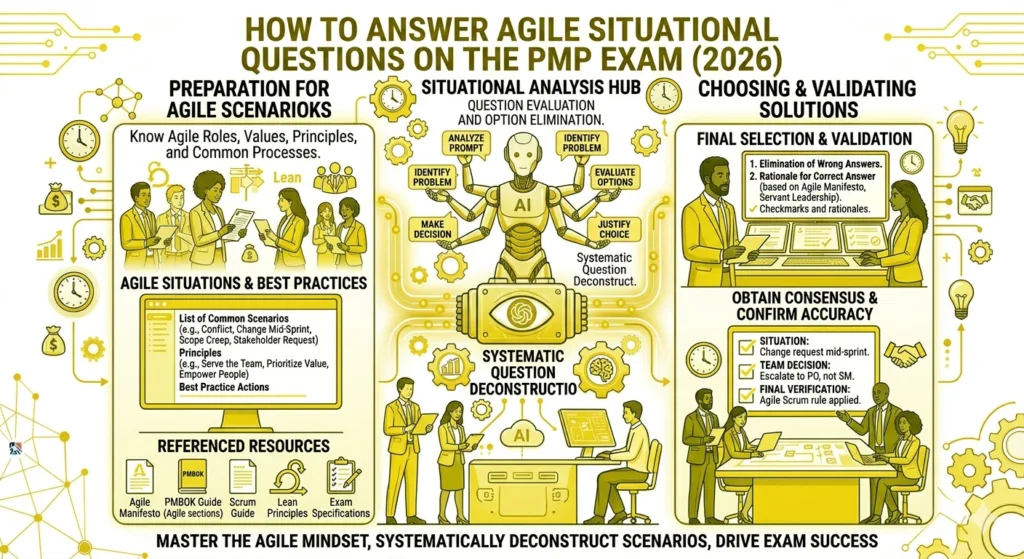
Wrong answers: Accept it because the client is important. Escalate to the project manager. Add it to the current sprint backlog.
Correct answer: The Scrum Master redirects the stakeholder to the Product Owner. The PO evaluates the request, adds it to the product backlog if appropriate, and prioritises it for a future sprint.
The rule: new requirements always go through the Product Owner and the backlog. The Development Team’s sprint commitment is protected. Direct stakeholder access to the dev team bypasses Scrum’s value management mechanism.
Pattern 2: The Team is Behind on the Sprint
Scenario: On day 8 of a 10-day sprint, it is clear the team will not complete all committed stories. What should happen?
Wrong answers: Add more hours. Ask the PM to extend the sprint. Remove a team member who is slowing things down.
Correct answer: The team and Scrum Master collaborate to identify which stories can be completed to the definition of done within the sprint. Incomplete stories are returned to the product backlog and reprioritised by the PO. The sprint end date does not move.
Sprints do not get extended because work is incomplete. Time-boxing is a Scrum fundamental. Incomplete work returns to the backlog — it is not carried forward into the next sprint as uncompleted work. The team’s velocity calculation reflects only fully completed stories.
Pattern 3: The Product Owner Keeps Changing Requirements
Scenario: The Product Owner changes the priority of backlog items frequently, disrupting the team’s sprint planning and creating instability.
Correct answer: The Scrum Master facilitates a conversation about the impact of instability on team velocity and sprint goals. The PO is coached on the importance of sprint goal stability. Backlog refinement practices are improved to give the team better visibility into upcoming priorities before sprint planning.
Pattern 4: A Team Member is Not Participating in Ceremonies
Scenario: One developer consistently skips the Daily Scrum and does not update their progress.
Correct answer: The Scrum Master addresses this directly with the team member — understanding the reason and reinforcing why the Daily Scrum serves the team’s coordination needs. If the behaviour continues, it is raised in the retrospective as a team process issue.
Note that the Scrum Master does not escalate this to management or the product owner. It is a team process issue — addressed within the Scrum Team first.
Pattern 5: Technical Debt is Accumulating
Scenario: The team is delivering features quickly but technical debt is growing and threatening future velocity.
Correct answer: The team raises technical debt in the retrospective and commits to addressing it. The Product Owner is informed of the risk to future velocity. Technical debt items are added to the backlog and prioritised accordingly.
The Three-Step Framework for Any Agile Situational Question
When you encounter an Agile situational question on the exam, apply this three-step process:
- Identify the Scrum violation: What Agile principle is being broken in the scenario? Is someone bypassing the PO? Is the sprint being disrupted? Is the team being micromanaged?
- Apply the correct role response: Which Scrum role should act? Scrum Master for process issues and team protection. Product Owner for scope and priority decisions. Development Team for technical approach decisions.
- Choose the most conservative, process-correct answer: When two answers both seem reasonable, choose the one that most closely follows Scrum principles without escalating beyond the Scrum Team unless absolutely necessary.
The most common mistake on Agile situational questions: escalating too quickly. PMI expects issues to be resolved within the Scrum Team first — through the Scrum Master, through the retrospective, through the PO. External escalation to management, the sponsor, or HR is a last resort, not a first response.
A Real Judgment Call: When the Exam and Reality Diverge
I want to be honest about something. In real projects — the ones I managed across Bizsense, Valethi, and Wipro — the textbook Scrum response is not always what happens. Stakeholders do go directly to developers. Sprints do get extended under client pressure. Technical debt does accumulate because delivery pressure wins.
None of that is what the PMP exam is testing. The exam is testing whether you know the correct Agile framework response — not what typically happens in imperfect organisations. Your job in the exam room is to think like a textbook Scrum practitioner, even if your real-world experience tells you otherwise. That mental separation is the skill the exam is actually measuring.
About the Author:

Rahul Dhakate is a PMP and PSM I certified project manager and product management leader based in Nagpur, India, with 20 years of experience managing software projects across BFSI, eCommerce, and enterprise software. He passed the PMP exam navigating both the straightforward knowledge questions and the judgment-heavy situational questions — finding that understanding PMI’s idealised Agile framework was the key to answering correctly even when real-world instinct pointed elsewhere. He writes at LearnXYZ.in to help working professionals pass the PMP exam and build modern project management careers.
Great Reads On This Site