By Rahul Dhakate · PMP Certified · May 2026 · learnxyz.in
This is the question every working professional asks before committing to the PMP — and it deserves a genuinely honest answer, not the cheerful ‘absolutely yes’ you’ll find on most certification prep websites.
I earned my PMP in January 2022. I had the training done for nearly a decade before that. In that gap, I asked myself the same question more than once: is this actually worth the effort? Is the credential going to open doors that are currently closed, or am I just paying for a badge?
Here is what I know now, from the other side of that decision — backed by current market data and 20 years of watching careers in project management develop across BFSI, eCommerce, and enterprise software.
Table of Contents
The Salary Data Is Compelling.
The Job Market Reality in 2026.
What PMP Does Beyond the Salary.
The Salary Data Is Compelling
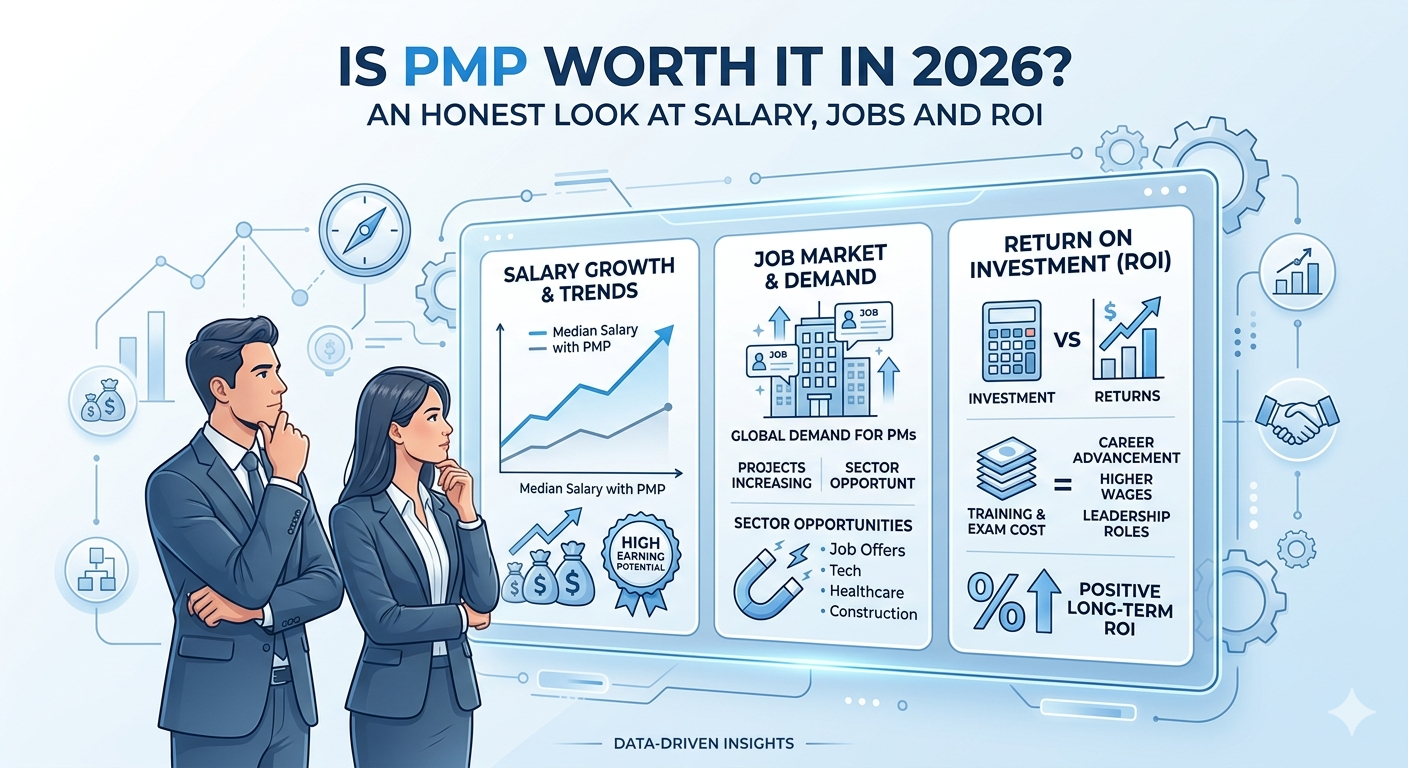
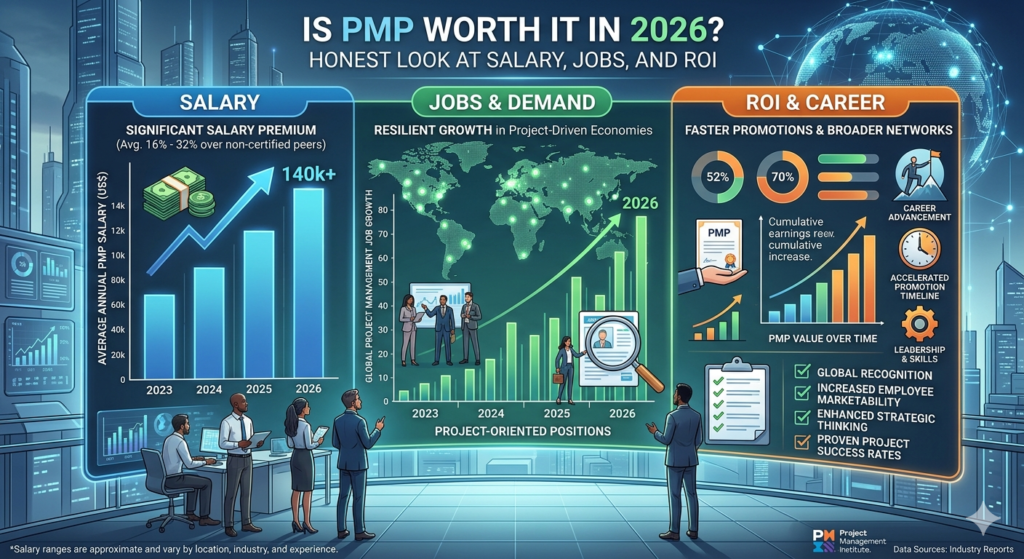
PMI’s annual salary survey consistently shows that PMP-certified professionals earn 20 to 25 percent more than their non-certified counterparts in the same role and geography. In the United States, the median salary for a PMP holder sits above $120,000 per year. In India, the premium is proportionally similar — PMP holders in senior PM roles command significantly higher packages than equivalent non-certified professionals.
To put this in ROI terms: the total investment in PMP — exam fee ($405 for PMI members), study materials ($100–300), and PMI membership ($139) — sits somewhere between $600 and $900 USD for most candidates. The salary premium on a US PM role of $120,000 at 20% represents $24,000 per year. The certification pays for itself within the first two weeks of employment in a role where it contributed to the hiring decision.
Even in India, where the absolute salary numbers are different, the percentage premium is significant enough that the ROI calculation is clearly positive for anyone in a mid-to-senior PM career.
The Job Market Reality in 2026
There are currently over 10,000 open roles in the United States listing PMP as a required or preferred qualification. PMI’s own research projects 2.3 million new project management roles opening globally every year through 2030.
What this means practically: PMP is not just a credential that sits nicely on a resume. It is actively filtering candidates out of consideration for senior PM roles at major companies. In BFSI, government contracting, healthcare IT, and enterprise software — four of the highest-paying sectors for project managers — PMP is frequently listed as a hard requirement, not a preference.
The question is not whether PMP opens doors. It clearly does. The more honest question is whether those doors were previously closed to you — and whether they’re doors you actually want to walk through.
What PMP Does Beyond the Salary
This is where most analysis of PMP’s value stops too early. The salary premium is real and worth pursuing. But in my experience, the deeper value of PMP is not financial.
Preparing for the PMP exam forced me to think about project management in a structured, principled way that two decades of hands-on experience alone had not. The exam does not just test whether you know what a risk register is. It tests whether you understand why risk management is done the way it is — and how to make good decisions when the textbook answer and the real-world situation don’t align perfectly.
That thinking — the PMI way of approaching projects, stakeholders, scope, and change — becomes genuinely useful in your daily work. It is not academic knowledge that you shelve after passing the exam. It is a framework for making better decisions under uncertainty, which is essentially what project management is.
I would recommend PMP not only for the jobs and the salary premium. I would recommend it for the knowledge and the thinking framework it forces you to develop. Those stay with you regardless of what the job market does.
The Honest Case Against PMP
Being fair to this question means acknowledging when PMP might not be the right priority.
- If you are very early in your career with limited project experience, PMP will not compensate for that lack of experience. The certification signals to employers that you know project management frameworks — but it does not substitute for demonstrated leadership of real projects. Build the experience first.
- If your industry or geography does not recognise PMP — certain niche sectors, some startup ecosystems — the credential may carry less weight than your portfolio of delivered work. Know your market before investing.
- If you are planning to move into Product Management rather than project management, PMP is valuable but not the primary signal employers look for. Product management hiring prioritises product thinking, business judgment, and delivery track record over PM certifications specifically.
- If your employer will not reimburse the cost and the investment is genuinely difficult financially at this stage — it is worth waiting until the timing is better rather than rushing into debt for a certification. The exam will still be there in 12 months.
Will AI Make PMP Irrelevant?
This is the question that has started appearing in every professional development conversation in 2025 and 2026, and it deserves a direct response.
AI is changing what project managers do — but it is not replacing them. What AI automates is the routine administrative work: generating status reports, populating risk logs, scheduling meetings, tracking dependencies. What AI cannot do is manage stakeholder conflict, make judgment calls under ambiguity, build trust with a nervous client, or decide which competing priority actually serves the project’s objective best.
These are the skills that PMP tests. They are also the skills that become more valuable as AI absorbs the administrative layer of the PM role. The project managers who will thrive in an AI-augmented environment are the ones with deep judgment, strong stakeholder skills, and frameworks for thinking clearly about complex problems. PMP develops exactly those capabilities.
The right framing for 2026: PMP plus working knowledge of AI tools for project managers is a significantly stronger combination than either alone. That is precisely what this site covers — and why the two pillars belong together.
My Direct Answer
Yes. PMP is worth it in 2026.
Not because it is a magic credential that transforms your career overnight. Not because every employer will immediately offer you 25% more the moment you list it on your resume. But because it represents a genuine investment in how you think about and practice project management — and that investment compounds over time in ways that are difficult to fully quantify from the outside.
I waited almost a decade to sit the exam. That was too long. The knowledge, the clarity of thinking, and the career signal it provides were all available to me sooner. If you are eligible and you are asking whether it is worth it — the answer is yes. The only question is when you start.
About the Author:

Rahul Dhakate is a PMP-certified project manager and product management leader based in Nagpur, India. He writes at LearnXYZ.in to help working professionals navigate the PMP journey honestly — including the questions most prep sites are too cautious to answer directly.
Read Next: