What to Do the Week Before Your PMP Exam

What to Do the Week Before Your PMP Exam By Rahul Dhakate · PMP & PSM I Certified · 18 June 2026 · learnxyz.in The week before your PMP exam is not the time to begin studying. It is not the time to panic. And it is most definitely not the time to start covering material you have not touched before. The week before your exam is the time to consolidate, rest, and prepare your mind and body for peak performance on exam day. Everything you need to know, you have already studied. The work of learning is done. The work of the final week is arriving at the exam room in the best possible state to access everything you have already learned. I experienced significant anxiety in the final days before my exam — and I want to be honest about that, because pretending exam nerves do not exist does not help anyone. What I found is that the same principles that help you perform under any kind of pressure apply here: proper sleep, genuine relaxation, and focused but light review. The Mindset Shift: From Learning to Accessing The most important mental shift for the final week is understanding that you are no longer in learning mode. You are in access mode. The information is in your mind — it has been going in for weeks or months. Your job now is to ensure your brain is in the optimal state to retrieve it under pressure. This means: no intensive new content. No staying up until 2 AM trying to memorise one more chapter. No anxiously rereading sections you already know because the anxiety makes you feel like you have forgotten everything. Once you are sufficiently prepared for the exam, do not let anxiety take control. Relaxation is the key. Good sleep stimulates brain function under pressure. The exam tests what you have already learned — and a rested, relaxed mind retrieves that learning far more effectively than an exhausted, anxious one. The Day-by-Day Final Week Plan Day Activity What to Avoid Day 7 (1 week before) Do one final timed practice session of 60 questions. Review wrong answers. Note your top 3 weak areas. Starting new topics. Full 180-question mock (too tiring this close) Day 6 Light review of your top 3 weak areas only. Re-read relevant PMBOK sections. No new material. Heavy study sessions. Testing yourself intensively. Day 5 Formula sheet review — 15 minutes maximum. Read through your notes from retrospectives and agile ceremonies. Anything that creates anxiety. New practice questions you haven't seen before. Day 4 Rest day. No study. Do something you enjoy — walk, exercise, spend time with family. Your brain needs a break. Any study materials. This day is intentionally clear. Day 3 Light review only: EVM formulas, communications formula, Tuckman's stages, contract types. Maximum 45 minutes. Long study sessions. Cramming. Day 2 (eve before) Confirm all logistics: exam ID, Pearson VUE confirmation, quiet room setup (if online). Read through formula sheet once. Early dinner. Early bed. Late night studying. Anything that disrupts your sleep schedule. Exam Day Light breakfast. Review formula sheet for 5 minutes. Begin exam with confidence. Heavy meals. Coffee overload. Last-minute intensive review. The Sleep Imperative Of all the advice in this article, sleep is the most important and the most frequently ignored. The research on cognitive performance and sleep is unambiguous: a well-rested brain recalls, analyses, and judges significantly better than a sleep-deprived one. For a 230-minute exam that tests judgment and reasoning across 180 complex scenarios, this matters enormously. Target 7 to 8 hours of sleep for the three nights before your exam. If you normally sleep at 11 PM, do not try to shift to 9 PM the night before — your body will not adjust in one night and you will lie awake. Maintain your normal sleep schedule but simply protect it from being shortened by late-night anxiety studying. If anxiety is preventing you from sleeping in the final days, the most effective intervention is physical activity during the day — even a 30-minute walk. Physical exercise reduces cortisol levels and genuinely improves sleep quality. It is more effective than any relaxation technique for exam-related anxiety. What Light Review Actually Means When I say light review in the final week, I mean exactly that — light. Not three-hour sessions. Not re-reading entire PMBOK chapters. Light review in this context means: • Reading through your formula sheet once, morning or evening — 10 minutes • Looking over your personal notes on weak areas — 20 to 30 minutes • Skimming through your Agile ceremony sequence once — 10 minutes • Reading your mnemonic list once — 5 minutes Total light review per day: 45 minutes maximum. The goal is to keep the material warm in your memory, not to add new information. Anything beyond 45 minutes of review in the final week is anxiety-driven — not preparation-driven. Managing Exam Anxiety — What Actually Works Exam anxiety in the final week is normal. I experienced it. Most PMP candidates experience it. The exam is expensive, the preparation has been long, and the stakes feel high. Those feelings are understandable. What does not help with exam anxiety: studying more, checking your mock exam scores repeatedly, reading forum posts about how hard the exam is, or talking to other anxious candidates. What actually helps: 1. Remind yourself of your evidence of readiness — your mock exam scores, the hours you have put in, the material you genuinely understand. The anxiety makes you feel underprepared. The data says otherwise. 2. Physical activity daily — even a 20-minute walk changes your neurochemistry in ways that reduce anxiety and improve focus. 3. Talk to someone who has passed the PMP — their perspective on the actual exam experience is grounding. The exam is difficult but it is manageable for well-prepared candidates. 4. Accept uncertainty — you will not feel completely ready. Nobody does. Preparation is about reaching sufficient readiness, not perfect readiness. Trust your preparation. About the Author Rahul Dhakate is a PMP and PSM I certified project manager and product management leader based in Nagpur, India, with 20 years of experience managing software projects across BFSI, eCommerce, and enterprise software. He experienced significant exam anxiety in the days before sitting the PMP, managing it through sleep discipline, light review, and focusing on his evidence of preparation rather than the anxiety-driven feeling of being underprepared. He writes at LearnXYZ.in to help working professionals pass the PMP exam and build modern project management careers. Next Article: PMP Exam Day — What to Expect, What to Bring, How to Manage Time

By Rahul Dhakate  ·  PMP & PSM I Certified  ·  18 June 2026  ·  learnxyz.in

The week before your PMP exam is not the time to begin studying. It is not the time to panic. And it is most definitely not the time to start covering material you have not touched before.

The week before your exam is the time to consolidate, rest, and prepare your mind and body for peak performance on exam day. Everything you need to know, you have already studied. The work of learning is done. The work of the final week is arriving at the exam room in the best possible state to access everything you have already learned.

I experienced significant anxiety in the final days before my exam — and I want to be honest about that, because pretending exam nerves do not exist does not help anyone. What I found is that the same principles that help you perform under any kind of pressure apply here: proper sleep, genuine relaxation, and focused but light review.

The Mindset Shift: From Learning to Accessing

The most important mental shift for the final week is understanding that you are no longer in learning mode. You are in access mode. The information is in your mind — it has been going in for weeks or months. Your job now is to ensure your brain is in the optimal state to retrieve it under pressure.

This means: no intensive new content. No staying up until 2 AM trying to memorise one more chapter. No anxiously rereading sections you already know because the anxiety makes you feel like you have forgotten everything.

Once you are sufficiently prepared for the exam, do not let anxiety take control. Relaxation is the key. Good sleep stimulates brain function under pressure. The exam tests what you have already learned — and a rested, relaxed mind retrieves that learning far more effectively than an exhausted, anxious one.

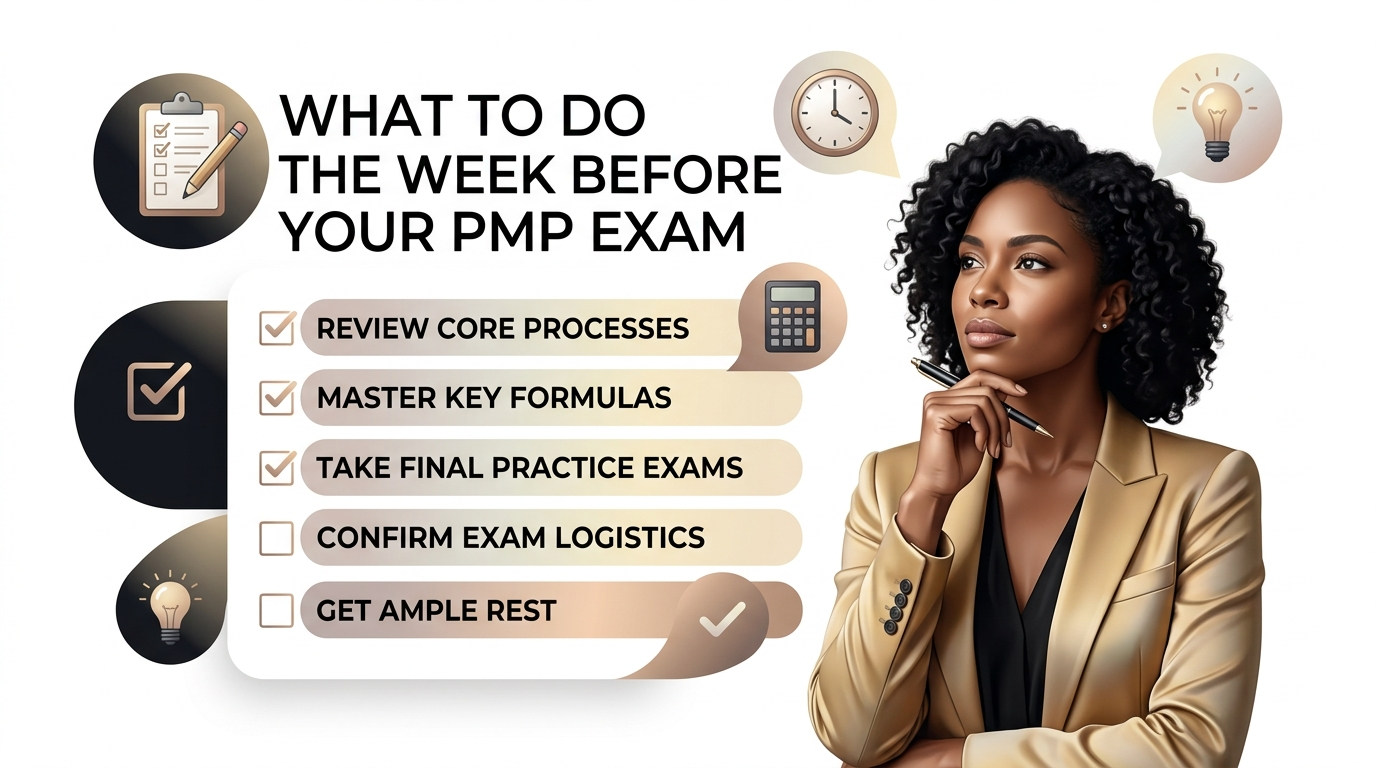
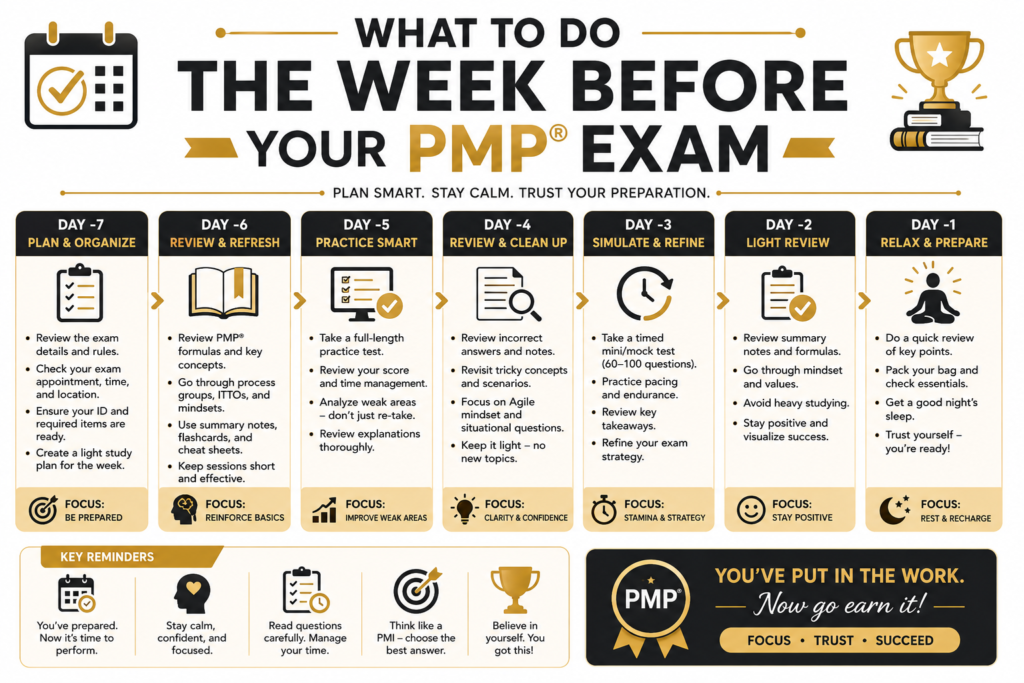
The Day-by-Day Final Week Plan

DayActivityWhat to Avoid
Day 7 (1 week before)Do one final timed practice session of 60 questions. Review wrong answers. Note your top 3 weak areas.Starting new topics. Full 180-question mock (too tiring this close)
Day 6Light review of your top 3 weak areas only. Re-read relevant PMBOK sections. No new material.Heavy study sessions. Testing yourself intensively.
Day 5Formula sheet review — 15 minutes maximum. Read through your notes from retrospectives and agile ceremonies.Anything that creates anxiety. New practice questions you haven’t seen before.
Day 4Rest day. No study. Do something you enjoy — walk, exercise, spend time with family. Your brain needs a break.Any study materials. This day is intentionally clear.
Day 3Light review only: EVM formulas, communications formula, Tuckman’s stages, contract types. Maximum 45 minutes.Long study sessions. Cramming.
Day 2 (eve before)Confirm all logistics: exam ID, Pearson VUE confirmation, quiet room setup (if online). Read through formula sheet once. Early dinner. Early bed.Late night studying. Anything that disrupts your sleep schedule.
Exam DayLight breakfast. Review formula sheet for 5 minutes. Begin exam with confidence.Heavy meals. Coffee overload. Last-minute intensive review.

The Sleep Imperative

Of all the advice in this article, sleep is the most important and the most frequently ignored. The research on cognitive performance and sleep is unambiguous: a well-rested brain recalls, analyses, and judges significantly better than a sleep-deprived one. For a 230-minute exam that tests judgment and reasoning across 180 complex scenarios, this matters enormously.

Target 7 to 8 hours of sleep for the three nights before your exam. If you normally sleep at 11 PM, do not try to shift to 9 PM the night before — your body will not adjust in one night and you will lie awake. Maintain your normal sleep schedule but simply protect it from being shortened by late-night anxiety studying.

If anxiety is preventing you from sleeping in the final days, the most effective intervention is physical activity during the day — even a 30-minute walk. Physical exercise reduces cortisol levels and genuinely improves sleep quality. It is more effective than any relaxation technique for exam-related anxiety.
What to Do the Week Before Your PMP Exam By Rahul Dhakate · PMP & PSM I Certified · 18 June 2026 · learnxyz.in The week before your PMP exam is not the time to begin studying. It is not the time to panic. And it is most definitely not the time to start covering material you have not touched before. The week before your exam is the time to consolidate, rest, and prepare your mind and body for peak performance on exam day. Everything you need to know, you have already studied. The work of learning is done. The work of the final week is arriving at the exam room in the best possible state to access everything you have already learned. I experienced significant anxiety in the final days before my exam — and I want to be honest about that, because pretending exam nerves do not exist does not help anyone. What I found is that the same principles that help you perform under any kind of pressure apply here: proper sleep, genuine relaxation, and focused but light review. The Mindset Shift: From Learning to Accessing The most important mental shift for the final week is understanding that you are no longer in learning mode. You are in access mode. The information is in your mind — it has been going in for weeks or months. Your job now is to ensure your brain is in the optimal state to retrieve it under pressure. This means: no intensive new content. No staying up until 2 AM trying to memorise one more chapter. No anxiously rereading sections you already know because the anxiety makes you feel like you have forgotten everything. Once you are sufficiently prepared for the exam, do not let anxiety take control. Relaxation is the key. Good sleep stimulates brain function under pressure. The exam tests what you have already learned — and a rested, relaxed mind retrieves that learning far more effectively than an exhausted, anxious one. The Day-by-Day Final Week Plan Day Activity What to Avoid Day 7 (1 week before) Do one final timed practice session of 60 questions. Review wrong answers. Note your top 3 weak areas. Starting new topics. Full 180-question mock (too tiring this close) Day 6 Light review of your top 3 weak areas only. Re-read relevant PMBOK sections. No new material. Heavy study sessions. Testing yourself intensively. Day 5 Formula sheet review — 15 minutes maximum. Read through your notes from retrospectives and agile ceremonies. Anything that creates anxiety. New practice questions you haven't seen before. Day 4 Rest day. No study. Do something you enjoy — walk, exercise, spend time with family. Your brain needs a break. Any study materials. This day is intentionally clear. Day 3 Light review only: EVM formulas, communications formula, Tuckman's stages, contract types. Maximum 45 minutes. Long study sessions. Cramming. Day 2 (eve before) Confirm all logistics: exam ID, Pearson VUE confirmation, quiet room setup (if online). Read through formula sheet once. Early dinner. Early bed. Late night studying. Anything that disrupts your sleep schedule. Exam Day Light breakfast. Review formula sheet for 5 minutes. Begin exam with confidence. Heavy meals. Coffee overload. Last-minute intensive review. The Sleep Imperative Of all the advice in this article, sleep is the most important and the most frequently ignored. The research on cognitive performance and sleep is unambiguous: a well-rested brain recalls, analyses, and judges significantly better than a sleep-deprived one. For a 230-minute exam that tests judgment and reasoning across 180 complex scenarios, this matters enormously. Target 7 to 8 hours of sleep for the three nights before your exam. If you normally sleep at 11 PM, do not try to shift to 9 PM the night before — your body will not adjust in one night and you will lie awake. Maintain your normal sleep schedule but simply protect it from being shortened by late-night anxiety studying. If anxiety is preventing you from sleeping in the final days, the most effective intervention is physical activity during the day — even a 30-minute walk. Physical exercise reduces cortisol levels and genuinely improves sleep quality. It is more effective than any relaxation technique for exam-related anxiety. What Light Review Actually Means When I say light review in the final week, I mean exactly that — light. Not three-hour sessions. Not re-reading entire PMBOK chapters. Light review in this context means: • Reading through your formula sheet once, morning or evening — 10 minutes • Looking over your personal notes on weak areas — 20 to 30 minutes • Skimming through your Agile ceremony sequence once — 10 minutes • Reading your mnemonic list once — 5 minutes Total light review per day: 45 minutes maximum. The goal is to keep the material warm in your memory, not to add new information. Anything beyond 45 minutes of review in the final week is anxiety-driven — not preparation-driven. Managing Exam Anxiety — What Actually Works Exam anxiety in the final week is normal. I experienced it. Most PMP candidates experience it. The exam is expensive, the preparation has been long, and the stakes feel high. Those feelings are understandable. What does not help with exam anxiety: studying more, checking your mock exam scores repeatedly, reading forum posts about how hard the exam is, or talking to other anxious candidates. What actually helps: 1. Remind yourself of your evidence of readiness — your mock exam scores, the hours you have put in, the material you genuinely understand. The anxiety makes you feel underprepared. The data says otherwise. 2. Physical activity daily — even a 20-minute walk changes your neurochemistry in ways that reduce anxiety and improve focus. 3. Talk to someone who has passed the PMP — their perspective on the actual exam experience is grounding. The exam is difficult but it is manageable for well-prepared candidates. 4. Accept uncertainty — you will not feel completely ready. Nobody does. Preparation is about reaching sufficient readiness, not perfect readiness. Trust your preparation. About the Author Rahul Dhakate is a PMP and PSM I certified project manager and product management leader based in Nagpur, India, with 20 years of experience managing software projects across BFSI, eCommerce, and enterprise software. He experienced significant exam anxiety in the days before sitting the PMP, managing it through sleep discipline, light review, and focusing on his evidence of preparation rather than the anxiety-driven feeling of being underprepared. He writes at LearnXYZ.in to help working professionals pass the PMP exam and build modern project management careers. Next Article: PMP Exam Day — What to Expect, What to Bring, How to Manage Time

What Light Review Actually Means

When I say light review in the final week, I mean exactly that — light. Not three-hour sessions. Not re-reading entire PMBOK chapters. Light review in this context means:

  • Reading through your formula sheet once, morning or evening — 10 minutes
  • Looking over your personal notes on weak areas — 20 to 30 minutes
  • Skimming through your Agile ceremony sequence once — 10 minutes
  • Reading your mnemonic list once — 5 minutes

Total light review per day: 45 minutes maximum. The goal is to keep the material warm in your memory, not to add new information. Anything beyond 45 minutes of review in the final week is anxiety-driven — not preparation-driven.

Managing Exam Anxiety — What Actually Works

Exam anxiety in the final week is normal. I experienced it. Most PMP candidates experience it. The exam is expensive, the preparation has been long, and the stakes feel high. Those feelings are understandable.

What does not help with exam anxiety: studying more, checking your mock exam scores repeatedly, reading forum posts about how hard the exam is, or talking to other anxious candidates.

What actually helps:

  1. Remind yourself of your evidence of readiness — your mock exam scores, the hours you have put in, the material you genuinely understand. The anxiety makes you feel underprepared. The data says otherwise.
  2. Physical activity daily — even a 20-minute walk changes your neurochemistry in ways that reduce anxiety and improve focus.
  3. Talk to someone who has passed the PMP — their perspective on the actual exam experience is grounding. The exam is difficult but it is manageable for well-prepared candidates.
  4. Accept uncertainty — you will not feel completely ready. Nobody does. Preparation is about reaching sufficient readiness, not perfect readiness. Trust your preparation.

About the Author

Rahul Dhakate is a PMP and PSM I certified project manager and product management leader based in Nagpur, India, with 20 years of experience managing software projects across BFSI, eCommerce, and enterprise software. He experienced significant exam anxiety in the days before sitting the PMP, managing it through sleep discipline, light review, and focusing on his evidence of preparation rather than the anxiety-driven feeling of being underprepared. He writes at LearnXYZ.in to help working professionals pass the PMP exam and build modern project management careers.

Good Reads:

Rahul Dhakate

Rahul Dhakate

Leave a Reply

Your email address will not be published. Required fields are marked *