By Rahul Dhakate · PMP & PSM I Certified · 9 June 2026 · learnxyz.in
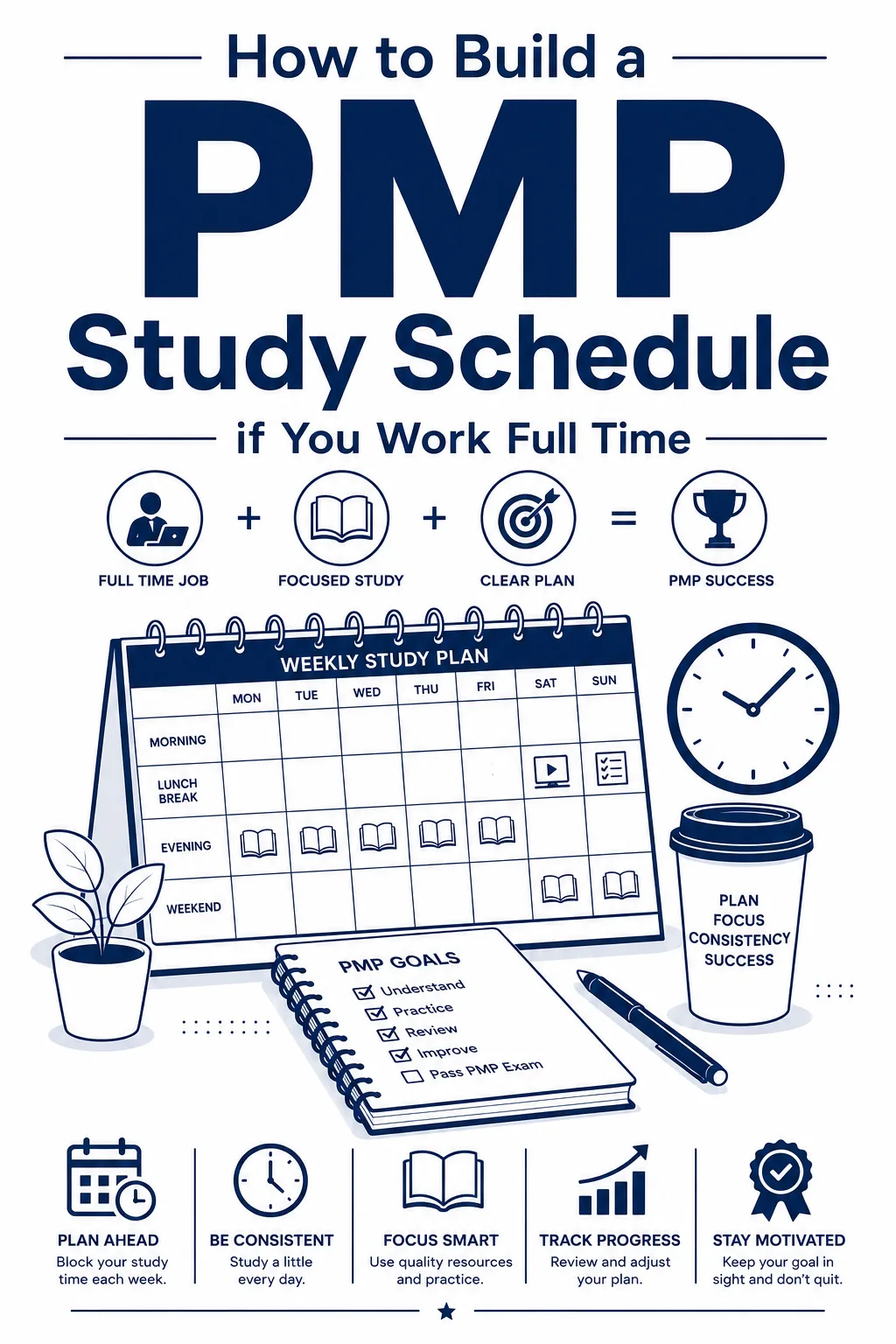
Let me start with the honest truth that most PMP study guides avoid: if you are a working professional — and especially if you are married with family responsibilities — building and sticking to a PMP study schedule is genuinely hard. It is not just about finding the hours. It is about finding the right hours that do not conflict with your work, your family, and your own need for rest.
I studied for PMP while working full time, studying 2 to 3 hours in the evenings after work. I know what works and what does not. And I know that the biggest challenge is not the content — it is the time management and the family adjustment that comes with committing to a serious certification while holding down a demanding job.
This article gives you practical, realistic guidance on building a study schedule that actually holds — not a theoretical plan that collapses the first week when work runs late or family needs your attention.
The Non-Negotiable First Step: Have the Family Conversation
If you are married or in a serious relationship, your study schedule is not just your decision. It requires your partner’s understanding and cooperation. Two to three hours of study time every evening — or dedicated weekend study blocks — takes time away from your family. Acknowledging this honestly and getting genuine buy-in before you start is more important than any specific study technique.
The conversation to have: explain what the PMP certification is, why you are pursuing it, how long the preparation will take, and what you are asking your partner and family to accommodate. A family that understands the goal and the timeline is significantly more supportive than one that feels the study schedule appeared without discussion.
If you are a working professional and married, you have dual responsibilities. Your study schedule must not interfere with your family activities and your office timings. Find the free time that belongs specifically to you — and protect it.
The Two Best Study Windows for Working Professionals
Window 1: Post-Dinner Evening Study (Most Accessible)
For most working professionals in a day shift, the most accessible study window is after dinner — approximately 9 PM to 11 PM. The day’s work is done, family commitments have been met, and the house is settling down. Two hours in this window is a realistic and sustainable daily commitment.
The advantage: you are not sacrificing family time during the day. Dinner happens as normal. Children are in bed or winding down. You have fulfilled your daily responsibilities before the books come out.
The challenge: you are studying when your mental energy is naturally lower. If you find yourself falling asleep over the PMBOK at 10 PM, this window may not be optimal for your most cognitively demanding material. Use this window for practice questions and review — save the harder conceptual reading for when you are fresher.
Window 2: Early Morning (Highest Quality Focus)
If you can train yourself to wake at 5:30 AM — before the household wakes, before the day’s demands begin — you have access to the highest-quality study time available to a working professional. The mind is rested. There are no interruptions. There is genuine quiet.
5:30 AM to 7:00 AM gives you 90 minutes of uninterrupted study before your morning routine begins. Over a week, that is more than 10 hours of focused study without touching evenings at all.
The challenge: it requires consistent early sleep — which itself requires discipline and family coordination. If your household runs late, a 5:30 AM alarm is sustainable for a week but not for three months.
The best combination: 90 minutes in the early morning for new content and conceptual reading, plus 60 minutes post-dinner for practice questions and review. This gives you approximately 150 minutes of study daily without sacrificing family time — and uses your best mental energy for the hardest material.
Weekends Are Your Most Productive Time
Weekends are where real progress happens for working professionals. Without the daily work routine consuming your morning and evening, you can dedicate structured blocks of time to study without the fragmented, time-pressured feeling of weeknight sessions.
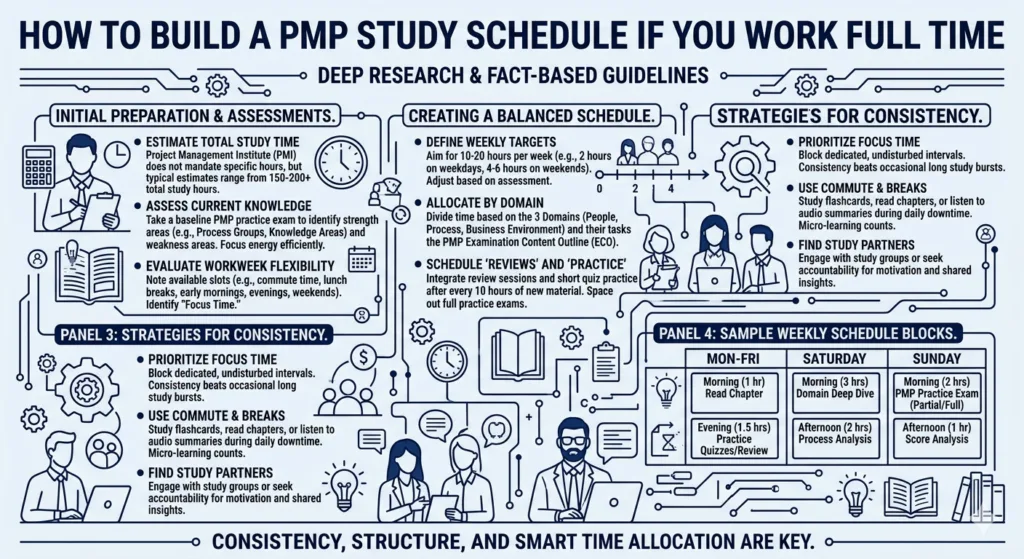
A realistic weekend schedule:
- Saturday morning: 2 hours — new content, reading, course videos
- Saturday evening: 1.5 hours — practice questions on Saturday morning content
- Sunday morning: 2 hours — review weak areas, re-read difficult sections
- Sunday afternoon: 1.5 hours — full-length practice question session (40-50 questions)
That is 7 hours of study over a weekend — more than three typical weeknight sessions combined. If you protect your weekends consistently, you can afford a lighter weeknight commitment without falling behind.
The Discipline Challenge: Staying Consistent
The biggest discipline challenge most working professionals face is not finding the initial motivation — it is maintaining consistency over 3 to 4 months when work pressures fluctuate, family needs change, and the exam still feels far away.
Three things that sustain consistency:
- Book your exam date at the start of your preparation — not at the end. A fixed date creates accountability. Study sessions become mandatory, not optional. The candidate who books first and studies toward a deadline consistently outperforms the one who waits until they feel ready.
- Accept imperfect weeks. There will be weeks where work is brutal and you manage only 3 hours instead of 10. That is normal. The rule is: never miss two weeks in a row. One bad week is a setback. Two becomes a pattern.
- Track progress visibly. A simple paper tracker — crossing off each day you studied — creates a visual record of commitment. Seeing 18 consecutive days crossed off makes missing day 19 feel significant in a way that a mental note never does.
What to Study When — Matching Content to Energy Level
| Study Window | Energy Level | Best Content |
| Early morning (5:30-7:00) | High — rested and focused | New PMBOK concepts, Agile Practice Guide reading, difficult formula sections |
| Commute (if applicable) | Medium — passive | Podcast reviews, audio course content, mental review of previous night’s notes |
| Lunch break (30-45 min) | Medium | Re-reading notes, flashcard review, light practice questions |
| Post-dinner evening | Lower — tired | Practice questions, review of wrong answers, lighter revision material |
| Weekend mornings | High — rested | Full mock exam sessions, new content blocks, deeper conceptual review |
| Weekend afternoons | Medium | Practice questions, formula work, review of weak areas |
Avoid studying after midnight. It feels productive but the retention is poor. An hour of fresh early morning study is worth more than two hours of exhausted late-night reading. Protect your sleep. A fatigued mind cannot absorb complex project management concepts regardless of how much time you put in.
The Schedule That Actually Works
Based on studying 2 to 3 hours post-job plus weekends, here is a sustainable weekly commitment:
| Day | Daily Commitment | Weekly Total |
| Monday to Friday | 1.5 to 2 hours (post-dinner or early morning) | 7.5 to 10 hours |
| Saturday | 3.5 hours (morning + evening blocks) | 3.5 hours |
| Sunday | 3.5 hours (morning + afternoon blocks) | 3.5 hours |
| Weekly total | — | 14 to 17 hours per week |
| Over 10 weeks | — | 140 to 170 hours total — within the recommended 130-190 hour range |
About the Author
Rahul Dhakate is a PMP and PSM I certified project manager and product management leader based in Nagpur, India, with 20 years of experience managing software projects across BFSI, eCommerce, and enterprise software. He studied for PMP while working full time as a software project manager, managing the study schedule around evening study sessions and weekend blocks while maintaining his work and family responsibilities. He writes at LearnXYZ.in to help working professionals pass the PMP exam and build modern project management careers.
Next Article