By Rahul Dhakate · PMP & PSM I Certified · 28 June 2026 · learnxyz.in
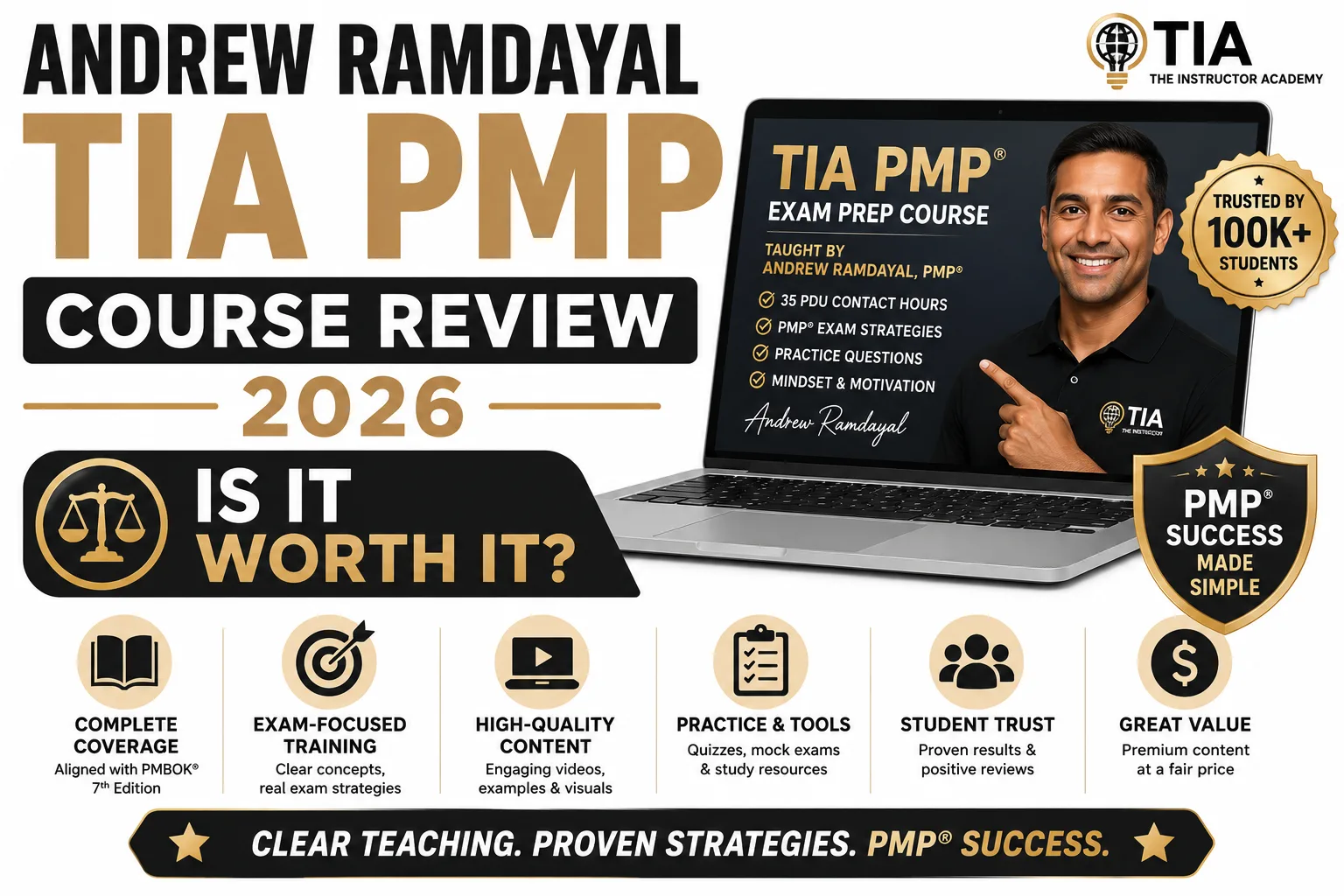
Andrew Ramdayal’s TIA course — Tricks into Agile — has built a strong reputation specifically for one thing: helping PMP candidates master the Agile and situational questions that consistently cause the most difficulty on the exam. I have researched his approach and his course materials thoroughly, and what stands out is that the foundation is genuinely solid — consistent with the strong base that any credible PMP resource needs to have.
What makes Ramdayal’s course distinctive is its specific focus on the hardest category of PMP question: Agile situational scenarios where there often is no single objectively correct answer, only a most-preferred response based on PMI principles.
Why Agile Situational Questions Are Uniquely Difficult
I want to explain this carefully because understanding why these questions are hard is more useful than any specific course review. Agile is fundamentally a philosophy and a way of handling development work through different streams — not a rigid rulebook. This means that in many Agile situational scenarios, you may not necessarily be wrong if you choose a particular path, unless you are carrying some unnecessary baggage or assumption into your answer that contradicts core Agile principles.
This is what makes these questions dicey rather than straightforward. Unlike a calculation question where there is one mathematically correct answer, Agile situational questions present scenarios where multiple responses might seem reasonable. The skill being tested is whether you can identify the most preferred way to solve the problem according to PMI’s framework — not just any defensible response.
Every project manager has a different management style, and a good PM may apply Agile principles in their own way depending on context. But on the exam, you must stick to the core principles as PMI defines them — team empowerment, protecting the sprint, embracing change through the backlog — even if your personal experience suggests other valid approaches exist in the real world.
What the TIA Course Specifically Addresses
Based on thorough research into the course structure and extensive candidate feedback, the TIA course focuses heavily on:
- Pattern recognition for Agile scenario types — teaching candidates to categorise situational questions into recognisable patterns rather than treating each as entirely novel
- The PMI mindset specifically for Agile contexts — distinguishing how PMI expects you to think in Scrum environments versus predictive environments
- Extensive situational question practice — the course is particularly praised for its volume of Agile-specific practice scenarios, which is the area most other prep resources cover more thinly
- Memory techniques tailored to Agile concepts — ceremonies, roles, and artefacts presented through structured recall systems
Current Pricing
| Format | Price (approx) | What’s Included |
| Udemy course (sale price) | $15-30 USD | Full video course, practice questions, downloadable resources |
| Udemy course (list price) | $90-110 USD | Same content — never pay this; wait for sale |
| TIA book (if purchased separately) | $25-35 USD | Companion print material for situational question practice |
Who Should Prioritise This Course
If your mock exam scores show a specific pattern — strong on predictive/process questions but consistently struggling on Agile and situational scenarios — this is precisely the gap Ramdayal’s course is designed to close. Given that approximately 50% of the current PMP exam is Agile and hybrid content, a persistent weakness here is a serious risk to your overall pass probability.
Candidates from strong predictive/Waterfall backgrounds — similar to my own early career in BFSI software, which was heavily Waterfall before transitioning to hybrid and Agile approaches — often benefit most from this kind of focused Agile situational training, because their instincts default to predictive-style answers even in clearly Agile scenarios.
Use your mock exam domain breakdown to decide whether this course deserves priority. If Agile situational questions are your specific weak area — confirmed by data, not just a feeling — a course built specifically around that weakness is a targeted, efficient use of your remaining study budget and time.
My Honest Recommendation
There is no single resource that makes situational questions easy — by their nature, they require judgment, not memorisation. But a course specifically built around training that judgment for Agile contexts, with a large volume of practice scenarios and explanations, addresses a genuine and common gap in PMP preparation.
If your budget allows for one additional resource beyond your primary book or course, and your weak area is confirmed to be Agile situational questions, the TIA course is a well-targeted investment, particularly at Udemy sale pricing.
| Andrew Ramdayal TIA (Udemy) | 15% Udemy affiliate commission | Add your Udemy affiliate link here — wait for sale pricing before recommending |
About the Author
Rahul Dhakate is a PMP and PSM I certified project manager and product management leader based in Nagpur, India, with 20 years of experience managing software projects across BFSI, eCommerce, and enterprise software. He has researched Andrew Ramdayal’s TIA approach extensively, finding its focus on Agile situational question patterns addresses a genuine gap for candidates transitioning from predictive PM backgrounds. He writes at LearnXYZ.in to help working professionals pass the PMP exam without unnecessary expense.
Good Reads:

Your blog is a breath of fresh air in the crowded online space. I appreciate the unique perspective you bring to every topic you cover. Keep up the fantastic work!
Thanks a ton