By Rahul Dhakate · PMP & PSM I Certified · May 2026 · learnxyz.in
This is one of the most searched questions in the project management certification space — and it deserves a genuinely honest answer, not a diplomatic one that avoids taking a position.
I hold both a PMP (Project Management Professional from PMI) and a PSM I (Professional Scrum Master from Scrum.org). I’ve run Scrum ceremonies, removed impediments for teams, coached multiple teams through Agile adoption, and managed projects across Waterfall, hybrid, and Agile environments over 20 years. When I chose between PSM and CSM for my Scrum certification, I had a specific reason — and I’ll share it plainly because it’s something most comparison articles completely ignore.
Let’s start with the basics and build to the real insight.
Contents
What is PSM I — and How Does it Differ from CSM?.
The Renewal Truth Nobody Talks About
What Does Running Scrum Actually Look Like in Practice?.
CSM vs PSM I: Which Scrum Certification Is Better?.
India vs US Market: Does the Choice Matter by Geography?
What is the PMP?
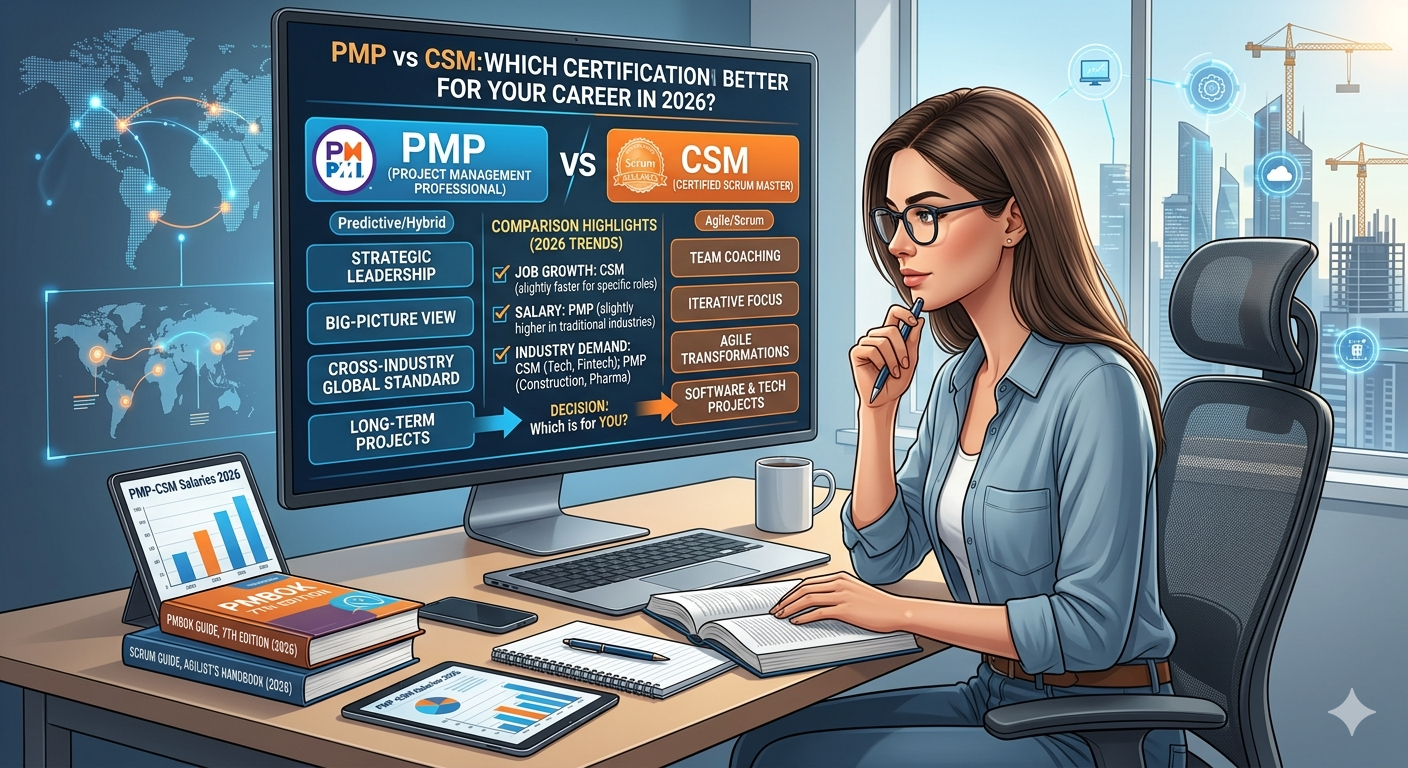
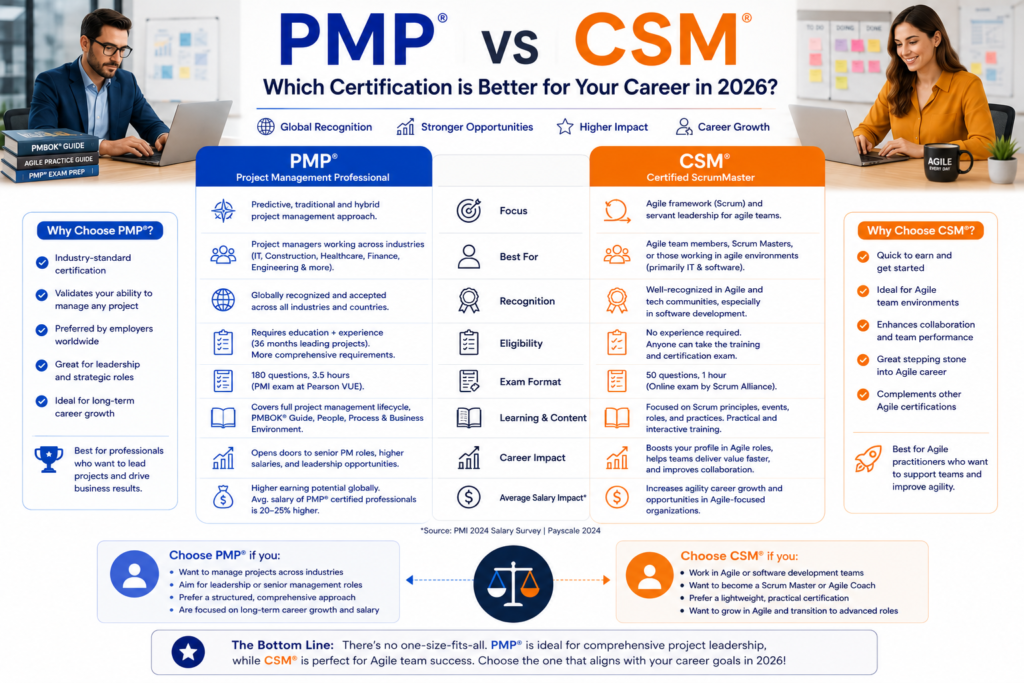
The Project Management Professional is the global standard for project management credentials, issued by the Project Management Institute (PMI). It covers the full spectrum of project management — predictive (Waterfall), Agile, and hybrid approaches — and requires documented project leadership experience to even apply.
Since 2021, approximately 50% of the PMP exam content is Agile or hybrid. This means the PMP now tests Scrum, Kanban, and adaptive approaches alongside traditional PM knowledge. A PMP holder in 2026 is expected to understand and apply both worlds.
What is the CSM?
The Certified ScrumMaster (CSM) is issued by the Scrum Alliance. It is specifically focused on the Scrum framework — one of the most widely adopted Agile methodologies. Unlike the PMP, CSM is narrow in scope. It teaches you to facilitate the Scrum process, support a Scrum team, and remove impediments to delivery.
The CSM is typically earned through a two-day mandatory training course delivered by a Certified Scrum Trainer (CST), followed by an online exam. The exam itself is relatively straightforward compared to PMP — the training course is the main investment.
What is PSM I — and How Does it Differ from CSM?
PSM I (Professional Scrum Master Level I) is issued by Scrum.org — an organisation founded by Ken Schwaber, one of the co-creators of Scrum. PSM I is also focused on the Scrum framework, but the certification pathway is different from CSM.
For PSM I, there is no mandatory training course. You study independently — primarily using the Scrum Guide, which is free — and then sit an 80-question online assessment. The exam is considered more rigorous than CSM’s, with a passing threshold of 85%.
The content covered by CSM and PSM I is substantially similar. Both test your understanding of Scrum roles, ceremonies, artefacts, and values. The difference lies in how you get certified, how long the certification lasts, and how much it costs to maintain.
The Renewal Truth Nobody Talks About
This is the one point in every PMP vs CSM comparison that almost never gets a straight answer. I want to give you one — because it directly affects your long-term cost and time investment.
The CSM from Scrum Alliance requires renewal every two years. To renew, you need to earn Scrum Education Units (SEUs) and pay a renewal fee — currently around $100 USD every two years. If you let it lapse and need to reinstate, the costs are higher.
The PSM I from Scrum.org does not expire. Once you earn it, it is yours permanently. No renewal fee. No SEU requirements. No annual maintenance cost.
I chose PSM I over CSM specifically for this reason. When you are building a professional certification portfolio — PMP, PSM I, potentially other certifications over time — the cumulative maintenance burden of multiple renewals adds up significantly. PMP alone requires 60 PDUs every three years. Adding CSM’s renewal requirements on top means more time, more money, and more administrative overhead.
PSM I sitting permanently alongside PMP removes one renewal cycle entirely. That is a real, practical advantage that most people overlook because they are focused only on which certificate looks better on a resume.
Now — does CSM’s renewal have a benefit? Yes. The requirement to earn SEUs to renew means that CSM holders are technically required to keep their Agile knowledge current. The renewal cycle forces engagement with the latest developments in the Scrum world. That is a genuine trade-off worth acknowledging. But for someone managing multiple professional commitments — as most working PMs are — the PSM I’s permanence is often the more pragmatic choice.
Side-by-Side Comparison
| Factor | PMP | CSM | PSM I |
| Issued by | PMI | Scrum Alliance | Scrum.org |
| Scope | Full PM spectrum — Waterfall, Agile, Hybrid | Scrum framework only | Scrum framework only |
| Experience required | 36–60 months project leadership | None | None |
| Training required | 35 contact hours (any provider) | 2-day mandatory course (~$1,000–1,500 USD) | None — self-study |
| Exam difficulty | High — scenario-based judgment | Moderate — knowledge recall | High — 85% pass threshold |
| Exam fee (approx) | $405 USD (PMI member) | Included in training fee | $200 USD |
| Certification validity | 3 years (renewable with 60 PDUs) | 2 years (renewable with SEUs + ~$100 fee) | Lifetime — no expiry |
| Renewal cost | PMI membership + PDU activities | ~$100 USD every 2 years | None |
| Global recognition | Highest — industry standard | High — especially in Agile teams | High — respected in tech |
| India job market | Strongly preferred for PM roles | Valued for Scrum Master / Agile Coach roles | Valued for tech-focused Agile roles |
| US job market | Frequently required for PM roles | Common in product and engineering teams | Growing recognition in tech companies |
| Best for | Senior PMs, program managers | New to Agile, team leads moving to SM role | Developers, tech leads, self-studiers |
What Does Running Scrum Actually Look Like in Practice?
This is worth addressing directly because there is often a gap between what certifications teach and what actually happens in organisations.
I have run Scrum ceremonies across multiple teams — sprint planning, daily standups, sprint reviews, retrospectives. I have removed impediments, managed team dynamics, and coached groups through Agile adoption. And my honest observation after doing this across multiple companies and domains is this: the skills involved are not fundamentally different from good project management. They are a subset of it.
People management, communication, removing blockers, keeping teams focused on outcomes — these are project management skills that any experienced PM carries into a Scrum environment. A CSM or PSM I gives you the formal framework and the vocabulary. The underlying capability, if you are an experienced project manager, you likely already have.
What I noticed at most organisations — and this is the same observation I made in the Agile vs Predictive article — is that companies say they are running Agile but are actually running a hybrid. Sprint cadences exist alongside formal approval gates. Scrum ceremonies happen within programme-level Waterfall governance. The Scrum Master role is often absorbed into the Project Manager role rather than existing separately.
This means that in practice, a PMP holder who understands Scrum well is more versatile — and often more valuable — than a CSM who doesn’t have broader PM experience. The PMP gives you the full toolkit. The CSM gives you one specialised instrument.
CSM vs PSM I: Which Scrum Certification Is Better?
If you have decided you want a dedicated Scrum certification alongside your PMP, here is how to choose between CSM and PSM I:
Choose CSM if:
- You learn better in a structured classroom environment and value the two-day intensive training experience
- Your organisation or clients specifically request CSM by name — some larger enterprises have preferred certifications listed
- You want a credential that requires ongoing renewal as motivation to stay current with Agile developments
- You are newer to Agile and want the guided onboarding that a certified trainer provides
Choose PSM I if:
- You are comfortable with self-directed learning and confident studying from the Scrum Guide independently
- You want a Scrum credential that never expires and carries no ongoing maintenance costs
- You already hold PMP and are managing multiple certification renewal cycles — PSM I removes one from the equation permanently
- You work primarily in technology-focused environments — PSM I has strong recognition in engineering and product organisations
The exam for PSM I is harder than CSM’s — the 85% pass threshold is serious. But if you study the Scrum Guide thoroughly and do practice assessments on Scrum.org (they offer free open assessments), you can prepare effectively without a formal course.
India vs US Market: Does the Choice Matter by Geography?
This is a relevant question for anyone targeting US remote roles from India, which is a growing and realistic aspiration for experienced Indian PMs.
In the Indian market, PMP is the dominant credential for senior PM roles across IT services, BFSI, and enterprise software. CSM is valued for Scrum Master and Agile Coach roles, particularly in product companies and startups. PSM I is recognised primarily in technology-focused organisations.
In the US market, PMP remains the standard for PM roles. CSM is extremely common in product and engineering teams — Scrum Alliance has done significant marketing work in the US and CSM has strong brand recognition. PSM I is respected, particularly in companies that value technical rigor in their Agile practice.
For someone targeting US remote roles: PMP is non-negotiable as your primary credential. A Scrum certification alongside it — whether CSM or PSM I — signals Agile fluency. Between the two, CSM has slightly higher brand recognition in US job postings, but PSM I is equally respected in technical environments and carries no ongoing cost.
My Direct Recommendation
| For most experienced project managers: PMP first, always. Then add PSM I if you want a dedicated Scrum credential — the lifetime validity and lower total cost make it the more practical choice when you are already managing PMP renewal. Choose CSM over PSM I only if your specific employer or industry context specifically values it, or if you genuinely benefit from the structured training format. |
If you are still early in your career and choosing your first credential: PMP when you have the experience. In the meantime, PSM I is an excellent standalone credential — self-study, low cost, no expiry, and genuinely respected in the technology sector.
The certifications are tools. What matters most is the judgment, experience, and communication skills you bring to managing projects and products. Certifications open doors. What happens after you walk through those doors is entirely determined by your actual capability — and no exam tests that as well as 20 years of doing the work.
About the Author:

Rahul Dhakate is a PMP and PSM I certified software project manager and product management leader based in Nagpur, India. He has run Scrum ceremonies, coached multiple teams through Agile adoption, and managed projects across Waterfall, hybrid, and Agile environments over 20 years. He chose PSM I over CSM for exactly the reasons described in this article. He writes at LearnXYZ.in to help working professionals make smarter decisions about their PM careers and certifications.
Next Article: