Conflict resolution techniques in PMP come up again and again in scenario questions, mostly in the People domain, which makes up 42% of the exam. The good news is that there are only five techniques, and the exam usually favours one of them.
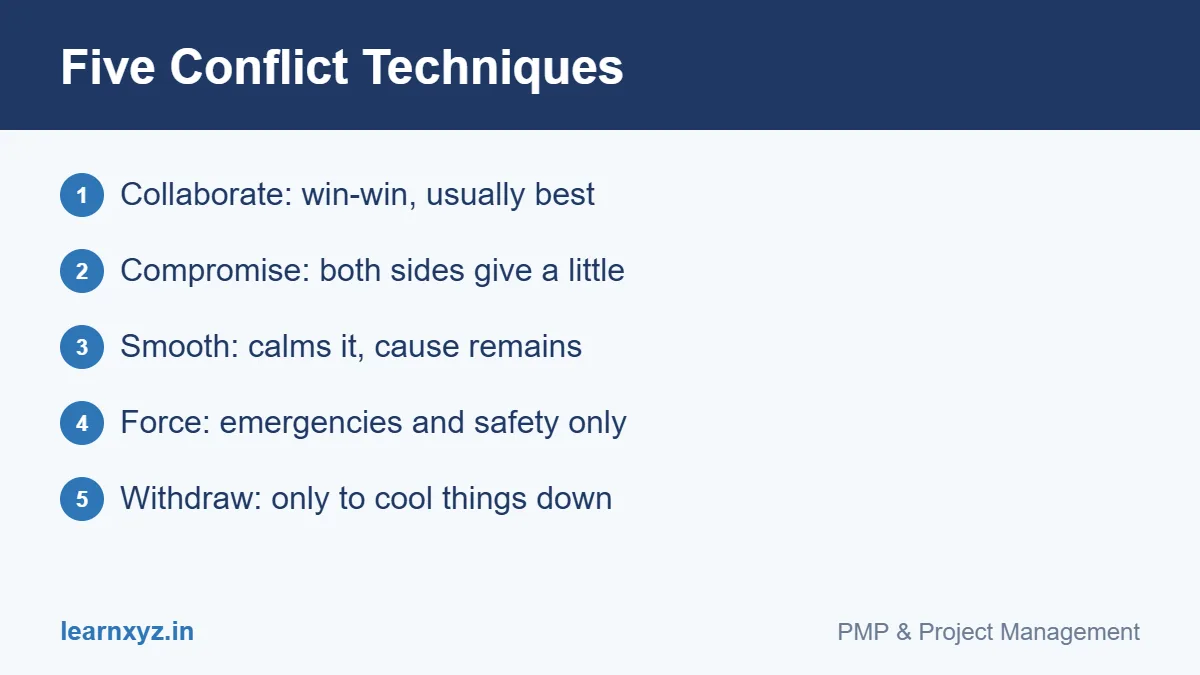
The five techniques
| Technique | Also called | What it looks like | When it fits |
|---|---|---|---|
| Collaborate | Problem solve | Both sides work together to find a solution that meets everyone’s needs | The best default when there is time and the issue matters |
| Compromise | Reconcile | Each side gives up something | Time is short and a partial solution is acceptable |
| Smooth | Accommodate | Play down the differences and stress what you agree on | Short-term calm, but the root cause stays |
| Force | Direct | One person’s view is imposed on the others | Emergencies, safety or legal issues |
| Withdraw | Avoid | Postpone the issue or step away | Tempers need to cool; rarely a final answer |
Most PMP trainers teach an order of preference: collaborate first, then compromise, then smooth, with force and withdraw at the bottom. That order matches how the exam tends to reward answers, even though it is a teaching rule and not an official ranking.
How to answer conflict questions
- Look for the root cause. Is it about priorities, resources, a technical opinion or personalities?
- Start with the people involved. Talk to them directly, usually in private, before bringing in anyone else.
- Aim for a win-win. Choose answers where both sides help solve the problem.
- Escalate only after you have tried the steps above, or when the issue is beyond your authority.
Quick test: if an answer has the project manager making a ruling, ignoring the issue or reporting people to the sponsor straight away, it is probably not the best choice. Answers where the PM brings people together to solve it tend to win.
Three short examples
Example 1. Two senior developers disagree about a design approach and the debate is slowing the sprint. The best move is to bring both together, look at the facts and the pros and cons, and agree on an approach. That is collaboration. Picking one view yourself would be force, and telling them to stop arguing would be withdrawing.
Example 2. A release is two hours away. Testers and developers disagree about shipping with a known cosmetic bug. A sensible answer is to ship, log the bug and fix it in the next release. Each side gets part of what it wants, so that is a compromise.
Example 3. Production is down and two engineers argue about who should fix it. Here the PM should simply assign an owner now and review the reasons afterwards. In a real emergency, a direct decision is the right call.
Conflict is normal
Conflict is not a sign that the team is failing. Most teams meet it during the storming stage of team development. Handled well, it leads to better decisions. The PM’s job is to keep the discussion about the problem and not about the person. Common sources include schedules, priorities, resources, technical opinions and personalities.
Mistakes to avoid
- Choosing smoothing because it sounds kind. It hides the problem instead of solving it.
- Escalating first. The exam expects you to try to resolve it with the people involved.
- Taking sides before you have heard everyone.
- Ignoring a conflict and hoping it fades. It rarely does.
For official exam details, see PMI’s PMP certification page.
Related reading
- Stakeholder Engagement in PMP: What the Exam Expects You to Know (2026)
- Scrum Roles for PMP: Product Owner, Scrum Master, Dev Team Explained
- PMP Situational Questions: How to Think the Way PMI Wants You To
- Resource Management in PMP: RACI, Responsibility Matrix and More
About the author: Rahul Dhakate is a PMP and PSM I certified project manager based in Nagpur, India, with 20 years of experience in software delivery. He writes at LearnXYZ.in about PMP exam prep and AI tools for project managers.