By Rahul Dhakate · PMP & PSM I Certified · 8 June 2026 · learnxyz.in
There is a moment that almost every PMP candidate experiences during exam preparation: you answer a practice question based on what you would genuinely do in that situation, feel confident, and then discover you got it wrong. The correct answer is something you would never actually do in a real organisation.
This moment is frustrating. It is also one of the most important learning opportunities in your entire preparation. It tells you that you are still thinking like a practitioner — and the exam needs you to think like PMI.
I experienced this myself. Real-world instinct and PMI framework do not always align. But here is what I found: the more deeply I worked through the PMBOK Guide and understood the principles behind the processes, the more natural the PMI way of thinking became. It is a genuine mental shift — and it is achievable.
What the PMI Mindset Actually Is
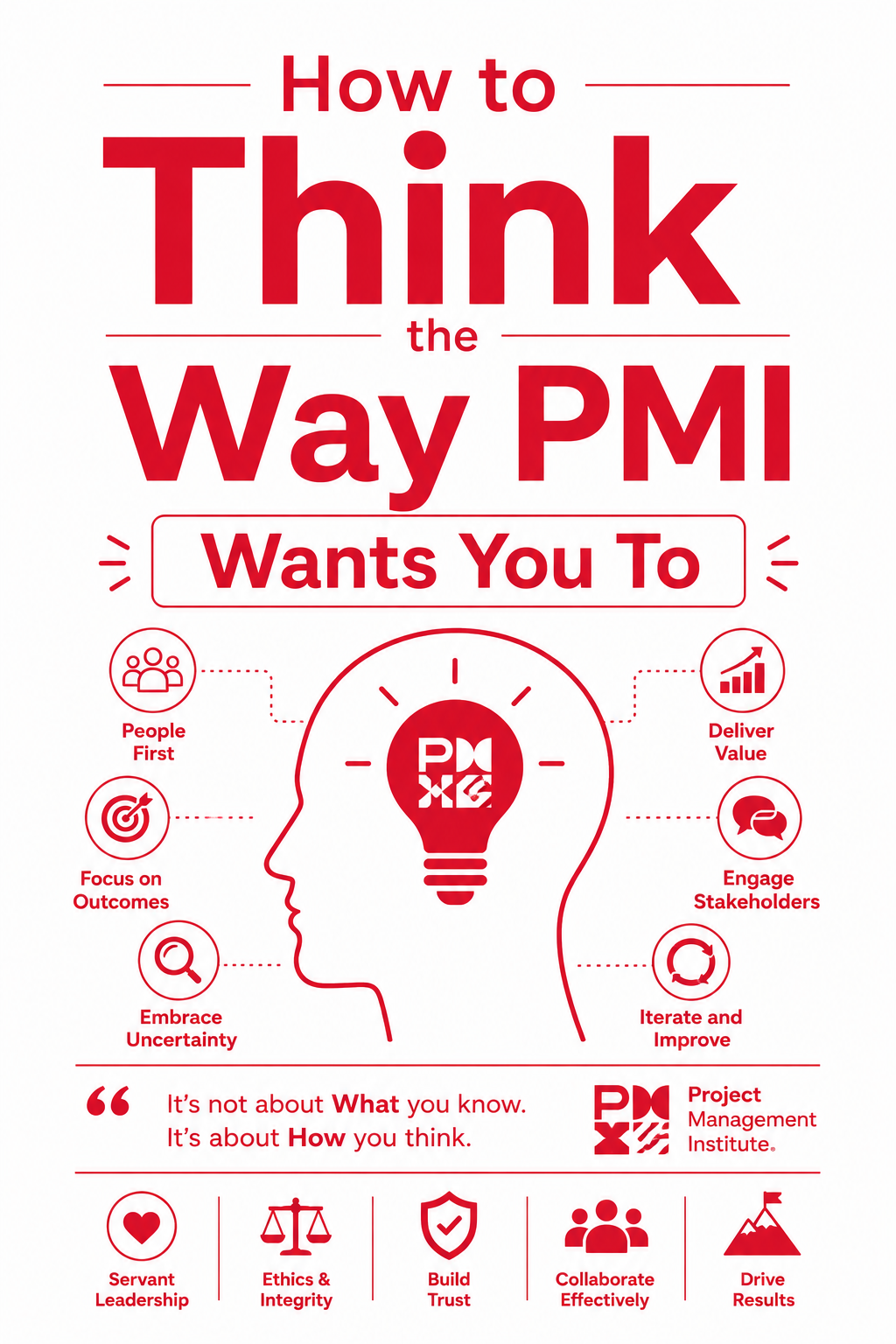
The PMI mindset is a specific, principled way of approaching project management decisions. It is not random or arbitrary — it is built on a coherent set of values that run through everything PMI publishes. Once you understand those values, the correct answer to most situational questions becomes logical rather than memorised.
The five core values of the PMI mindset:
| PMI Value | What It Means | Exam Implication |
| Proactive communication | Address problems early and transparently. Never bury bad news. | When in doubt — communicate. Immediately. To the right people. |
| Follow the process | PMI has a process for everything. Use it. Do not improvise. | Change control, risk registers, stakeholder plans — follow them even when it feels bureaucratic |
| Stakeholder focus | The project exists to deliver value to stakeholders. Their needs drive decisions. | When stakeholders have concerns — address them. Do not dismiss or defer. |
| Team empowerment | Teams are professionals. Trust them. Do not micromanage. | The PM creates conditions for success — does not direct every task |
| Ethics and accountability | PMs are accountable. They own problems and solutions. | The PM does not blame others. They own the outcome and take action. |
The PMBOK Guide Is the Real Treasure
I want to share something I genuinely believe after going through this process: the PMBOK Guide is not just an exam preparation document. It is a framework that changes how you think about project management work. I found that roughly 80% of the time, the PMBOK principles I studied for the exam were directly applicable to my day-to-day project management activities.
Reading the PMBOK for the exam and reading it to become a better project manager are the same thing. The people who find the exam most difficult are often those who approach it as a memorisation exercise. The people who find it most manageable are those who engage with the principles and understand why the framework is structured the way it is.
The PMBOK is a real treasure. Every aspect of the work is covered. It takes practice and study to internalise — but once you do, you start to see your real projects differently. That dual benefit — passing the exam and becoming a more effective PM — is what makes the PMP investment worthwhile.
The Most Common Real-World vs PMI Conflicts
Here are the specific situations where real-world experience most frequently produces wrong answers on the PMP exam:
| Real-World Instinct | PMI Correct Response | Why They Differ |
| Fix the problem first, then document it | Follow change control before implementing any change | PMI prioritises process integrity over speed of resolution |
| Tell the team to work overtime when behind schedule | Analyse the root cause of the delay and assess options with the sponsor | Rushing to action without analysis is not the PMI way |
| Accept a small scope addition without formal change | Evaluate all scope changes through change control regardless of size | Any change to scope, schedule, or cost requires formal assessment |
| Let conflicts between team members resolve themselves | Facilitate conflict resolution proactively — conflict is a PM responsibility | PMI views unresolved conflict as a project risk requiring PM action |
| Escalate a problem to the sponsor immediately | Try to resolve within your authority first. Escalate only when necessary. | Escalating too quickly signals poor PM capability in PMI’s view |
| Adjust the baseline to reflect reality | Maintain the original baseline. Track actual vs baseline. Report variance. | The baseline is the reference point — changing it destroys accountability |
The Mental Shift: From Practitioner to PMI Professional
The shift that helped me most was learning to ask a specific question when facing any exam scenario: what does the PMI framework say should happen here, regardless of what typically happens in real organisations?
This question creates the necessary separation between your experience and the exam. It is not that your real-world judgment is wrong — in most cases it reflects genuinely good PM practice. It is that the exam is testing a specific framework, and that framework has specific prescribed responses.
Three practices that accelerate this mental shift:
- Read the PMBOK Guide actively — not as a textbook to memorise but as a framework to understand. Ask yourself why each process exists and what problem it solves. When you understand the purpose, the prescribed responses become logical.
- Review every wrong practice question answer thoroughly — not just noting that you were wrong, but understanding which PMI principle the correct answer reflects. Over time you build an intuition for the PMI way of thinking.
- Practice introspection during questions — before selecting an answer, ask: am I answering this from my real experience, or from the PMI framework? If the two conflict, the exam wants the framework answer.
The Formula for Situational Questions
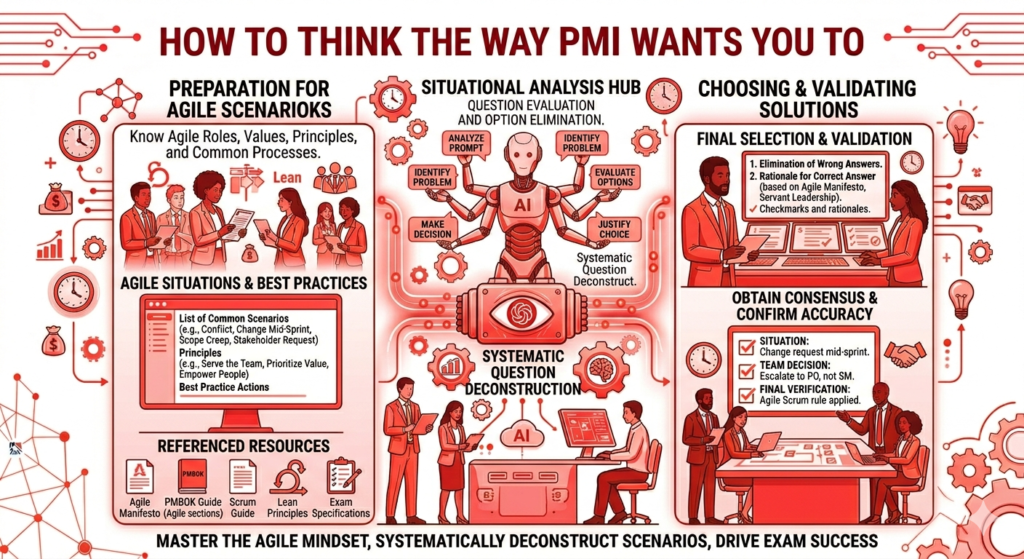
When you encounter any situational question — Agile or predictive — apply this decision sequence:
- Read the full question twice. Identify exactly what is being asked. Is it asking what to do first? What to do next? What the PM should do? These are different questions with potentially different answers.
- Identify the domain: is this a People, Process, or Business Environment scenario? This tells you which PMI values are most relevant.
- Eliminate obviously wrong answers: options that involve skipping process, ignoring stakeholders, or blaming others are almost never correct.
- Between the remaining options, choose the most proactive, process-correct, stakeholder-focused answer. When two answers both seem right — the one that involves more communication, more transparency, or more adherence to the framework is almost always the better choice.
The exam rewards the thoughtful, principled project manager — not the experienced one who has learned to navigate organisational shortcuts. Channel your inner ideal PM for the three hours and fifty minutes of the exam. Your real-world pragmatism can come back afterwards.
About the Author:

Rahul Dhakate is a PMP and PSM I certified project manager and product management leader based in Nagpur, India, with 20 years of experience managing software projects across BFSI, eCommerce, and enterprise software. He passed the PMP exam and found that deeply engaging with the PMBOK Guide not only helped him pass but changed how he approached real project management decisions — finding the framework applicable to approximately 80% of day-to-day PM activities. He writes at LearnXYZ.in to help working professionals pass the PMP exam and build modern project management careers.
Read our technical article