By Rahul Dhakate · PMP Certified · 22 May 2026 · learnxyz.in
Resource management is one of the knowledge areas that every project manager deals with every single day — and yet it is often underestimated on the PMP exam because candidates assume it is just about assigning people to tasks.
PMI’s framework for resource management is broader and more nuanced than that. It covers how you plan for resources, how you acquire them, how you develop the team’s capability, and how you manage both the people and the physical resources throughout the project lifecycle. The RACI matrix — the most tested tool in this area — is just one component of a larger picture.
I want to start with the reality of managing large, distributed teams, because my experience at Wipro fundamentally shaped how I think about resource management at scale.
Table of Contents
Resource Management in PMP: RACI, Responsibility Matrix and More
Managing Resources at Scale: The Wipro Experience
The RACI Matrix — How It Works
A sample RACI matrix for a software project sprint
Resource Acquisition — Internal vs External
Team Development — Tuckman’s Model
Resource Levelling and Resource Smoothing.
How Resource Management Is Tested on the Exam..
Managing Resources at Scale: The Wipro Experience
At Wipro, my role as Delivery Manager gave me responsibility for a programme of over 70 team members. Each client workstream was led by its own project manager, who was responsible for their development team and QA team. My role was not to manage individual tasks — it was to manage the managers, ensure delivery standards were consistent across all workstreams, and handle cross-project resource allocation when priorities shifted.
The RACI matrix was not an optional document in that environment — it was essential. With 70+ people across multiple client projects, development teams, QA teams, and business analysis functions, ambiguity about who was responsible for what created immediate problems. A developer who was unsure whether they reported to the development lead or the project manager for a given deliverable was a developer who might receive conflicting instructions. A QA engineer who did not know whether the project manager or the QA lead was accountable for sign-off might delay a release waiting for the wrong person’s approval.
The RACI matrix eliminated that ambiguity. Every significant deliverable, every key activity, every decision point had clearly defined Responsible, Accountable, Consulted, and Informed parties. In meetings and status updates, it served as the shared reference that kept everyone aligned on who owned what.
In smaller project environments — where I owned both the development and QA teams as the sole project manager — the approach was different but the principle was the same. I worked closely with each team member, ensuring that during each sprint, every developer knew exactly what they were building and every QA engineer knew exactly what they were testing. Clarity of responsibility at the individual level is resource management at its most practical.
The Resource Management Plan
The Resource Management Plan is created during the Plan Resource Management process. It documents:
- How resources will be identified, acquired, managed, and released
- Roles and responsibilities — the RACI matrix and organisational charts
- Project organisation charts — who reports to whom
- Team development approach — how team capabilities will be built during the project
- Resource control methods — how resource utilisation will be tracked and managed
- Recognition and rewards plan — how team performance will be acknowledged
The RACI Matrix — How It Works
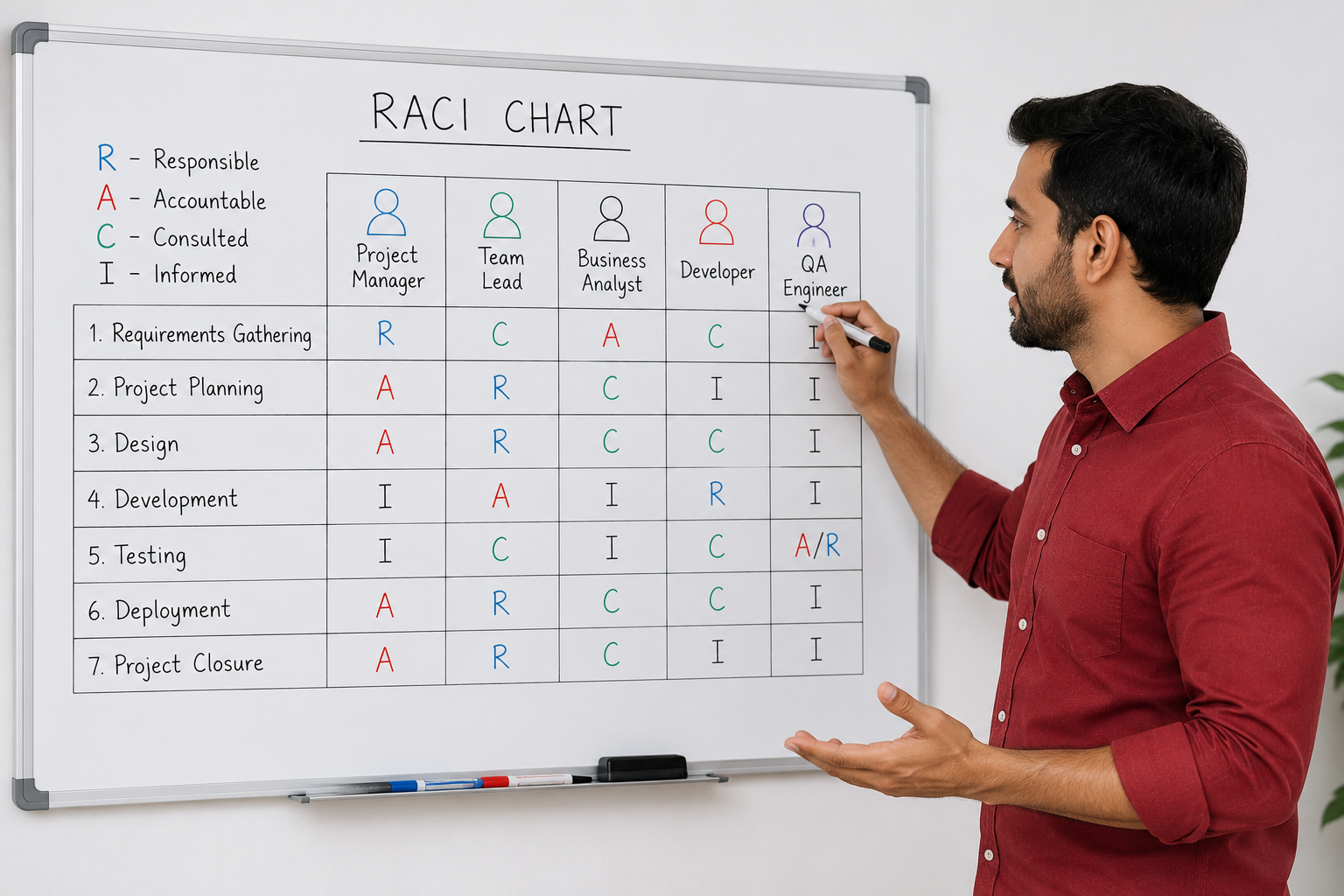
RACI stands for Responsible, Accountable, Consulted, and Informed. It is a Responsibility Assignment Matrix (RAM) — a tool that maps project roles and responsibilities to work packages or activities.
| Letter | Role | Definition | How Many Per Task? |
| R | Responsible | The person or people who do the actual work to complete the task | One or more — multiple people can be responsible |
| A | Accountable | The single person who is ultimately answerable for the correct completion of the task — the decision-maker | Exactly one — there must be one and only one A per task |
| C | Consulted | People whose input is sought before or during task completion — two-way communication | Zero or more — not every task needs consultees |
| I | Informed | People who are kept up to date on progress and outcomes — one-way communication | Zero or more — informed parties receive updates, not requests for input |
The single most important RACI rule: there must be exactly one Accountable person for every task. Multiple accountable parties means nobody is truly accountable. If a deliverable fails and two people are both marked as Accountable, each can point to the other. The RACI matrix eliminates this by forcing a single owner for every outcome.
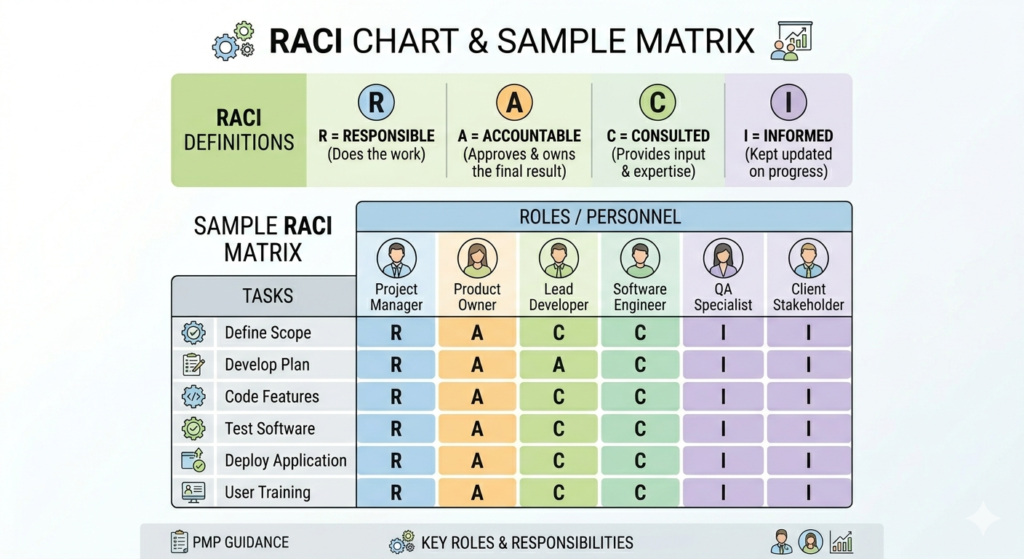
A sample RACI matrix for a software project sprint:
| Activity / Deliverable | PM | Dev Lead | Developer | QA Lead | BA |
| Sprint planning | A | C | R | C | C |
| Requirements definition | I | C | I | C | A/R |
| Feature development | I | A | R | I | C |
| Test case creation | I | C | C | A/R | C |
| Bug fix verification | I | I | R | A | I |
| Sprint review prep | A | R | R | R | R |
| Stakeholder demo | A/R | C | I | I | C |
| Release sign-off | A | I | I | R | I |
Read the RACI matrix column by column to check for gaps: if any column has a role with no A assignment anywhere, that person has work to do but nobody answering for outcomes — a gap. Read row by row to check for overload: if one person is Responsible for everything, you have a single point of failure.
Resource Acquisition — Internal vs External
Before you can manage resources, you need to acquire them. PMI distinguishes between two sources:
- Internal resources: Team members from within the organisation, assigned from functional departments or resource pools. The project manager may need to negotiate with functional managers for their time.
- External resources: Contractors, consultants, or vendors hired specifically for the project. These require procurement processes and contract management.
In matrix organisations — which are common in IT services companies including Wipro — project managers often do not have direct authority over the resources they need. Team members report functionally to their department heads and are assigned to projects by negotiation. This creates a classic challenge: the PM is responsible for delivery but does not have direct authority over the people doing the work.
Managing effectively in a matrix environment requires influence skills, clear expectation-setting, and the kind of communication structures we discussed in the previous article. The RACI matrix is particularly valuable here — it establishes accountability in writing, which helps when functional managers and project managers have different views of where a team member’s priorities should lie.
Team Development — Tuckman’s Model
PMI references Tuckman’s Ladder — a model of team development stages — in the resource management knowledge area. The PMP exam tests whether you know the stages and what they mean for how a project manager should manage the team.
| Stage | What’s Happening | PM’s Role |
| Forming | Team members are new to each other — polite, uncertain, testing boundaries. Little productive conflict. | Provide direction and structure. Set expectations clearly. Help people understand their roles. |
| Storming | Conflict emerges as team members assert themselves, challenge each other, and compete for position. Productivity drops temporarily. | Facilitate conflict resolution. Keep focus on goals. Don’t suppress conflict — it is necessary for the team to move forward. |
| Norming | Team establishes working norms, resolves conflicts, and begins to function cohesively. Trust develops. | Step back from directing. Enable collaboration. Reinforce positive team behaviours. |
| Performing | Team operates effectively and autonomously. High productivity, mutual trust, shared commitment to goals. | Delegate. Empower the team. Focus on removing external obstacles rather than internal management. |
| Adjourning | Project ends and the team disbands. Emotional response to dissolution of the group. | Recognise contributions. Facilitate knowledge transfer. Support team members’ transitions. |
In real projects, teams do not move linearly through these stages. Adding a new team member can regress a performing team back to storming. A significant scope change can create new norming requirements. Good project managers recognise these regressions and respond to them rather than assuming the team will naturally recover.
Resource Levelling and Resource Smoothing
Two scheduling techniques directly related to resource management appear on the PMP exam:
- Resource Levelling: Adjusting the project schedule to address resource constraints — typically by delaying tasks until the required resource is available. Resource levelling can extend the project end date. It prioritises resource availability over schedule.
- Resource Smoothing: Adjusting the schedule within the existing float of activities to avoid resource peaks — without extending the project end date. Resource smoothing prioritises the schedule but may not fully resolve resource conflicts.
PMP exam trap: Resource Levelling CAN change the critical path and extend the project end date. Resource Smoothing cannot extend the project end date — it only works within available float. When a question asks which technique can push out the project completion, the answer is resource levelling.
How Resource Management Is Tested on the Exam
- RACI questions: Who is the single Accountable person for a deliverable? Why can there be only one A? What happens if there is no A?
- Team development stage questions: A new team member joins a high-performing team and conflict re-emerges. What stage has the team regressed to? Storming.
- Resource conflict questions: Two critical tasks compete for the same resource. Which technique adjusts the schedule without extending the end date? Resource smoothing.
- Matrix organisation questions: A functional manager reassigns a key team member mid-project. What should the PM do? Negotiate with the functional manager, escalate to the sponsor if necessary, and update the resource management plan.
- Motivation theory questions: PMI references theories including Maslow’s Hierarchy, Herzberg’s Motivation-Hygiene Theory, McClelland’s Theory of Needs, and McGregor’s Theory X/Y. Know the basic premise of each.
For motivation theory questions, the key insight is that hygiene factors (salary, working conditions, job security) prevent dissatisfaction but do not create motivation. Motivators (achievement, recognition, growth, responsibility) create positive motivation. This is Herzberg’s key contribution — and it appears on the exam regularly in scenario questions about what a PM should do to improve team performance.
About the Author

Rahul Dhakate is a PMP-certified project manager and product management leader based in Nagpur, India, with 20 years of experience managing software projects across BFSI, eCommerce, and enterprise software. He managed teams ranging from small agile squads to a 70+ member programme at Wipro, applying RACI matrices, clear role definitions, and structured communication to maintain clarity of responsibility across complex distributed teams. He writes at LearnXYZ.in to help working professionals understand both the theory and real-world practice of project management.
Learn More, Learn Better