By Rahul Dhakate · PMP & PSM I Certified · 23 May 2026 · learnxyz.in
Few debates in software project management have generated more heat and less light than Agile versus Waterfall. Agile advocates describe Waterfall as a relic of the past — rigid, slow, and disconnected from how software is actually built. Waterfall defenders point to the discipline it imposes and the value of clear upfront planning in high-stakes environments.
After 20 years of managing software projects across both approaches — and across many real combinations of the two — my view is more nuanced than either camp typically admits. I am going to give you the honest answer, grounded in real experience, because that is what this site is for.
Contents
Agile vs Waterfall for Software Projects: A PMP Perspective.
The Honest Answer: Waterfall Delivered the Most Consistent Results — But Context Is Everything.
The Case for Agile in Software Projects.
Why Most Organisations Are Neither — They Are Hybrid.
Choosing Between Them — A Practical Framework.
What Happened When Methodology Was Chosen for Me.
The Honest Answer: Waterfall Delivered the Most Consistent Results — But Context Is Everything
Here is my direct experience: in environments where requirements were stable, regulatory compliance was mandatory, and the cost of getting something wrong was high — Waterfall delivered the most consistent, predictable results. My decade at Ebix Software managing SmartOffice CRM releases for BFSI clients is the clearest example. Insurance and wealth management software operates in heavily regulated environments. Requirements from regulators do not evolve iteratively. A feature either complies with the standard or it does not. In that context, the rigour of Waterfall — detailed upfront specification, formal review gates, documented test evidence — was not a limitation. It was the right tool for the job.
Waterfall also has a significant advantage that is rarely acknowledged honestly: it is easier to manage and predict. You know what you are building, when you are building it, and when it will be done. For project managers and for clients who need certainty — budget approvals, resource planning, contractual commitments — Waterfall provides a clarity that Agile genuinely struggles to match.
The honest limitation of Waterfall: it takes a long time to deliver value to end users. In a multi-year software project, users may wait 18 months or more to see the first working version of the system they requested. By then, the business environment has often changed enough that some of what was specified is no longer what they need. The feedback loop is too long.
Waterfall always delivered the best results in terms of predictability and compliance. But Agile is the right approach for the way most software is built today — and it ensures that working software reaches users faster, allowing them to give feedback and adjust direction before significant investment is locked in.
The Case for Agile in Software Projects
Agile’s core value proposition is speed to feedback. By delivering working software at the end of every sprint — typically every two weeks — Agile gives users and stakeholders something real to evaluate. They can say ‘this is not quite what we meant’ after two weeks, when a change is relatively cheap. In Waterfall, that same feedback arrives 18 months in, when a change may require rearchitecting a significant portion of the system.
For software projects where requirements are inherently uncertain — a new product for a new market, a digital transformation initiative with evolving business needs, or any project where the end state is genuinely not known at the start — Agile is not just preferable. It is the only rational approach. Building a complete specification for something you do not yet fully understand is an exercise in fiction.
In my experience across eCommerce platforms at Valethi Technologies and product work at Amla Commerce, Agile was the dominant framework — and it suited these environments well. Clients wanted to see features shipped. Product priorities shifted as the market responded. The ability to adapt the backlog between sprints and deliver incrementally was the right approach for that pace of change.
Agile also changed team culture in ways that Waterfall could not. Daily standups, retrospectives, and sprint reviews created transparency about progress, problems, and priorities that formal status reports rarely matched. Teams felt more ownership over their work. Problems surfaced faster. And the regular rhythm of delivery gave stakeholders visible confidence that the project was moving — rather than a long silence followed by a big reveal.
Why Most Organisations Are Neither — They Are Hybrid
The real-world pattern I observed across almost every organisation I worked in: companies adopted Agile terminology and some Agile practices without fully abandoning their Waterfall governance structures. They ran sprints but also had fixed release dates determined months in advance. They had product backlogs but also wrote detailed specifications before development began. They called it Agile, but it was hybrid.
This is not a failure. It is a pragmatic adaptation to organisational reality. Most companies operate with annual budgeting cycles, contractual commitments, regulatory reporting requirements, and executive stakeholders who need certainty. Pure Agile requires a level of flexibility in governance and planning that many organisations cannot practically achieve. The hybrid that emerges — Agile delivery within a Waterfall governance structure — is often the best achievable approach rather than a compromise of principle.
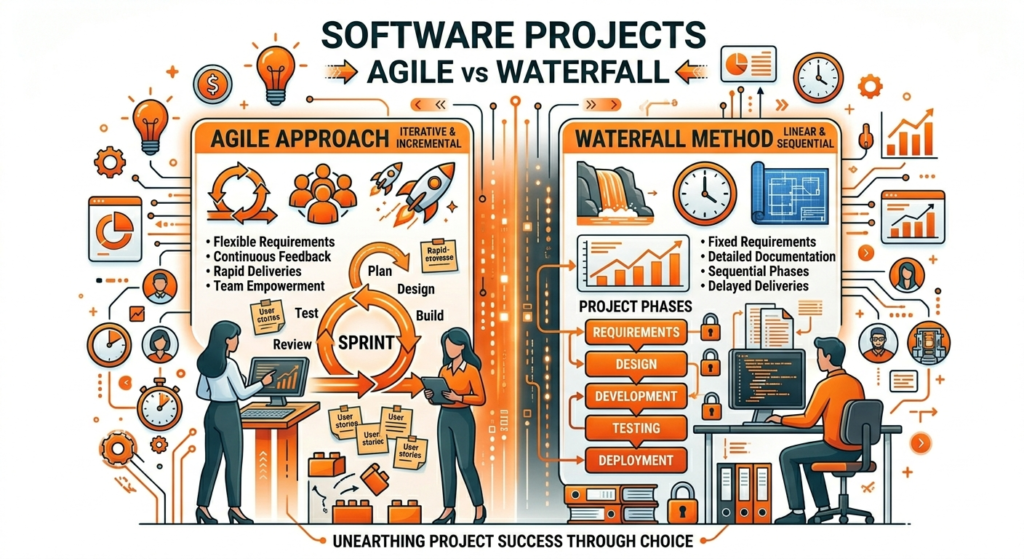
The PMP exam now reflects this reality. 50% Agile and 50% predictive content does not mean the exam expects you to choose one over the other. It expects you to understand both well enough to know when each approach — and which hybrid combinations — is appropriate for a given situation. That judgment is the mark of an experienced project manager.
Choosing Between Them — A Practical Framework
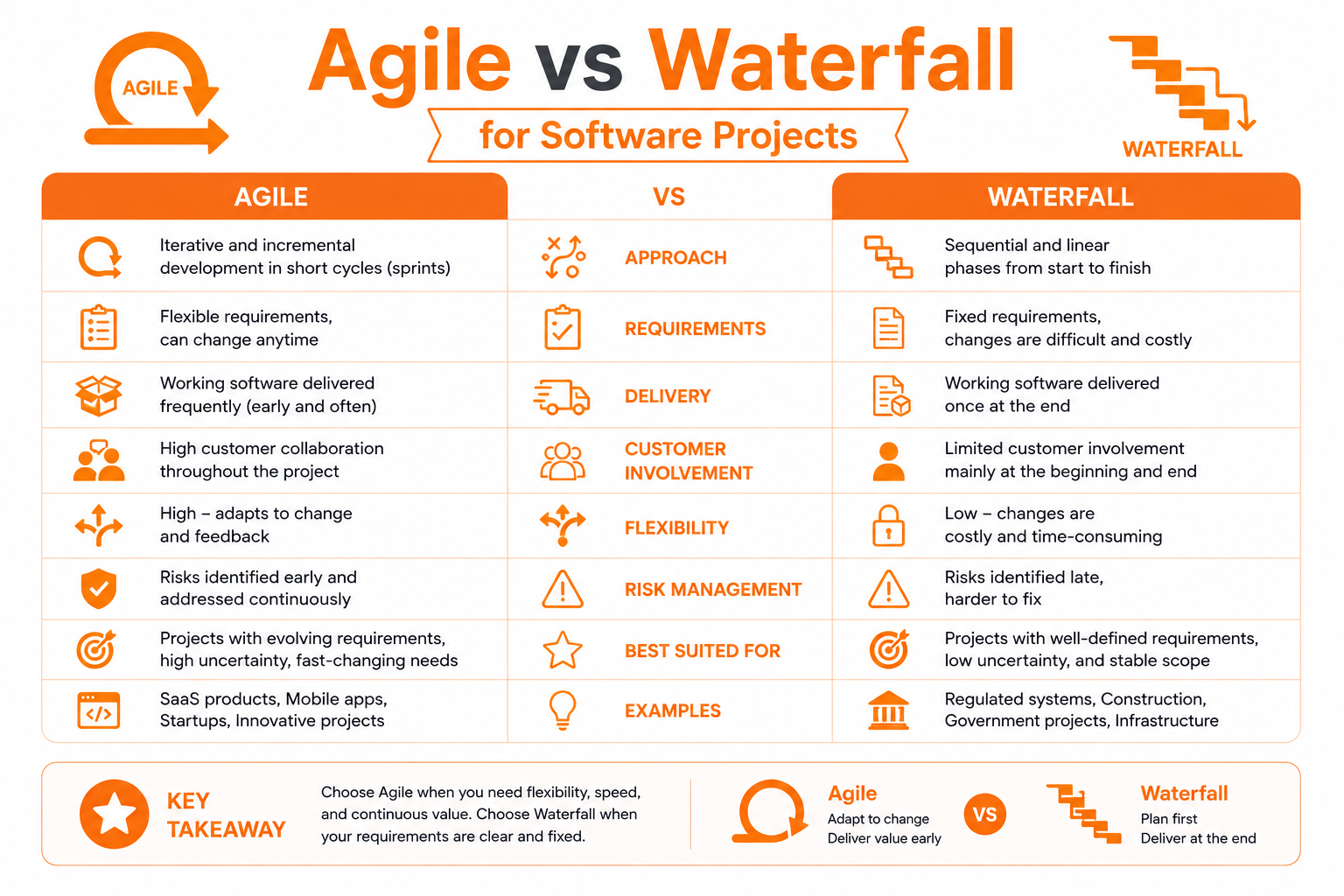
| Factor | Favours Waterfall | Favours Agile |
| Requirements clarity | Clear, stable, fully defined upfront | Evolving, uncertain, or expected to change |
| Regulatory environment | High regulation — compliance documentation required | Low to moderate regulation — flexibility is possible |
| Stakeholder availability | Limited — stakeholders available only at milestones | High — stakeholders can engage regularly each sprint |
| Team experience | Team is familiar with formal PM processes | Team is cross-functional and self-organising |
| Project duration | Long — 18 months or more | Short to medium — 3–12 months per release cycle |
| Risk tolerance | Low — cost of failure is high | Higher — iterative delivery limits the cost of any single mistake |
| Value of early delivery | Low — complete solution needed before value is realised | High — partial working software delivers early value |
| Contract type | Fixed price with defined scope | Time and material or flexible scope |
What Happened When Methodology Was Chosen for Me
Honestly, in most of the projects I worked on across my career, I inherited the methodology rather than choosing it. The framework was already in place when I joined a project — the team was already running sprints, or the project was already following a phase-gated Waterfall plan. My job was to manage excellently within that structure, not to redesign it.
This is the reality for most project managers, and it is worth stating plainly. Methodology selection is usually a company-level or client-level decision, not an individual PM’s decision. What differentiates good project managers is not choosing the right methodology — it is executing effectively within whatever methodology the project requires, understanding its strengths, managing around its weaknesses, and adapting pragmatically when the prescribed approach is not serving the project.
For the PMP exam: do not fall into the trap of thinking either Waterfall or Agile is universally superior. The correct PMI answer is always contextual — the right approach depends on the nature of the project, the stability of requirements, the stakeholder environment, and the level of uncertainty involved. Demonstrate that judgment in scenario questions and you will answer them correctly.
The Bottom Line
Waterfall is not dead — it is the right tool for a specific and important category of projects. Agile is not a silver bullet — it requires team discipline, stakeholder availability, and genuine willingness to adapt that not every organisation can provide. The most skilled project managers are fluent in both, honest about the limitations of each, and pragmatic about the hybrid reality of how most projects actually run.
That is the PMP perspective. And after 20 years, it is the real-world perspective too.
About the Author
Rahul Dhakate is a PMP and PSM I certified project manager and product management leader based in Nagpur, India, with 20 years of experience managing software projects across BFSI, eCommerce, and enterprise software. He managed software projects across both Waterfall (10 years in BFSI CRM) and Agile environments (eCommerce, healthcare, product development), giving him a balanced view of when each approach delivers and when it falls short. He writes at LearnXYZ.in to help working professionals understand both the theory and the real-world practice of project management.
Next Article: