By Rahul Dhakate · PMP & PSM I Certified · 12 July 2026 · learnxyz.in
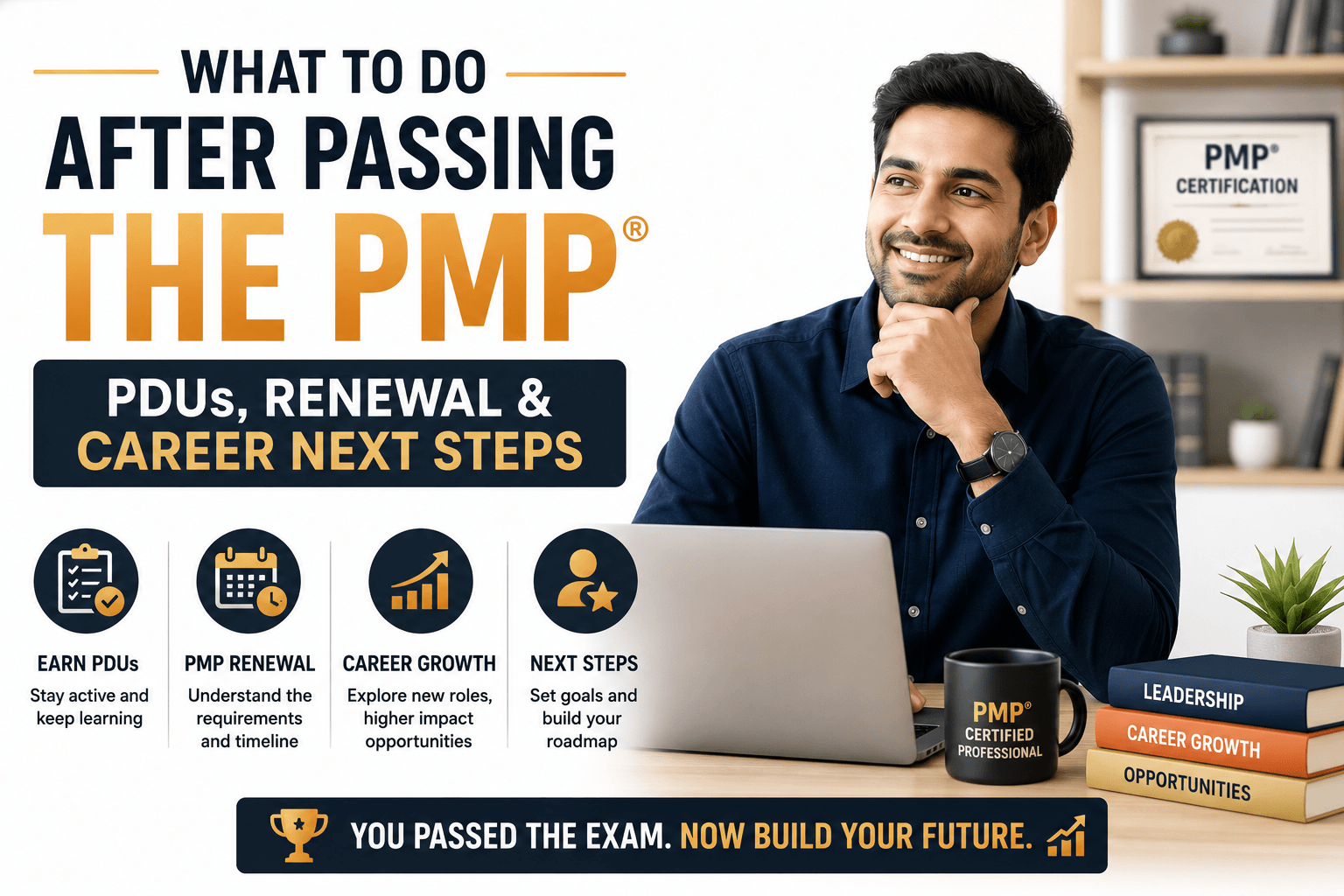
Passing the PMP exam is a genuine achievement — but it is the start of a new phase, not the finish line. What you do in the days and months immediately after passing determines whether the certification becomes a career asset or simply a line item on your resume that nobody notices.
This article covers exactly what to do after you pass: the immediate actions, the PDU requirements you now carry, and how to translate the credential into actual career momentum.
Table of Contents
The Immediate Actions — Do These First
Understanding Your New PDU Obligation.
How to Actually Earn PDUs — Real Methods.
Translating the Certification Into Career Growth.
The Immediate Actions — Do These First
Once you pass, you must communicate your achievement actively. This is not optional self-promotion — it is a necessary step that most newly certified PMs underestimate. Earning the certification and then not telling anyone defeats much of its career value.
- Update your LinkedIn profile immediately. Add the certification to your Licenses & Certifications section with the credential ID. Update your headline if it does not already reflect PMP status. Post about achieving the certification — a short, genuine post about your journey gets more engagement than you might expect and signals your achievement to your entire professional network.
- Update your resume across every platform — Naukri, LinkedIn, and any other job platforms you use. Add it prominently near the top, not buried in a certifications section at the bottom.
- Inform your employer formally. Even if your manager already knew you were preparing, a formal notification — email or in your next one-on-one — creates a documented record that can support compensation or promotion conversations.
- Update your email signature and any professional bios (company website, LinkedIn About section, conference speaker profiles) to include the credential.
Of course, communicating your achievement is exactly what you must do. Update your resume, update your professional contacts, and let people know about what you have earned. This is not boasting — it is making sure the investment you made translates into the recognition and opportunities it should.
Understanding Your New PDU Obligation
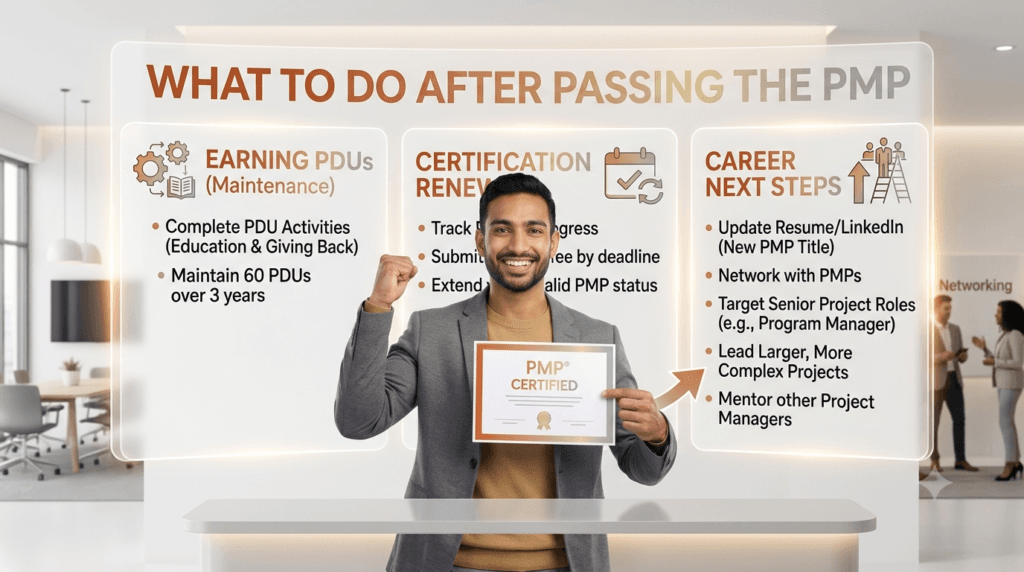
Passing the PMP starts a three-year certification cycle. Within that cycle, you must earn 60 Professional Development Units (PDUs) to maintain your certification. This is not optional — failure to earn sufficient PDUs results in your certification becoming inactive.
PDUs are split across two categories:
| Category | PDUs Required | What Counts |
| Education | 35 minimum | Courses, webinars, conferences, formal learning activities related to PM |
| Giving Back | 25 maximum (can be 0) | Working as a PM, volunteering, creating content, mentoring, speaking |
How to Actually Earn PDUs — Real Methods
There are multiple practical ways to accumulate PDUs, and most are more accessible than candidates initially realise:
- Join a local PMI chapter. Chapters run regular seminars, workshops, and networking events — most of which qualify for PDUs. This is one of the most straightforward and socially valuable ways to accumulate your education PDUs.
- Attend PMI webinars. PMI’s own platform offers a continuous stream of free webinars that count toward your education PDUs.
- Write and publish articles. Writing PM-related content — like the articles on this very site — and sharing it through recognised channels (LinkedIn, PMI community, your own blog when registered appropriately) can count toward giving-back PDUs. This involves logging your activity with PMI to keep your record updated.
- Continue working as a certified PM. Active practice of project management itself contributes toward your giving-back PDU category, up to the maximum allowed.
- Take additional courses. Udemy, Coursera, and LinkedIn Learning courses related to project management, Agile, or leadership typically qualify for education PDUs — check the course description for PDU eligibility.
- Mentor others. If you mentor junior project managers or PMP candidates — exactly the kind of mentorship that helped me through my own application — this activity can be logged for giving-back PDUs.
Do not wait until year two or three of your cycle to start earning PDUs. Spread the requirement across all three years — roughly 20 PDUs per year — so you are never facing a last-minute scramble before your renewal deadline.
The Renewal Process
At the end of your three-year cycle, you submit your accumulated PDUs through PMI’s Continuing Certification Requirements (CCR) system online. PMI members pay a reduced renewal fee (approximately $60 USD) compared to non-members (approximately $150 USD) — another reason maintaining PMI membership throughout your cycle makes financial sense.
PMI may audit your PDU claims, similar to how your initial application could be audited. Keep documentation of your activities — certificates of completion, screenshots of published articles, records of chapter event attendance — in case verification is requested.
Translating the Certification Into Career Growth
Having the certification is necessary but not sufficient for career advancement. Here is how to actively leverage it:
- Use it in performance review conversations. If your organisation ties promotions partly to credentials, explicitly reference your new certification when discussing your next role or compensation review.
- Target roles that list PMP as required or preferred. Your job search should now actively filter for and prioritise roles where the certification is recognised as a qualifying credential — these roles typically pay the salary premium associated with PMP holders.
- Build visible thought leadership. Writing about project management — as I have done extensively on this site — both earns PDUs and builds your professional reputation as someone who has moved beyond simply holding the credential to genuinely understanding and applying it.
- Network within the PM community. PMI chapters, LinkedIn PM groups, and industry events connect you with people who can open doors — both for new roles and for collaborative opportunities.
My Own Path After Passing
After passing, I did exactly what I am recommending here: updated my professional profiles, communicated the achievement to my network and employer, and began the PDU accumulation process through PMI chapter activities and online learning. Writing — which eventually led to building this site — became one of my primary PDU sources, alongside continued active practice as a project manager and product management leader.
The certification itself did not instantly transform my career. What it did was remove a barrier that had quietly been limiting how my contributions were recognised. Combined with continued delivery and active visibility, it became part of a broader professional growth trajectory rather than a single transformative event.
About the Author
Rahul Dhakate is a PMP and PSM I certified project manager and product management leader based in Nagpur, India, with 20 years of experience managing software projects across BFSI, eCommerce, and enterprise software. He earns ongoing PDUs through PMI chapter participation, continued professional practice, and writing — including the articles published on LearnXYZ.in, which contribute to his giving-back PDU category while helping other working professionals navigate their own PMP journeys. He writes at LearnXYZ.in to help working professionals pass the PMP exam and build modern project management careers.
Next Article


You actually make it seem so easy with your presentation but I find this topic to be actually something that I
think I would never understand. It seems too complicated and very broad for me.
I am looking forward for your next post, I will try to get the hang of it!
Heya i am for the first time here. I found this
board and I find It really useful & it helped me out
a lot. I hope to give something back and aid others like you helped me.
Its like you read my mind! You appear to know a lot about this, like you wrote the book in it or something.
I think that you could do with a few pics to drive the message home a bit, but other
than that, this is excellent blog. An excellent read.
I’ll certainly be back.
Thanks! Do come back again.
I couldn’t refrain from commenting. Very well written!
Thank you!
Howdy! I could have sworn I’ve been to this website before but after reading through some of the
post I realized it’s new to me. Anyhow, I’m definitely delighted I found it and I’ll be book-marking and checking back often!
Everyone loves what you guys are usually up too. This type of clever
work and exposure! Keep up the amazing works guys I’ve you guys to my personal blogroll.
Here is my web blog https://www.mail.com/
This post delivered a thoughtful explanation of the subject while browsing online and I look forward to reading more from you