By Rahul Dhakate · PMP & PSM I Certified · 09 Aug 2026 · learnxyz.in
This is a question that you being a Project Manager simply cant deny. Will you get replaced by A.I. ? Read on to understand my take on it. I published my personal opinion on this question in Article 56 of this series. My position was direct: AI could take on significant PM responsibilities within 1 to 2 years, and the timeline is shorter than most people in this profession are comfortable admitting.
This article approaches the same question differently. Instead of opinion, I want to show you the actual research — what Gartner, PMI, academic studies, and independent market analysis are finding in 2026. Then I will tell you what I think the data actually means, which is not the same conclusion most of those sources draw.
Index
Will AI Replace Project Managers? What the Data Says in 2026.
PMI Research: AI Teams Deliver Dramatically Better Results.
The 54% Administrative Time Problem..
Academic Research: Which Tasks Are Most at Risk.
The Emerging Hybrid Workforce.
What the Data Actually Tells Us — My Interpretation.
The Task Automation Breakdown — What Is Already Gone.
The Career Implication — What the Data Recommends.
The Key Research Findings
Gartner: 80% of PM Tasks Automated by 2030
The most widely cited data point in this discussion comes from Gartner’s research: by 2030, 80% of project management tasks will be handled by AI, powered by big data, machine learning, and natural language processing. This prediction has been repeated across the industry since it was first published.
What most articles miss when citing this figure: Gartner explicitly means tasks, not roles. The distinction is important. A project manager’s role consists of many tasks. If 80% of those tasks are automated, the role changes fundamentally — but a role still exists. The question is what that remaining 20% looks like, and whether it sustains the same number of jobs at the same compensation levels.
This is a critical nuance. 80% task automation by 2030 does not mean 80% of project managers are unemployed by 2030. It means 80% of what project managers currently do day-to-day will be handled differently. The remaining work becomes higher-value, higher-judgment, and arguably more important — not less.
PMI Research: AI Teams Deliver Dramatically Better Results
PMI’s AI Innovators study found that companies using AI-driven project management tools delivered 61% of projects on time, compared to 47% for teams not using AI. That is a 30% improvement in on-time delivery — one of the most significant performance differentials in project management research.
The same study found that only approximately 20% of project managers currently have extensive or good practical knowledge of AI tools. This creates an immediate, measurable skills gap — and an opportunity for project managers who develop AI fluency now while the majority have not yet done so.
PMI’s data is unambiguous: AI-using PM teams significantly outperform non-AI teams. This means AI adoption is not just a career protection strategy — it is a performance strategy. The question for every working PM is not whether AI will affect the role, but whether they will be on the 61% side or the 47% side of project delivery outcomes.
The 54% Administrative Time Problem
Independent research in 2026 found that project managers spend up to 54% of their work week on administrative tasks: status updates, meeting notes, schedule adjustments, risk logs, and reporting. More than half of a PM’s working week is on work that does not directly move projects forward.
This is the most important single data point for understanding the AI impact on project management. Every hour spent on administrative work is an hour not spent on stakeholder management, team development, problem-solving, and strategic decision-making — the genuinely high-value PM activities that require human judgment. AI tools available today can handle the 54% administrative layer almost entirely. That is not a future prediction. That is a current capability.
Academic Research: Which Tasks Are Most at Risk
A peer-reviewed study published in late 2025 gathered insights from 32 experienced project managers across five industries and six European countries, using the Nominal Group Technique to identify which PM activities AI was most likely to replace, transform, or leave unchanged.
The findings: administrative coordination tasks (scheduling, reporting, documentation) were rated most susceptible to AI replacement. Strategic and relationship-based activities — stakeholder conflict resolution, team motivation, executive communication, ethical decision-making — were consistently rated as remaining human responsibilities, at least for the near term. The study concluded that while AI would not cause a collapse of the project manager profession, it would significantly transform many of the currently examined activities.
The Emerging Hybrid Workforce
APM (Association for Project Management) research published in early 2026 described the most significant shift for project managers in 2026 as the emergence of a hybrid human-AI workforce — not a replacement scenario, but a collaboration scenario where autonomous AI systems manage entire workflows within defined parameters while humans manage the exceptions, the relationships, and the strategic direction.
What the Data Actually Tells Us — My Interpretation
Here is where I differ from most commentators who cite the same research: I think the mainstream interpretation — AI will not replace project managers, it will just change the role — is correct in its conclusion but dangerously complacent about the timeline and the magnitude of change.
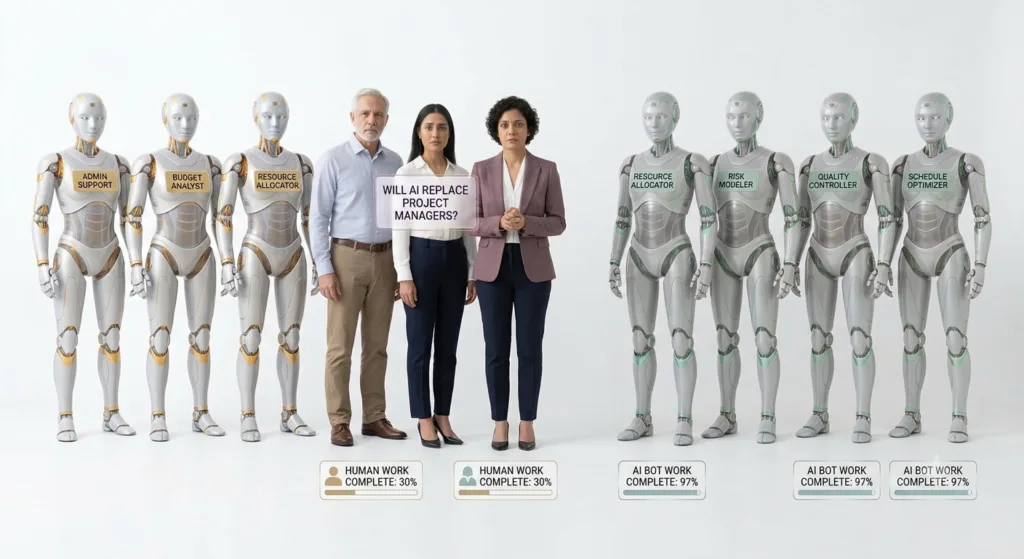
The data shows that 54% of current PM work is administrative and already automatable by tools shipping today. It shows that 80% of PM tasks will be automatable by 2030 — which is only four years away. It shows that AI-using teams already deliver 30% better outcomes than non-AI teams. And it shows that 80% of PMs still do not have strong AI tool knowledge.
The data does not say project managers will be replaced. It says the project manager who does not adopt AI will be replaced — by a project manager who has. That is a meaningful distinction. But the window for making that shift is shorter than most professional development timelines assume. The 1 to 2 year horizon I described in Article 56 refers not to job elimination but to when AI-fluent PMs will have a decisive performance and employability advantage over non-fluent ones. That advantage is already visible in the delivery data.
The Task Automation Breakdown — What Is Already Gone
| Task Category | Current AI Capability | Timeline |
| Status report generation | Fully automated by ClickUp Brain, Monday AI, Wrike AI | Now |
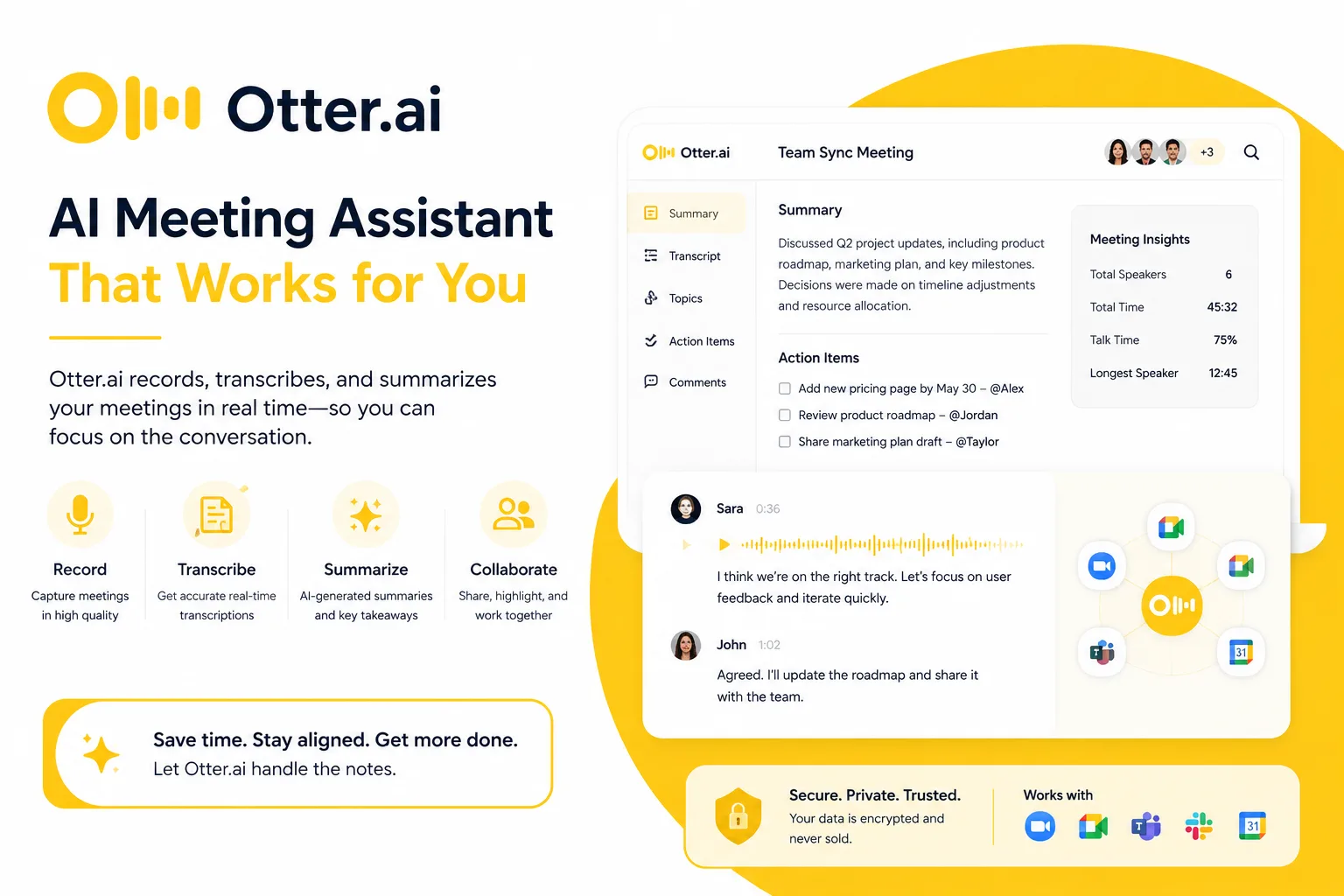
| Meeting transcription and action items | Fully automated by Fathom, Fireflies, Otter.ai | Now |
| Risk identification and flagging | Automated by Wrike AI Agents (launched Feb 2026) | Now |
| Schedule optimisation and resource levelling | Automated by AI scheduling tools | Now |
| Stakeholder communication drafts | AI-assisted, human-reviewed | Now |
| Dependency conflict detection | Automated in ClickUp, Wrike | Now |
| Budget variance analysis | Automated EVM in most PM platforms | Now |
| Stakeholder relationship management | Human only — AI cannot build trust | 2028-2030+ |
| Strategic decision-making under ambiguity | Human only — judgment required | 2028-2030+ |
| Team conflict resolution | Human only — emotional intelligence required | 2028-2030+ |
| Organisational politics navigation | Human only — deeply context-dependent | Indefinite |
The Career Implication — What the Data Recommends
Every piece of research points to the same practical implication: the project managers who thrive in the AI era are those who shift their personal productivity model from doing administrative PM work to overseeing AI-managed administrative work, freeing their human judgment for higher-value activities.
Concretely, this means:
- Adopt at least one AI PM tool seriously in the next 6 months — not experimentally, but as a genuine replacement for manual administrative processes
- Develop explicit AI fluency as a professional skill — understand what current tools can and cannot do, and be able to demonstrate that understanding to employers
- Invest disproportionately in the human skills AI cannot replicate: stakeholder management, conflict resolution, strategic thinking, and communication
- Position yourself as an AI-enabled PM rather than a traditional PM — the salary premium for the former is already visible in 2026 job market data
The PMI research is the most actionable single data point here: AI-using PM teams deliver 61% on time versus 47% for non-AI teams. That differential represents approximately 30% better delivery performance. In an industry where on-time delivery is the primary measure of PM success, a 30% improvement from AI adoption is not optional — it is competitive necessity.
About the Author
Rahul Dhakate is a PMP and PSM I certified project manager and product management leader based in Nagpur, India, with 20 years of experience managing software projects across BFSI, eCommerce, and enterprise software. He writes about both PMP exam preparation and AI tools for project managers at LearnXYZ.in, believing the combination of certified PM expertise and AI fluency represents the strongest career position available to project management professionals in 2026. He writes at LearnXYZ.in about PMP exam prep and AI tools for modern project managers.
Awesome reads: