By Rahul Dhakate · PMP & PSM I Certified · 26 May 2026 · learnxyz.in
Risk management has always been one of the most important — and most neglected — aspects of project management. In practice, risk registers are often created at project initiation, presented at a steering committee meeting, and then forgotten until something goes wrong. By the time a risk materialises into an issue, it is too late for the register to help.
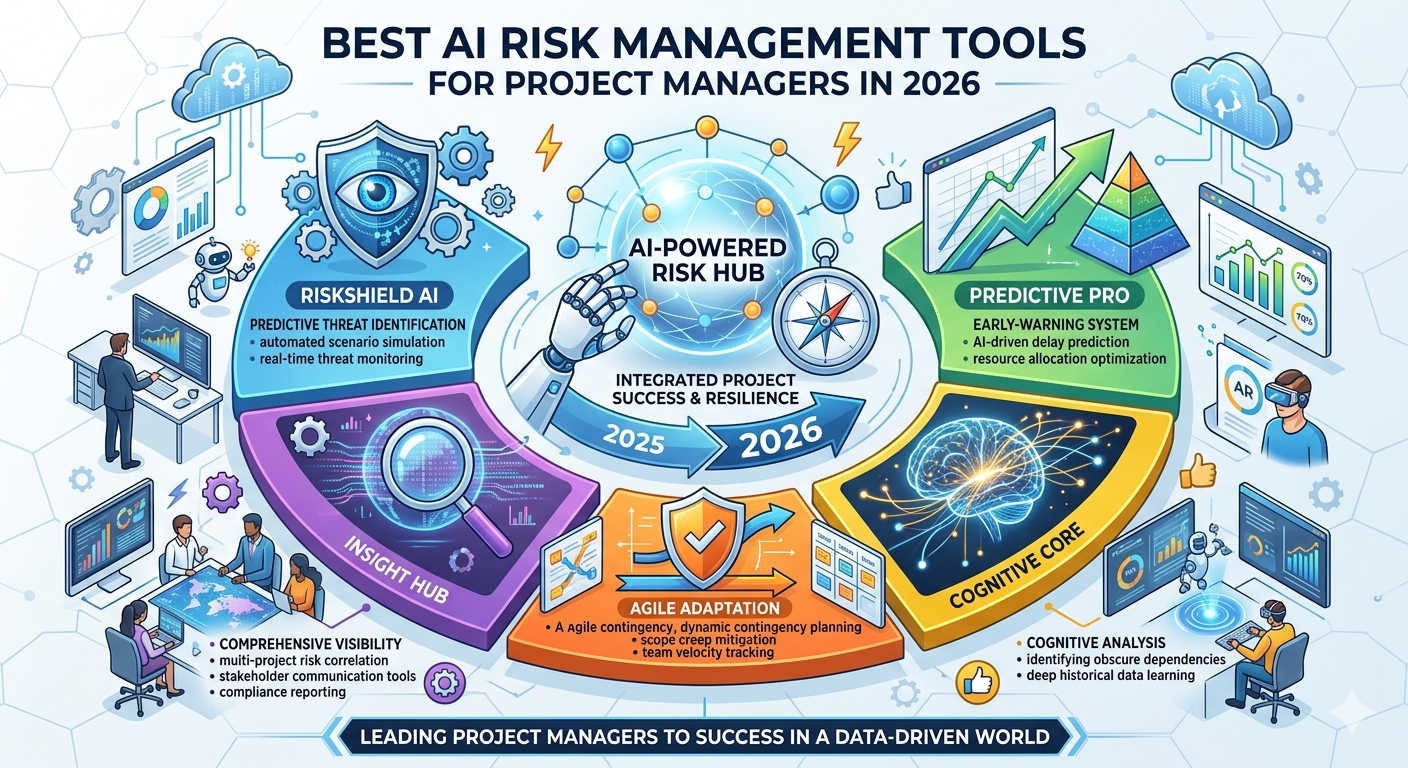
AI is changing this fundamentally. The most advanced AI risk management tools in 2026 do not just store risks — they predict them. By analysing task dependency patterns, team velocity, resource utilisation, and historical project data, these tools can flag potential risks before they become visible to the project manager’s eye.
Table of Contents
What AI Risk Management Actually Does in 2026.
Tool 1: Wrike — The Most Advanced AI Risk Intelligence
Tool 2: ClickUp Brain — Best Value Risk Flagging.
Tool 3: Zoho Projects with Zia AI — Best for Zoho Ecosystem Teams.
AI Risk Management Beyond Platforms: ChatGPT as a Risk Thinking Partner
The Honest State of AI Risk Management in 2026.
From my experience managing complex software projects with distributed teams — including the Barcelona API situation I described in Article 14 — the value of early risk detection is enormous. Had an AI tool flagged the API dependency risk based on the team’s geographic distribution and the critical path dependency, we might have activated our mitigation strategy two weeks earlier. That kind of proactive signal is what the best AI risk tools now provide.
What AI Risk Management Actually Does in 2026
Current AI risk management capabilities fall into four categories:
- Predictive risk identification: AI analyses task patterns, dependency chains, team workload, and historical project data to predict which risks are most likely to materialise before they are visible
- Automated risk scoring: AI calculates risk probability and impact continuously as project data changes — not just at initiation when your risk register was last updated
- Early warning alerts: AI sends notifications when project metrics — velocity decline, overdue tasks accumulating, budget variance growing — reach thresholds that historically correlate with project delays
- Risk response suggestions: AI recommends mitigation strategies based on the risk type and the organisation’s historical responses to similar risks
The most transformative capability is predictive risk identification. Gartner research indicates that large IT projects run 45% over budget on average. McKinsey data shows schedule overruns of 7% are typical. AI risk tools trained on historical project failure patterns can flag the specific combinations of factors that precede these failures — and they can do it weeks before the PM would notice through manual tracking.
Tool 1: Wrike — The Most Advanced AI Risk Intelligence
| Wrike — Enterprise-grade AI risk prediction via Knowledge Graph | |
| Tool | Wrike |
| Best For | Enterprise delivery teams, programme managers, regulated industries needing governance + AI |
| Pricing | Team plan from $9.80/user/month. Business and Enterprise plans with full AI. AI included in all paid plans — no add-on fee. |
| Affiliate Program | Affiliate program available via Wrike’s partner network |
| Our Rating | ★★★★★ — 3x consecutive Gartner Leader in CWM. 60% competitive win rate in enterprise PM. |
Wrike has the most sophisticated AI risk capability in the project management market in 2026. Its Knowledge Graph uses machine learning to analyse project data and forecast delays before they happen — surfacing risks from dependency patterns, resource constraints, and velocity trends that a project manager reviewing their Gantt chart manually would not detect.
In February 2026, Wrike launched AI Agents — autonomous capabilities that include a dedicated Risk Agent. The Risk Agent monitors project data continuously, identifies emerging risks, and can take multi-step actions in response: flagging the risk to the PM, updating the risk register, and suggesting mitigation actions — all without manual prompting.
Wrike Copilot acts as a real-time AI teammate during project work — answering questions about project data in natural language (‘What tasks are at risk of missing this sprint?’) and generating summaries, risk reports, and update drafts on demand.
For project managers in regulated industries — BFSI, healthcare, government — Wrike’s enterprise security credentials are significant: SOC 2 Type II, ISO 27001/27017/27018/27701, and HIPAA compliance. The AI operates within your organisation’s data boundary, not on shared training data.
Wrike is the strongest choice for programme managers and delivery leads managing complex, multi-project portfolios where early risk detection has the highest business value. Its pricing reflects the enterprise positioning — it is not the tool for a solo PM running small projects.
Tool 2: ClickUp Brain — Best Value Risk Flagging
| ClickUp Brain — AI risk flagging built into your core PM platform | |
| Tool | ClickUp Brain |
| Best For | Teams already using ClickUp who want AI risk insights without a separate tool |
| Pricing | Included in all ClickUp paid plans from $7/user/month. No add-on fee. |
| Affiliate Program | 20% recurring commission on ClickUp referrals |
| Our Rating | ★★★★☆ — Strong value, less sophisticated than Wrike’s dedicated risk engine |
ClickUp Brain’s risk capability is less specialised than Wrike’s but meaningful for day-to-day project management. It identifies bottlenecks based on task dependency patterns, flags overdue tasks that are blocking other work, and surfaces resource conflicts based on team member workload. For project managers managing software sprints and product backlogs, these signals cover the most common risk scenarios.
The integration advantage: because ClickUp Brain operates within your existing ClickUp workspace, there is no data migration, no additional tool to learn, and no extra login. Risk insights appear within the context of your actual project work — in the same view where you are managing tasks. This integration makes the risk signals more actionable than alerts from a separate risk tool.
Tool 3: Zoho Projects with Zia AI — Best for Zoho Ecosystem Teams
| Zoho Projects + Zia — Predictive risk scoring within the Zoho ecosystem | |
| Tool | Zoho Projects + Zia |
| Best For | Teams using Zoho CRM, Zoho People, or other Zoho products who want integrated AI PM |
| Pricing | From $4/user/month (Premium). Zia AI included. Enterprise from $9/user/month. |
| Affiliate Program | Zoho affiliate program available — competitive commission structure |
| Our Rating | ★★★★☆ — Strong predictive risk and forecasting; best-in-class Zoho integration |
Zoho Projects with Zia AI offers predictive risk scoring and project forecasting that rivals more expensive tools. Zia is Zoho’s in-house AI model (1.3B–7B parameters) — importantly, it runs with regional data residency and no third-party data sharing, making it attractive for organisations with strict data governance requirements.
For teams already embedded in the Zoho ecosystem — using Zoho CRM, Zoho People, Zoho Books — Zoho Projects is the natural choice. The cross-product data integration means Zia can draw on client data, team capacity data, and financial data simultaneously when assessing project risk, producing more contextually rich risk assessments than tools operating on project data alone.
AI Risk Management Beyond Platforms: ChatGPT as a Risk Thinking Partner
One AI risk management capability that every project manager can use today, regardless of which platform they are on, is using ChatGPT as a structured risk thinking partner.
The prompt that produces the most useful results:
“I am managing a [type] project with [team size] members across [locations]. The project involves [brief description]. Key dependencies include [list]. The project is [on track / X weeks behind]. What are the top 5 risks I should be actively monitoring, and what mitigation strategies would you recommend for each?”
This prompt produces a structured risk analysis based on the project context you provide. It will not have access to your actual project data — that is what the platform tools above provide — but it gives you a structured starting point for a risk review that you can then validate against your project’s specific situation.
Combined with your platform’s automated risk flagging, ChatGPT’s structured risk thinking represents a genuinely powerful dual-layer risk management approach that requires no additional tooling budget beyond a ChatGPT Plus subscription at $20/month.
The Honest State of AI Risk Management in 2026
AI risk management tools in 2026 are genuinely valuable — but they are not magic. They work best when:
- Your project data is accurate and up-to-date — AI predicts based on the data it sees, and outdated task statuses produce misleading risk signals
- Your team uses the PM platform consistently — the AI learns from patterns, and irregular platform use creates gaps in the pattern data
- You treat AI risk alerts as inputs to your judgment, not as directives — the AI can flag a statistical risk pattern, but you decide whether the context makes it a real concern
AI risk tools reduce the probability of risk surprises. They do not eliminate the need for a project manager who understands the project’s context, the stakeholders’ expectations, and the team’s actual capability. That judgment layer is irreplaceable. AI handles the data surveillance. You handle the human intelligence.
About the Author

Rahul Dhakate is a PMP and PSM I certified project manager and product management leader based in Nagpur, India, with 20 years of experience managing software projects across BFSI, eCommerce, and enterprise software. He managed risk registers across complex multi-geography projects, including situations where API delivery dependencies from distributed teams created cascading risks — exactly the type of early warning that AI risk tools are now designed to surface. He writes at LearnXYZ.in about PMP exam prep, project management, and AI tools for modern project managers.
Good Reads: