
By Rahul Dhakate · PMP Certified · 21 May 2026 · learnxyz.in
A common statistic in project management — one that PMI cites and that practitioners echo — is that project managers spend approximately 90% of their time communicating. Whether or not that exact figure holds in every context, the underlying truth is clear: communication is the dominant activity of project management. Not planning, not risk management, not scheduling — communication.
And yet communication management is one of the topics that PMP candidates study least thoroughly, because it seems intuitive. Everybody communicates. What is there to learn?
Quite a lot, as it turns out — both for the exam and for real project delivery. Let me start with a real situation where communication failure created a genuine project crisis, because it illustrates everything important about this topic better than any definition can.
Contents
PMP Communications Management: Who Needs to Know What and When
The Steering Committee That Exposed Poor Communication
PMI’s Communications Management Framework
The Communications Management Plan
A Real Communications Structure: What We Actually Used
The Communication Channels Formula.
Communication Methods — Push, Pull, and Interactive
Formal vs Informal Communication
How Communications Management Is Tested on the PMP Exam.
The Steering Committee That Exposed Poor Communication
On one of the projects I managed, we had a situation where the project was running behind schedule. Not catastrophically — but there were delays, and the delivery timeline was slipping. This information was known to the project team and to me as the project manager. It needed to be communicated to the project’s senior stakeholders.
The communication went through a business analyst on the team who was handling some of the stakeholder update calls. The BA, uncomfortable with delivering bad news directly, softened the message. The actual situation — that specific milestones were delayed, that the timeline needed to be revised — was not clearly communicated. The implication given to stakeholders was that things were broadly on track.
When the steering committee meeting came — the monthly forum where all senior stakeholders gathered — the reality of the delays became impossible to conceal. The stakeholders, who believed the project was on track, were confronted with a situation significantly worse than they had understood. The loss of confidence was immediate. The meeting became difficult. The project team’s credibility was damaged.
After that experience, we made a fundamental change: all significant project communications — especially anything involving delays, budget issues, or timeline revisions — were communicated directly, proactively, and completely. No softening, no delay, no delegation to someone uncomfortable with the message. The next time we had to report a delay, we brought it to stakeholders with the full picture: what had slipped, by how much, why, and what we were doing about it. The response was entirely different. Stakeholders who feel respected and kept informed can handle bad news. Stakeholders who feel they have been managed or misled cannot.
The lesson from that steering committee experience is the most important principle in communications management: bad news delivered early and clearly is manageable. Bad news discovered late by stakeholders is a crisis. The project manager owns this — not the BA, not the team. The PM is responsible for ensuring the right information reaches the right people at the right time.
PMI’s Communications Management Framework
PMI’s communications management consists of three processes:
- Plan Communications Management: Determine the communication needs of all stakeholders and document the approach, methods, and frequency of communication throughout the project
- Manage Communications: Create, collect, distribute, store, and retrieve project information in accordance with the Communications Management Plan
- Monitor Communications: Ensure stakeholder communication needs are being met — assess whether communication is effective and adjust the approach when it is not
The Communications Management Plan
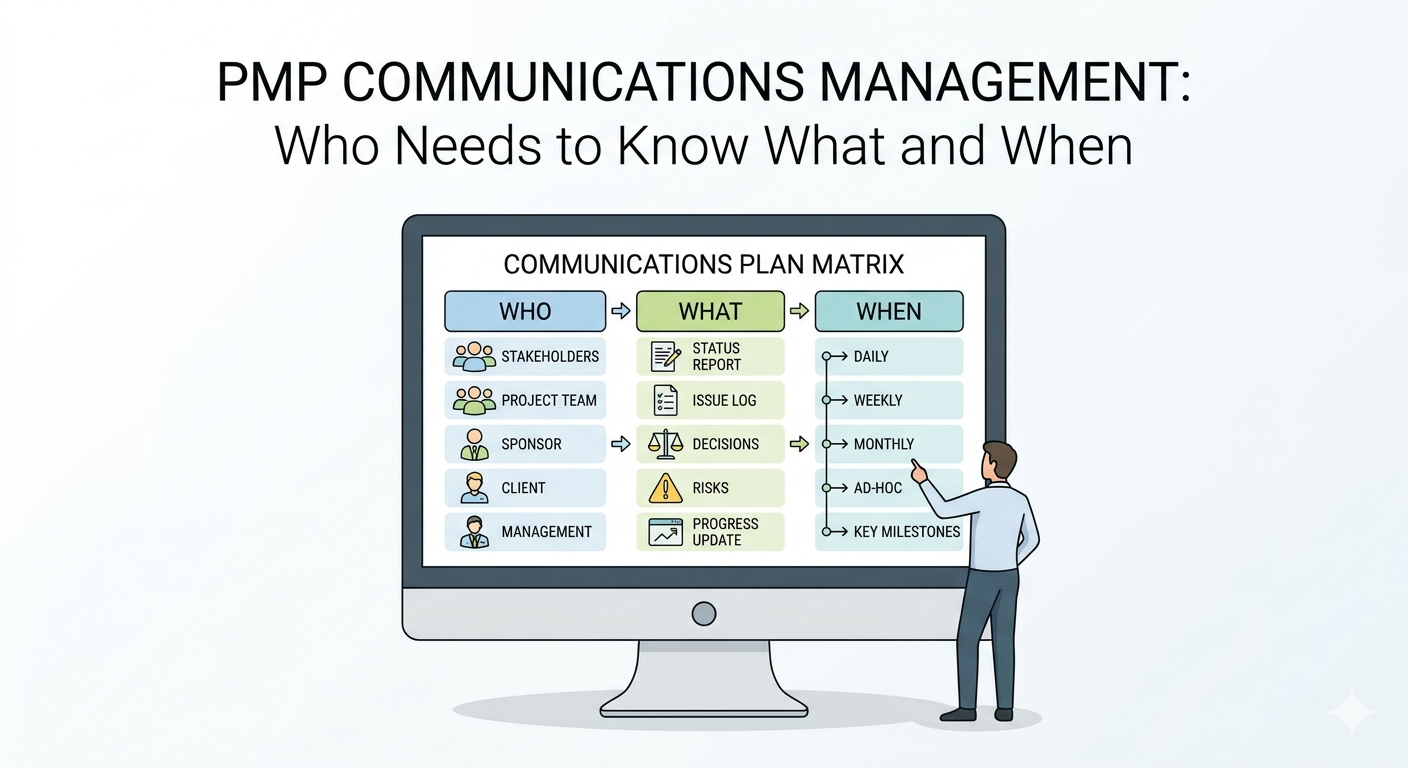
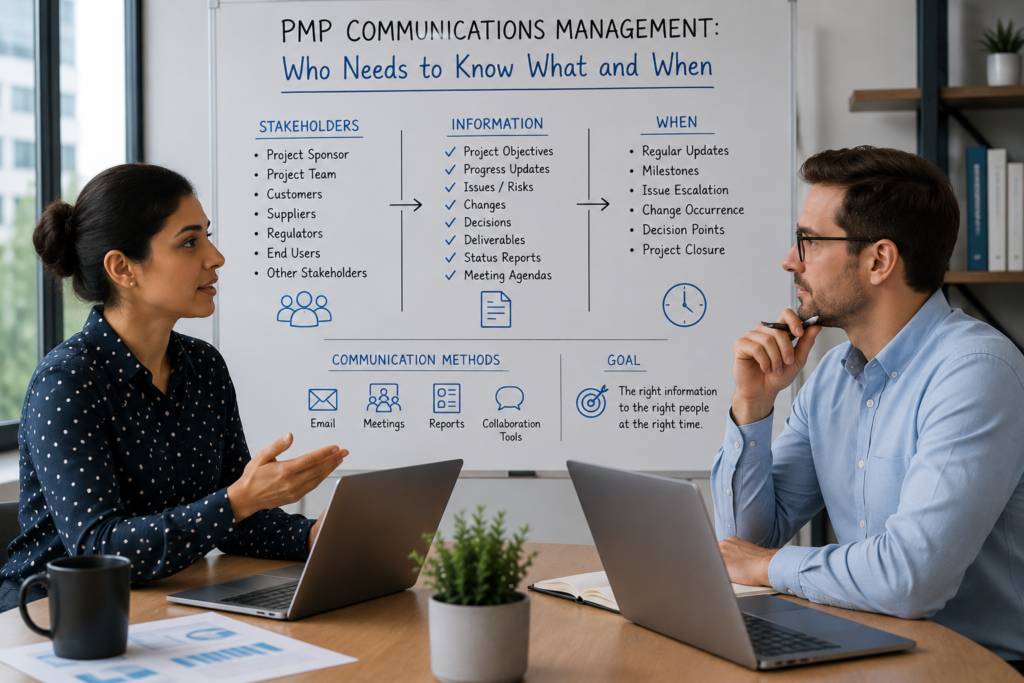
The Communications Management Plan defines, for every stakeholder or stakeholder group:
- What information they need — scope updates, budget status, risk reports, technical decisions
- Why they need it — their role and interest in the project
- When they need it — frequency of communication
- How it will be delivered — format and channel (written report, email, meeting, dashboard)
- Who is responsible for sending it — which team member owns each communication
- Who has authority to release confidential information — not all project information is shareable with all stakeholders
A well-constructed Communications Management Plan is what prevents the situation I described above. If the BA’s communication responsibilities had been clearly defined — with the expectation that delay information is reported accurately and escalated to the PM before going to stakeholders — the steering committee situation could have been avoided.
A Real Communications Structure: What We Actually Used
In practice, across multiple projects, our communication structure looked like this:
| Communication | Audience | Frequency | Content |
| Internal team standup | Development + QA team | Daily | Yesterday’s progress, today’s plan, blockers |
| Onsite / external team standup | Client-side or offshore team | Daily | Integration points, dependencies, cross-team blockers |
| Status report | Senior PM or VP | Weekly | Progress vs plan, risks, issues, budget status, upcoming milestones |
| Steering committee meeting | All senior stakeholders — client, sponsor, leadership | Monthly | Full project health update — scope, schedule, budget, risks, decisions required |
| Ad hoc escalation | Sponsor or client PM | As needed | Any issue requiring immediate attention or decision beyond the PM’s authority |
Notice that different audiences receive different information at different frequencies. The development team does not need the monthly steering committee report. The client steering committee does not need the daily standup notes. Matching the right information to the right audience at the right time is the core skill of communications management.
The Communication Channels Formula
One of the most tested calculations in PMP communications management is the formula for the number of communication channels in a project team. This appears as a direct calculation question on the exam.
| Communication Channels = n × (n − 1) ÷ 2 where n = number of stakeholders / team members |
Example: A project team has 10 members. Communication channels = 10 × 9 ÷ 2 = 45. If a new member joins, making it 11: channels = 11 × 10 ÷ 2 = 55. Adding one person added 10 new communication channels — showing how rapidly complexity grows with team size.
This formula matters practically as well as for the exam. A team of 70 members — like the programme I managed at Wipro — has 2,415 potential communication channels. Obviously not all of those are active simultaneously, but the formula explains why large teams need formal communication structures. Without them, the sheer volume of potential communication paths creates noise, misalignment, and the kind of information gaps that surface at steering committee meetings as unwelcome surprises.
Communication Methods — Push, Pull, and Interactive
PMI categorises communication methods into three types, and the exam tests whether you know when each is appropriate:
| Method | Description | When to Use | Examples |
| Interactive | Two or more parties exchanging information in real time — immediate response possible | When complex issues need discussion, decisions need to be made, or alignment needs to be confirmed | Meetings, video calls, phone calls, instant messaging |
| Push | Information sent to specific recipients — no guarantee it is received or understood | When distributing information to large groups without requiring immediate response | Email, status reports, memos, written updates, newsletters |
| Pull | Information stored in a central location for recipients to access at their own discretion | When large volumes of information need to be available but do not require active distribution | Project portals, SharePoint, wikis, document repositories, dashboards |
PMP exam trap: Push communication does not mean the recipient understood or received the information. Sending an email is push communication — but it is not a substitute for interactive communication when genuine alignment or decision-making is needed. Exam questions that describe a situation where a project manager emailed important information to stakeholders and nobody acted on it — the issue is often the wrong communication method, not the wrong information.
Formal vs Informal Communication
Another distinction the exam tests: formal communication is documented, planned, and part of the official project record. Informal communication is impromptu, undocumented, and relationship-based.
Both have their place. Formal communications — status reports, meeting minutes, change requests — create the audit trail and the shared record of project decisions. Informal communications — corridor conversations, quick calls, relationship building — create the trust and relationship context that makes formal communications land well.
The project manager who only communicates formally often feels distant and bureaucratic to their team and stakeholders. The one who only communicates informally creates confusion about what is and is not officially decided. The effective PM uses both — informal communication to build relationships and sense the pulse of the project, formal communication to document decisions and ensure accountability.
How Communications Management Is Tested on the PMP Exam
- Communication channels formula: Calculate the number of channels for a given team size. Remember n × (n−1) ÷ 2.
- Communication method selection: Given a scenario, which method is most appropriate — interactive, push, or pull? Complex decisions need interactive. Mass information distribution uses push. Self-service reference material uses pull.
- Communication plan questions: A stakeholder is not receiving the right information. What should the PM do? Review and update the Communications Management Plan.
- Responsibility questions: Who is responsible for ensuring stakeholders receive the right information? The project manager — not the BA, not the communications team, not the sponsor.
- Escalation questions: A significant issue arises between scheduled reports. What should the PM do? Communicate immediately — do not wait for the next scheduled update.
About the Author

Rahul Dhakate is a PMP-certified project manager and product management leader based in Nagpur, India, with 20 years of experience managing software projects across BFSI, eCommerce, and enterprise software. He managed communications structures across multiple project teams including daily standups, weekly status reports, and monthly steering committee meetings — and learned firsthand how indirect or softened communication to stakeholders creates worse outcomes than honest, direct reporting of project status. He writes at LearnXYZ.in to help working professionals understand both the theory and real-world practice of project management.
Great Reads:


Hello, Neat post. There’s a problem with your website in internet explorer, may test this… IE still is the market chief and a big component to other folks will leave out your fantastic writing because of this problem.