By Rahul Dhakate · PMP Certified · May 2026 · learnxyz.in
The Critical Path Method — CPM — is one of the most tested topics on the PMP exam and one of the most practically useful scheduling techniques in real project management. It is also one of the topics that candidates either fully understand and find straightforward, or never quite grasp and stumble over on exam day.
This guide will give you a clear, practical understanding of CPM — not through abstract network diagrams with letters and arrows, but through a real software project example from my own experience, followed by exactly what the PMP exam tests and how to approach those questions.
What is the Critical Path Method?
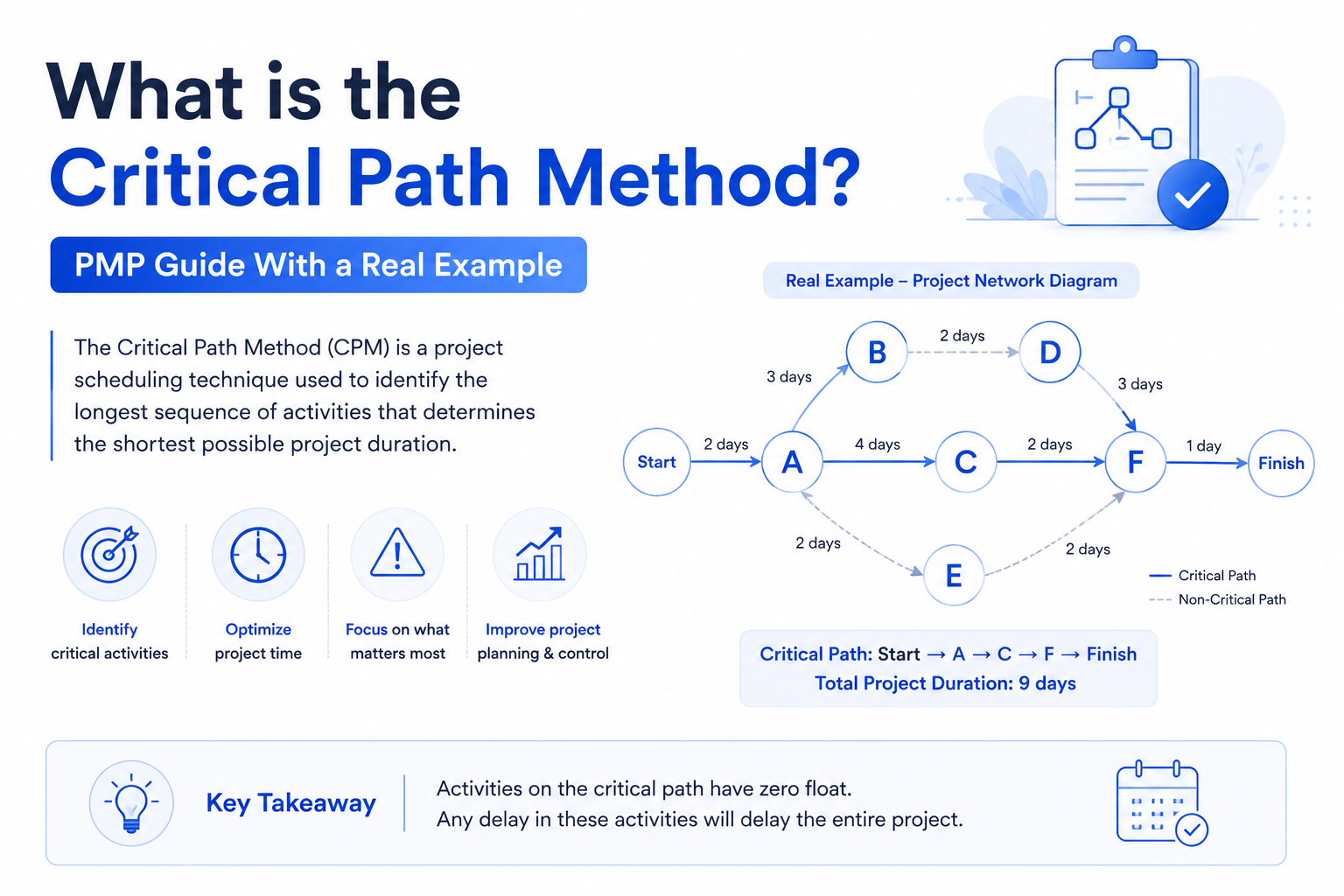
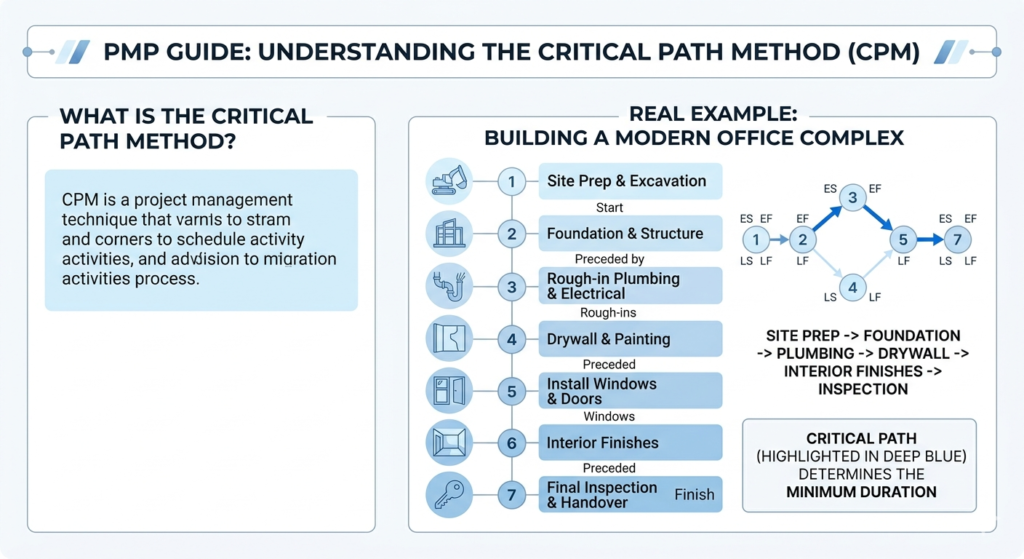
The Critical Path Method is a project scheduling technique used to identify the longest sequence of dependent tasks that must be completed on time for the entire project to finish on schedule. This longest sequence is called the critical path.
Any delay to a task on the critical path directly delays the project end date. Tasks that are not on the critical path have what is called float — extra time that can be used without affecting the final delivery date.
Three concepts sit at the heart of CPM:
- Critical Path: The longest sequence of dependent activities from project start to project finish
- Float (also called Slack): The amount of time a task can be delayed without delaying the project end date. Tasks on the critical path have zero float.
- Dependencies: The relationships between tasks — which tasks must finish before others can start
The critical path is not necessarily the most important work — it is the work that determines how long the project takes. Knowing your critical path tells you exactly where to focus your attention as a project manager.
A Real Example: Login Screen Before the Database
Let me share how we used the Critical Path Method in a real software project, because abstract examples with boxes and arrows rarely capture how CPM actually works in practice.
We were building a multi-tenant SaaS platform. The client needed to see a working product demonstration as early as possible — a common requirement in software delivery. What made this project interesting from a scheduling perspective was the decision about where to start.
The natural instinct in software development is to build the database first — establish the data model, set up the schema, then build the application on top. But this approach would have meant weeks of backend work before the client saw anything tangible. The risk: the client might have changed their requirements significantly once they saw the actual interface.
Instead, we identified the critical path differently. The login screen and tenant management module — the front door of the application — were made the first deliverable. This was the critical starting point not only because the client requested it, but because every other part of the application depended on the authentication and tenancy framework being established first.
The sequence looked like this: Login screen and tenant architecture → Core database schema → Module development → Integration → Testing → Delivery. The login and tenant work sat squarely on the critical path because no subsequent development could start without it. The full database design, meanwhile, had some float — portions of it could be refined in parallel once the core tenant model was locked.
This real example illustrates something important about CPM that textbooks often obscure: the critical path is a tool for sequencing decisions, not just a scheduling calculation. Identifying what must happen first — and what can happen in parallel — is where the real project management value lies.
How to Calculate the Critical Path
For the PMP exam, you need to understand CPM calculation. Here is the process step by step, using a simplified version of the example above.
Imagine five tasks:
| Task | Description | Duration | Depends On |
| A | Login screen & tenant setup | 5 days | None — Start here |
| B | Core database schema | 8 days | A |
| C | UI module development | 6 days | A |
| D | Backend API development | 7 days | B |
| E | Integration & testing | 4 days | C and D |
There are two possible paths from start to finish:
- Path 1: A → B → D → E = 5 + 8 + 7 + 4 = 24 days
- Path 2: A → C → E = 5 + 6 + 4 = 15 days
Path 1 is longer at 24 days — this is the critical path. The project cannot finish in fewer than 24 days.
Task C (UI module development) is on Path 2, which is 9 days shorter than the critical path. This means Task C has 9 days of float. It can slip by up to 9 days without delaying the project end date.
On the PMP exam: if a question asks ‘what is the float of Task C?’ the answer is 9 days (24 minus 15). If it asks ‘what is the float of Task D?’ the answer is 0 — it is on the critical path.
Forward Pass and Backward Pass
For more complex network diagrams, the PMP exam may ask you to calculate Early Start (ES), Early Finish (EF), Late Start (LS), and Late Finish (LF) for each task. These are calculated using two passes through the network.
Forward Pass — Calculates Early Start and Early Finish
- Early Start (ES) of the first task = 0 (or Day 1, depending on convention)
- Early Finish (EF) = Early Start + Duration
- Early Start of any task = the latest Early Finish of all its predecessors
Backward Pass — Calculates Late Start and Late Finish
- Late Finish (LF) of the last task = its Early Finish (project end date)
- Late Start (LS) = Late Finish − Duration
- Late Finish of any task = the earliest Late Start of all its successors
Float Formula
| Float = Late Start − Early Start (or) Late Finish − Early Finish A task with Float = 0 is on the Critical Path |
PMP exam trap: questions will sometimes describe a situation where a task on the critical path is delayed and ask what happens to the project end date. The answer is always: the project end date is delayed by the same amount. Don’t overthink it.
What Happens When the Critical Path Changes?
Critical paths are not fixed for the life of a project. As tasks are completed, delayed, or added, the critical path can shift to a different sequence of tasks. This is called a critical path shift and it is one of the most important things a project manager monitors during execution.
In our example: if Task C (UI module development) slipped by 10 days — one more than its available float — it would consume all its float and become part of a new critical path. The project end date would now be driven by a 25-day path instead of 24 days.
This is why monitoring float consumption is a key project management activity. When a non-critical task begins consuming its float, it is a warning signal that the critical path may be at risk of shifting.
How CPM Is Tested on the PMP Exam
The PMP exam tests Critical Path Method in several ways:
- Calculation questions: Given a network diagram, identify the critical path and calculate float for specific tasks. These require you to do the forward and backward pass correctly.
- Scenario questions: A task on the critical path is delayed — what is the impact on the project? Answer: the project end date is delayed by the same number of days.
- Float interpretation questions: Which tasks have zero float? Which has the most float? What does negative float mean? (It means the project is already behind schedule.)
- Crashing and fast-tracking: How can the critical path be shortened? Crashing adds resources to critical path tasks. Fast-tracking overlaps tasks that were previously sequential.
Study tip: draw out network diagrams by hand when practising CPM questions. The physical act of drawing the paths and doing the pass calculations builds the intuition faster than reading about it. Once you have done 10–15 practice problems, the pattern becomes automatic.
CPM in Real Project Management vs the Exam
One thing worth stating clearly: in real projects, the critical path is rarely calculated by hand the way the exam tests it. Tools like MS Project, Jira, or any modern PM software calculate the critical path automatically as you enter task dependencies.
But understanding CPM conceptually — what the critical path means, why float matters, and how delays propagate through dependent tasks — is essential for making good scheduling decisions. When I was managing the multi-tenant platform project, the decision to put the login and tenant module first was a critical path decision even if we never formally drew the network diagram. We understood the dependencies and sequenced the work accordingly.
That is what the PMP exam is ultimately testing: not whether you can perform the arithmetic, but whether you understand the scheduling logic well enough to make sound decisions in real project situations.
About the Author:

Rahul Dhakate is a PMP-certified project manager and product management leader based in Nagpur, India, with 20 years of experience managing software projects across BFSI, eCommerce, and enterprise software. He applied Critical Path Method principles in software delivery projects across BFSI and eCommerce, including sequencing decisions on multi-tenant platform development. He writes at LearnXYZ.in to help working professionals understand both the theory and the real-world practice of project management.
Good Reads :
https://learnxyz.in/how-to-write-your-pmp-application-experience-hours-in-2026-with-real-examples/