By Rahul Dhakate · PMP Certified · May 2026 · learnxyz.in
Of all the steps in the PMP application process, this one generates the most anxiety — and the most questions.
The PMI online portal asks you to describe your project management experience for each project you list. The descriptions need to demonstrate that you were leading and directing projects — not just participating in them. And they need to do this in language that PMI’s reviewers will recognise as genuine project management work.
Get this right, and your application moves smoothly to approval. Get it wrong — descriptions that are too vague, too technical, or that read more like a project summary than a PM experience description — and you risk delays, audit complications, or rejection.
Here is exactly how to write these descriptions, with real before-and-after examples.
Contents
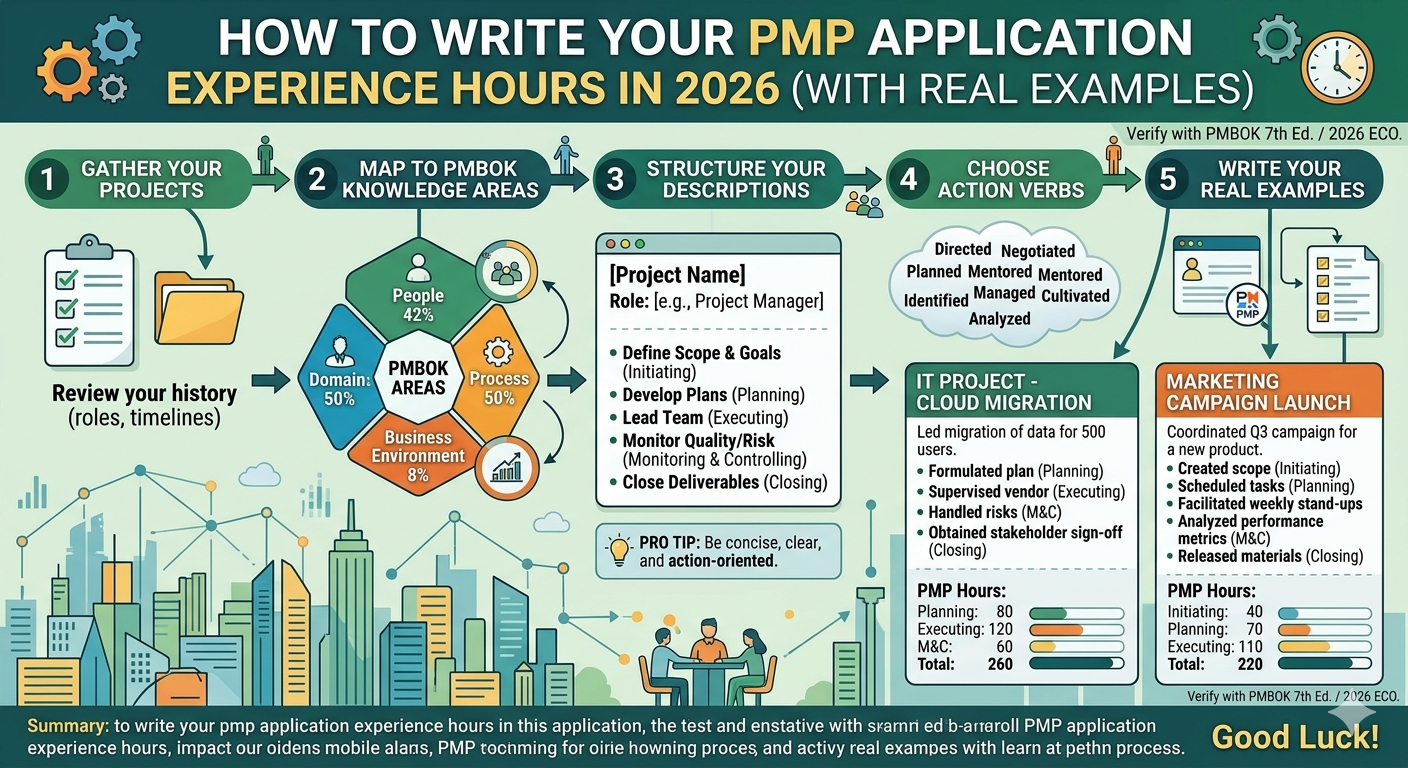
How to Write Your PMP Application Experience Hours in 2026 (With Real Examples)
What PMI Is Actually Looking For
The Structure of a Strong Experience Description.
Example 1 — Software Development Project
Example 2 — eCommerce Platform Project
Example 3 — CRM Product Development (Long-Duration Role)
Mistake 1: Writing a Project Summary Instead of a PM Experience Description.
Mistake 2: Using Technical Jargon Without PM Context
Mistake 4: Listing Experience You Cannot Verify.
A Note on Overlapping Projects.
Getting Your Descriptions Reviewed Before Submitting.
What PMI Is Actually Looking For
PMI defines the project management experience requirement as: leading and directing projects. This means your descriptions must demonstrate that you were making PM decisions — not just executing tasks assigned to you by someone else.
The five areas PMI cares about most, based on the PMP exam’s performance domains, are:
- Scope — did you define, manage, or control what the project would and would not deliver?
- Schedule — did you plan timelines, track progress, and manage delays?
- Stakeholders — did you communicate with, manage expectations of, and report to people who had a stake in the project outcome?
- Risk — did you identify, assess, and respond to risks that could affect the project?
- Team — did you lead, coordinate, or direct the people doing the project work?
Your experience descriptions do not need to cover all five areas for every project. But collectively across your listed projects, you should demonstrate experience in each of these domains.
The Structure of a Strong Experience Description
Each project description in the PMI portal should answer four questions:
- What was the project? — brief context, one sentence
- What was your role and responsibility? — specific PM activities, not job title
- How did you manage it? — methodology, team size, key PM processes used
- What was the outcome? — delivered on time, within scope, key result
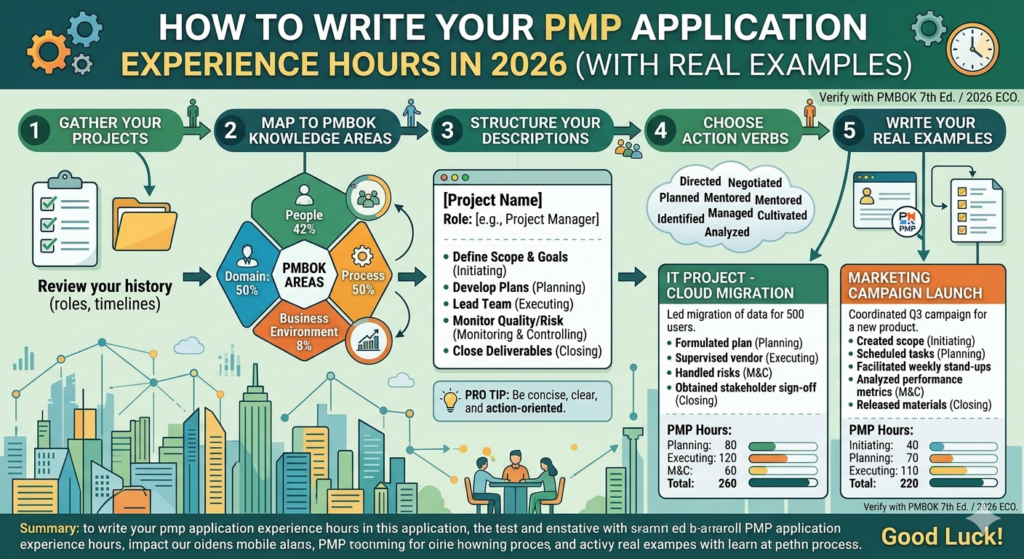
Aim for 100–150 words per project. Long enough to be credible, short enough to be readable. PMI reviewers look at many applications — clarity and specificity are more valuable than length.
Before and After Examples
These examples show the difference between a weak description that gets flagged and a strong one that gets approved.
Example 1 — Software Development Project
| WEAK ✗ | Worked on a software development project for a banking client. Coordinated between teams and helped with testing and documentation. Project was delivered successfully. |
| STRONG ✓ | Led end-to-end delivery of a core banking software integration project for a US-based financial services client. Defined project scope and deliverables in collaboration with the client’s business team, created and maintained the project schedule using MS Project, managed a cross-functional team of 12 members across development and QA, and conducted weekly stakeholder status reviews. Identified and mitigated three critical delivery risks during the execution phase. Project was delivered on schedule with zero scope creep. |
Why the strong version works: it names the project type, specifies PM activities (scope definition, schedule management, stakeholder reviews, risk mitigation), mentions team size, and gives a clear outcome.
Example 2 — eCommerce Platform Project
| WEAK ✗ | Managed an eCommerce platform project. Worked with developers and product team. Made sure things were delivered on time. |
| STRONG ✓ | Managed the full project lifecycle for an eCommerce platform release serving retail clients across India and the UK. Defined and prioritised the product backlog in collaboration with business stakeholders, facilitated sprint planning and retrospectives for a Scrum team of 8 developers and 2 QA engineers, and maintained project governance documentation for executive stakeholders. Resolved a critical third-party API dependency issue mid-project that threatened the release timeline by negotiating an accelerated delivery from the vendor. Delivered two major platform releases with a 98% on-time rate. |
Example 3 — CRM Product Development (Long-Duration Role)
For roles where you managed multiple projects over several years — such as a 10-year tenure in a product company — you don’t need to list every project separately. You can describe representative projects or a programme of related work.
| STRONG ✓ | Led product development and release management for SmartOffice CRM — an enterprise CRM platform serving insurance and wealth management clients across the US, UK, Canada, and APAC. Gathered and documented requirements from global stakeholders through workshops, interviews, and business analysis; created PRDs, BRDs, and functional specifications for each major release. Managed cross-functional teams of developers, QA engineers, and business analysts across India, US, and Singapore. Owned the release schedule, coordinated UAT with enterprise clients, and managed change requests through a formal change control process. Delivered 5 major product releases with a 99.5% on-time delivery rate across 50+ enterprise client implementations. |
Common Mistakes to Avoid
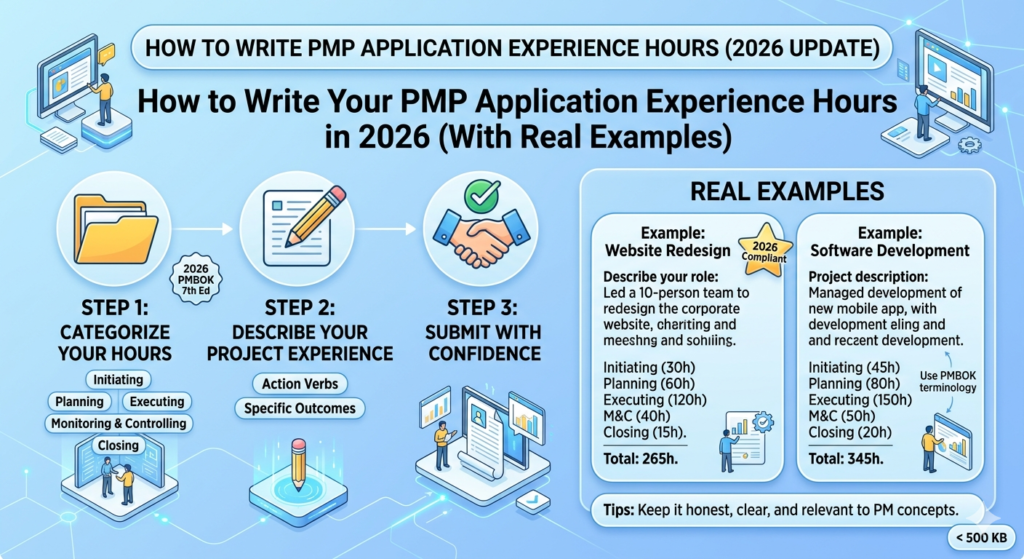
Mistake 1: Writing a Project Summary Instead of a PM Experience Description
The description should be about what YOU did as a project manager — not what the project was. Many candidates write a detailed description of the project’s technical scope and forget to mention their own PM activities. PMI is evaluating your experience, not the project.
Mistake 2: Using Technical Jargon Without PM Context
If you are from a technical background — software development, QA, business analysis — there is a tendency to describe the work in technical terms. PMI reviewers need to see PM language: scope, schedule, stakeholders, risk, change control, team leadership. Technical details are fine as context, but the PM activities must be explicit.
Mistake 3: Vague Outcomes
‘Project was successful’ tells PMI nothing. ‘Delivered on schedule within approved scope, resulting in client sign-off and go-live’ tells them something specific. Wherever possible, include a concrete, verifiable outcome.
Mistake 4: Listing Experience You Cannot Verify
A percentage of applications are randomly selected for audit. During audit, PMI contacts the supervisors you have listed to verify your experience. Only list projects and supervisors that are genuinely reachable and would confirm what you have written. Accuracy matters far more than impression management.
A Note on Overlapping Projects
If you managed multiple concurrent projects — which is common in consulting, IT services, and product companies — you can list them separately but must be careful not to double-count the months. The 36-month requirement is based on calendar months of project leadership, not a sum of months across all projects.
For example: if you led three projects simultaneously for six months, that counts as six months of experience — not eighteen. List each project separately with accurate dates, and PMI will calculate your eligible months correctly.
If you are unsure how to count your months correctly, draw a simple timeline on paper — one row per project, with start and end dates — and count the unique calendar months where you were leading at least one project. That is your eligible experience total.
Getting Your Descriptions Reviewed Before Submitting
As I mentioned in the application guide, having someone who has been through the PMI application recently review your experience descriptions before you submit is genuinely worthwhile.
This is one area where a mentor who holds a PMP and understands PMI’s language makes a real difference. Not because there is anything complicated about the process — but because it is easy to be too close to your own experience to see where your descriptions are thin, too technical, or not sufficiently framing your PM leadership role.
A second pair of eyes from someone who knows what PMI is looking for can turn a borderline description into a clear, confident one.
Your Next Step
Open a document and write a draft description for each project you plan to list before you touch the PMI portal. Apply the four-question structure — what was the project, what was your role, how did you manage it, what was the outcome — and check each description against the five PM areas: scope, schedule, stakeholders, risk, and team.
Then find someone who holds a PMP and ask them to review your drafts. Once you are satisfied with the quality of your descriptions, the portal entry itself is straightforward.
Strong experience descriptions are the foundation of a clean, fast PMI application. Take the time to write them well before you begin.
About the Author:
Rahul Dhakate is a PMP-certified project manager and product management leader based in Nagpur, India, with 20 years of experience across BFSI, eCommerce, and enterprise software. He navigated the PMI application process with mentor support and writes at LearnXYZ.in to help working professionals handle every step of the PMP journey confidently.
Next Article: PMP vs CAPM — Which Certification Should You Pursue First?