By Rahul Dhakate · PMP Certified · May 2026 · learnxyz.in
If you’re new to project management certifications, you’ve probably come across two names from PMI — the Project Management Professional (PMP) and the Certified Associate in Project Management (CAPM). And you’re probably wondering which one makes sense for where you are right now in your career.
I’ll give you an honest answer — the same answer I’d give a colleague asking me in person.
I came across the CAPM only recently, well after I had already earned my PMP in 2022. In over 20 years of working in software project management across BFSI, eCommerce, and enterprise software, nobody in a hiring conversation ever mentioned CAPM to me — not once. Every conversation was about PMP. That alone tells you something important about where each certification sits in the real world.
But let me be fair to both. Here is a complete, honest comparison so you can make the right decision for your specific situation.
Table of Contents
What is the CAPM?
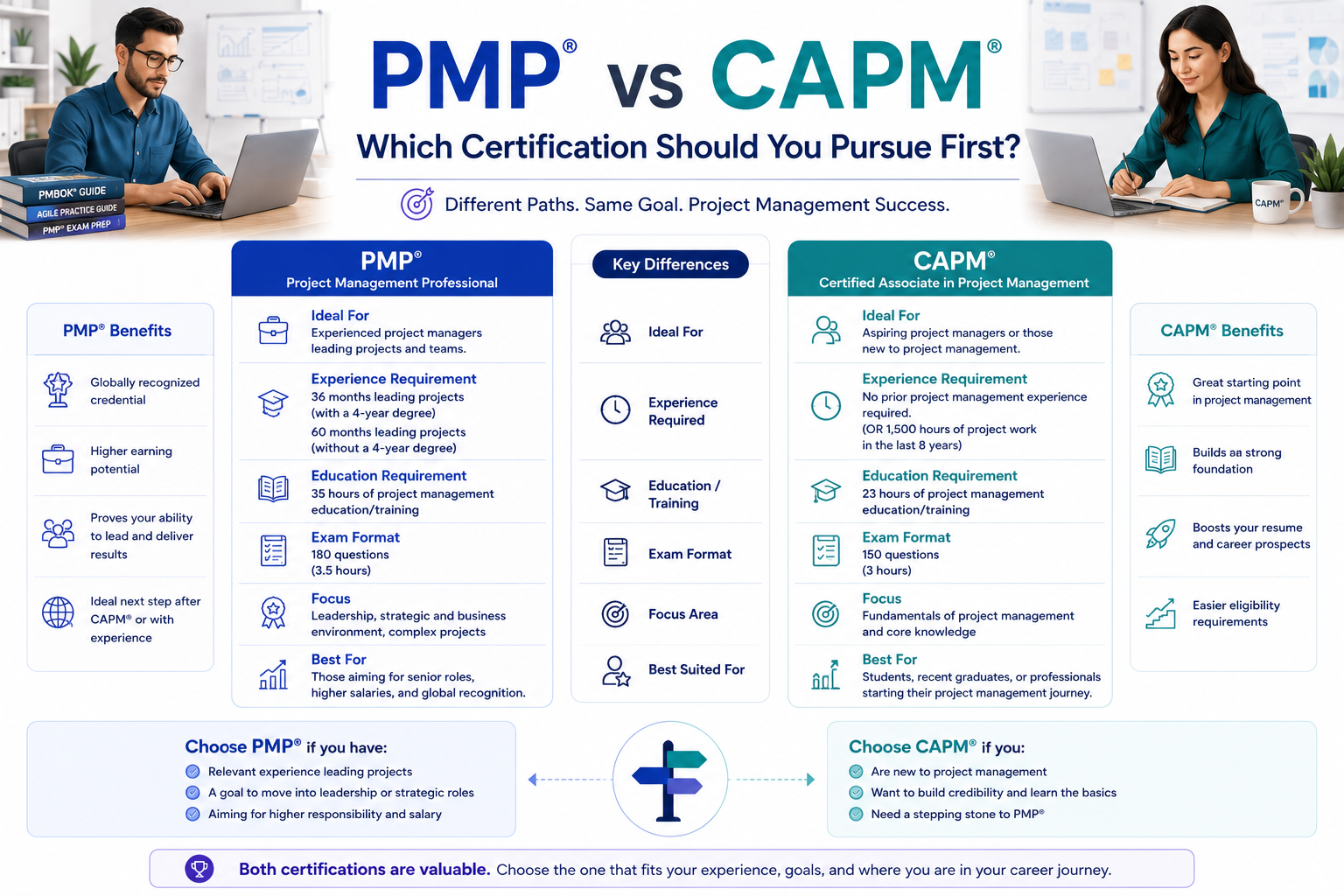
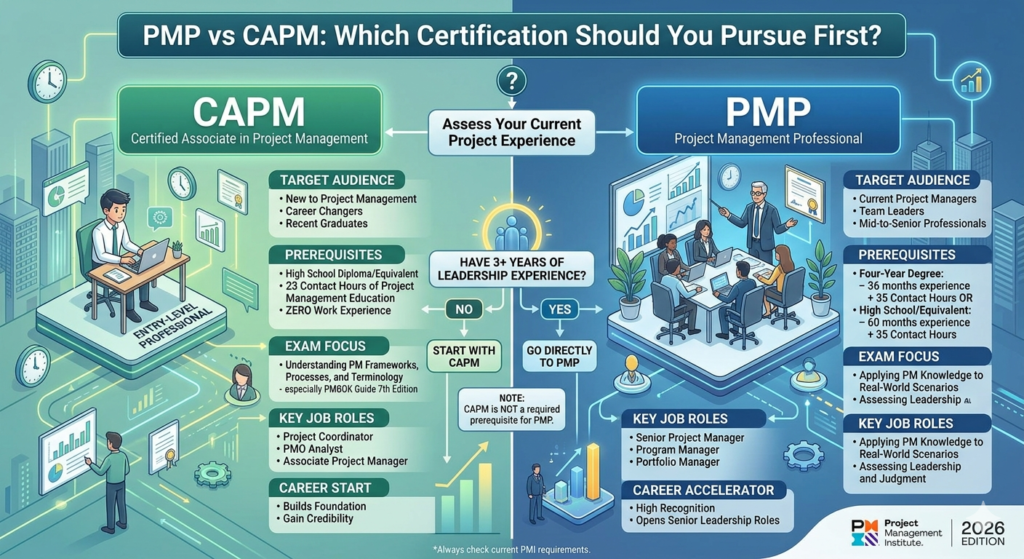
The Certified Associate in Project Management (CAPM) is an entry-level project management certification, also issued by PMI. It was designed specifically for people who are newer to project management — those with limited project experience who want to establish a foundational credential before accumulating the years of hands-on PM experience required for the PMP.
The CAPM exam consists of 150 questions to be completed in 3 hours. It tests your knowledge of project management fundamentals — primarily drawn from the PMBOK Guide — but does not require the same depth of practical experience as the PMP.
CAPM Eligibility Requirements
- A secondary degree — high school diploma, associate’s degree, or global equivalent
- 23 contact hours of project management education
- No project management experience required
That last point is the key. CAPM has no experience requirement. It is a knowledge-based certification, not an experience-based one. This makes it accessible to students, career changers, and professionals who are just beginning to work on projects.
What is the PMP?
The Project Management Professional (PMP) is the gold standard of project management certification globally. Also issued by PMI, it requires documented project leadership experience, formal education, and passing a rigorous 180-question exam that tests not just knowledge but judgment — how you would actually handle real-world project situations.
PMP Eligibility Requirements
- A four-year degree plus 36 months of project leadership experience, OR
- A high school diploma plus 60 months of project leadership experience
- 35 contact hours of formal project management education
The PMP tests experience as much as knowledge. This is why the exam uses scenario-based questions — it is assessing how you think and decide under real conditions, not just whether you can recall definitions from a textbook.
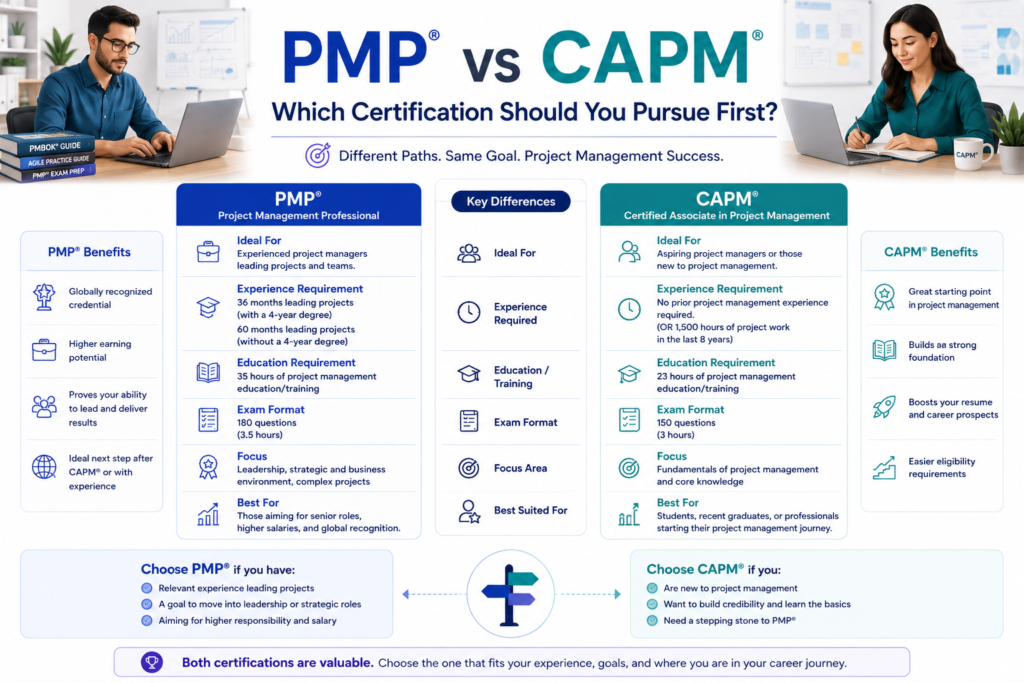
Side-by-Side Comparison
| Factor | CAPM | PMP |
| Issued by | PMI | PMI |
| Target candidate | Beginners, students, career changers | Experienced project managers |
| Experience required | None | 36 or 60 months of project leadership |
| Education required | High school diploma | 4-year degree (or high school + extra experience) |
| Contact hours | 23 hours | 35 hours |
| Exam questions | 150 questions / 3 hours | 180 questions / 3 hours 50 min |
| Exam fee (member) | ~$225 USD | ~$405 USD |
| Renewal required | Every 3 years (15 PDUs) | Every 3 years (60 PDUs) |
| Global recognition | Limited — entry level signal | Universally recognised — career standard |
| Job market weight | Low to moderate | High — often a requirement |
| Salary impact | Minimal premium | 20–25% premium on average |
Who Should Choose CAPM?
The CAPM makes sense in a specific and narrow set of circumstances. Consider it if:
- You are a student or fresh graduate with no professional project management experience and you want a PMI credential on your resume while you build that experience
- You are changing careers from a completely unrelated field and want a low-barrier entry point into project management before you have the experience hours for PMP
- Your organisation specifically asks for a PMI credential and you don’t yet qualify for PMP — CAPM demonstrates PMI knowledge and commitment
- You are in a junior or coordinator role supporting project managers and want to formalise your understanding of PM frameworks
Even in these cases, I would encourage you to think carefully. The CAPM requires effort, study time, and money. If you are within 12 to 18 months of accumulating the experience needed for PMP, it may be more efficient to wait and go directly for PMP rather than study for CAPM now and PMP later.
Who Should Choose PMP?
The PMP is the right choice if you have the experience to qualify. And I would extend that further — if you are anywhere close to qualifying, prioritise accumulating that experience and go straight for PMP. Here is why.
PMP is the de facto standard when it comes to project management jobs. I say this not just from research but from 20 years of working in software project management environments. When clients, hiring managers, and senior stakeholders ask about project management credentials, they ask about PMP. Not CAPM.
Beyond the job market signal, the knowledge you gain preparing for PMP is simply richer and more practically applicable. Because PMP preparation requires you to study at depth — the PMBOK Guide, the Agile Practice Guide, scenario-based thinking — you come away with a much more sophisticated understanding of how to manage projects than CAPM preparation provides. The exam demands more of you, and that demand makes you better.
My honest view: PMP is not just about the credential. It is about the knowledge and the thinking it forces you to develop. Even if two people earn the same title, the one who went through PMP preparation thinks about projects differently.
The One Scenario Where CAPM Genuinely Helps
There is one situation where CAPM has clear practical value: if you are actively managing projects right now but don’t yet have the documented experience months to qualify for PMP.
In this case, CAPM gives you a PMI credential to show while you continue building your PMP-qualifying experience. It signals to employers that you are serious about the profession, that you understand PMI’s framework, and that you are on a clear path to PMP.
Think of it as a placeholder credential — valuable for a specific window of time, with a clear exit strategy into PMP as soon as you qualify.
What About Cost and Renewal?
Both certifications require renewal every three years. PMP requires 60 Professional Development Units (PDUs). CAPM requires 15 PDUs. If you hold both, you are managing two renewal cycles and two sets of PDU requirements.
For most working professionals who are building a portfolio of certifications over time — PMP, PSM I, possibly CAPM — the combined maintenance burden is worth factoring into your decision. Certifications require ongoing investment of time and money. Fewer certifications maintained well is generally better than many certifications maintained poorly.
If you already qualify for PMP, skip CAPM entirely. The PMP carries the recognition, the salary premium, and the knowledge depth that matters. CAPM is a stepping stone — a useful one for specific situations, but not a destination in itself.
What Employers Actually Look For in 2026
Based on current job market patterns in both India and the US, here is what the data shows about PMP vs CAPM in hiring:
- Senior PM roles (5+ years experience): PMP listed as required or preferred in over 80% of postings. CAPM rarely mentioned.
- Mid-level PM roles (2–5 years): PMP strongly preferred, CAPM occasionally accepted as an alternative for candidates with strong experience
- Junior PM and coordinator roles: CAPM is relevant here — it demonstrates foundational knowledge and PMI familiarity
- US remote roles hiring from India: PMP is the expected credential at any level above coordinator. CAPM is almost never listed in US job postings.
The pattern is consistent. PMP is the currency of the project management profession globally. CAPM is a useful local currency for a specific phase of your early career.
My Direct Recommendation
| If you have the experience hours — go straight for PMP. Don’t take a detour through CAPM. The investment of time and money is better spent on one rigorous, globally recognised certification than two certificates of unequal weight. |
If you are a student, fresh graduate, or career changer without the experience hours — CAPM is a reasonable credential to pursue while you build that experience. Just be clear in your own mind that it is a bridge, not a destination.
And if you are somewhere in between — a few months away from the experience requirement — my advice is to wait. Spend that time studying so that the moment you qualify, you can apply immediately and sit the PMP exam with strong preparation already in place.
The PMP remains the de facto standard in project management credentials in 2026. That status has not changed, and is not likely to change. Build toward it with purpose.
About the Author:
Rahul Dhakate is a PMP-certified software project manager and product management leader based in Nagpur, India. He earned his PMP in January 2022 after 20 years of managing software projects across BFSI, eCommerce, and healthcare. He writes at LearnXYZ.in to help working professionals navigate the project management certification landscape clearly and honestly.

Essential Reads: