By Rahul Dhakate | PMP Certified | Software Project Manager | India
Last Updated: May 2026 | Reading Time: ~11 minutes
Let me tell you something most PMP prep websites won’t.
I completed my PMP classroom training almost nine years before I actually sat for the exam.
Nine years. The training was done, the contact hours were logged, and I was technically
eligible. But life kept happening — software projects, work deadlines, the usual. The exam
kept getting pushed to “next quarter.” And then next quarter became next year, and next
year became nearly a decade.
If that sounds familiar, you’re not alone. It’s one of the most common patterns among PMP
candidates — especially working professionals who manage real projects and can’t afford to
step away from their responsibilities to study full-time.
So when people ask me how many hours it takes to prepare for the PMP exam, I don’t give
them the textbook answer. I give them the honest one, based on what I actually experienced
and what I’ve seen other working professionals go through.
Here’s the complete picture.
What the Official Guidance Says
PMI doesn’t officially prescribe a specific number of study hours for PMP exam preparation.
What they do specify is the 35 contact hours of formal project management education
required just to be eligible to sit the exam — but those are hours of coursework, not selfstudy.
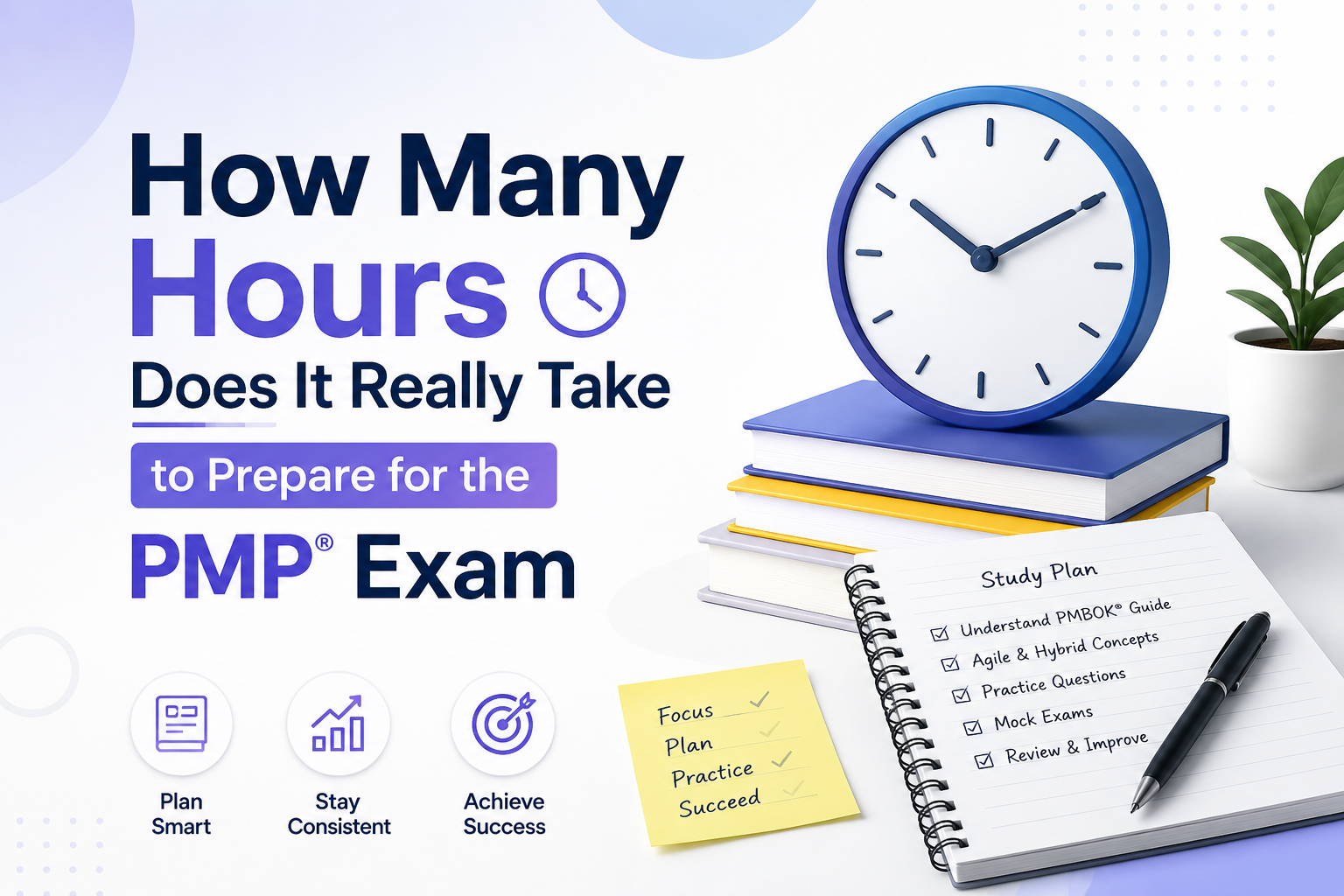
Most prep courses and exam coaches suggest somewhere between 150 and 300 hours of
total preparation time. That’s a wide range, and it’s intentionally so, because the actual
number varies dramatically depending on your background, your study habits, and how you
learn.
What I can tell you is that the candidates who walk into the exam underprepared almost
always made one of two mistakes: they either studied the wrong material, or they
overestimated how much they knew from their work experience and underestimated how
different the PMI exam mindset actually is.
The Honest Breakdown: What the Hours Actually Look Like
Rather than giving you a single number, let me break down what those preparation hours
actually consist of — because understanding what you’re studying is just as important as
understanding how long.
Reading and Content Review (50–80 hours)
This is the foundation. At minimum you need to read and understand:
PMBOK Guide 7th Edition — Don’t try to memorise it. Read it to understand the
principles and how PMI thinks about project management. Most candidates spend 20–
30 hours on this alone.
Agile Practice Guide — This is non-negotiable. 50% of the exam is Agile or hybrid
content, and this guide is the primary source. Budget 10–15 hours.
Your chosen prep book or course — Whether that’s Rita Mulcahy’s PMP Exam Prep
book, Andrew Ramdayal’s TIA course on Udemy, or Joseph Phillips’s course, plan for
20–30 hours of engagement with supplementary material.
Practice Questions (60–80 hours)
This is where most candidates don’t spend enough time — and it’s the single most impactful
part of your preparation.
You need a minimum of 1,500 to 2,000 practice questions before exam day. Not to
memorise answers, but to train your brain to recognise the PMI mindset in different
scenarios. Every wrong answer is a learning opportunity — if you review it properly.
At roughly 60–70 questions per hour (including review time), that’s 25–35 hours of active
practice question work. Add in the time spent reviewing explanations, making notes, and
revisiting concepts you got wrong, and this easily becomes your largest time investment.
The PM PrepCast simulator is widely regarded as the closest to the real exam in terms of
question style and difficulty. If you’re going to invest in one paid resource for exam prep,
that’s where I’d put the money
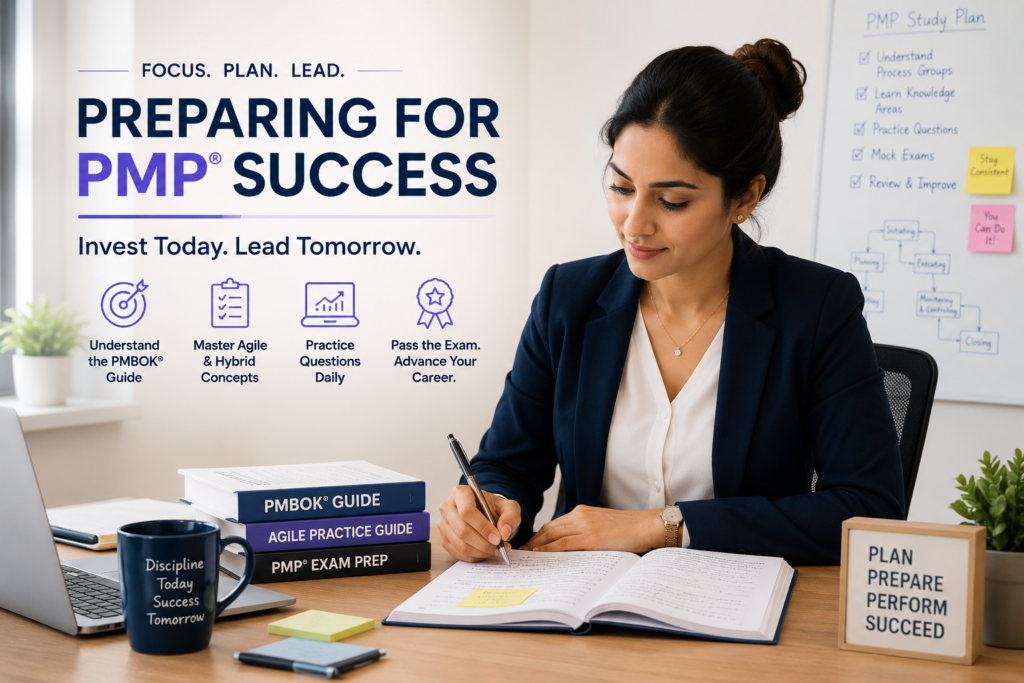
Revision and Weak Area Focus (20–30 hours)
In the final two to three weeks before your exam, you should be doing two things: full-length
mock exams (180 questions in one sitting) and targeted revision of your weak areas. This
phase is where everything consolidates.
Most candidates need three to five full-length mock exams before they feel ready. At
roughly four hours each including review, that’s another 15–20 hours right there.
Total Realistic Range: 130–190 Hours
For a working professional studying 2–3 hours after work — which is exactly what I did —
this translates to roughly 3 to 4 months of consistent preparation. Not 3 weeks. Not 6
months of casual browsing through PMBOK chapters. Three to four months of deliberate,
structured study
My Personal Experience: 2–3 Hours a Day, Post-Job
When I finally committed to sitting the exam, I was studying 2 to 3 hours in the evenings
after a full day of work as a software project manager. Some days it was easy to focus.
Other days — after a long day of meetings, stakeholder issues, and code reviews — sitting
down to read about Earned Value Management at 9pm felt like the last thing in the world I
wanted to do.
What I found, and what I’d tell anyone in the same position, is that consistency matters far
more than intensity.
Two hours every evening, seven days a week, adds up to roughly 60 hours a month. Over
three months, that’s 180 hours — right in the middle of the recommended range. The
candidates who struggle are the ones who try to compensate for inconsistency with
weekend cramming sessions. Your brain doesn’t retain information the same way in a 10-
hour Saturday marathon as it does in daily 2-hour focused sessions.
I also found that my real-world project management experience — a decade of managing
software development projects — was both an advantage and a trap.
The advantage: I genuinely understood concepts like risk management, stakeholder
communication, and resource planning from lived experience. Those sections of the exam
felt natural.
The trap: I kept answering questions based on what I would actually do on the job, rather
than what PMI considers best practice. These are sometimes the same thing — but not
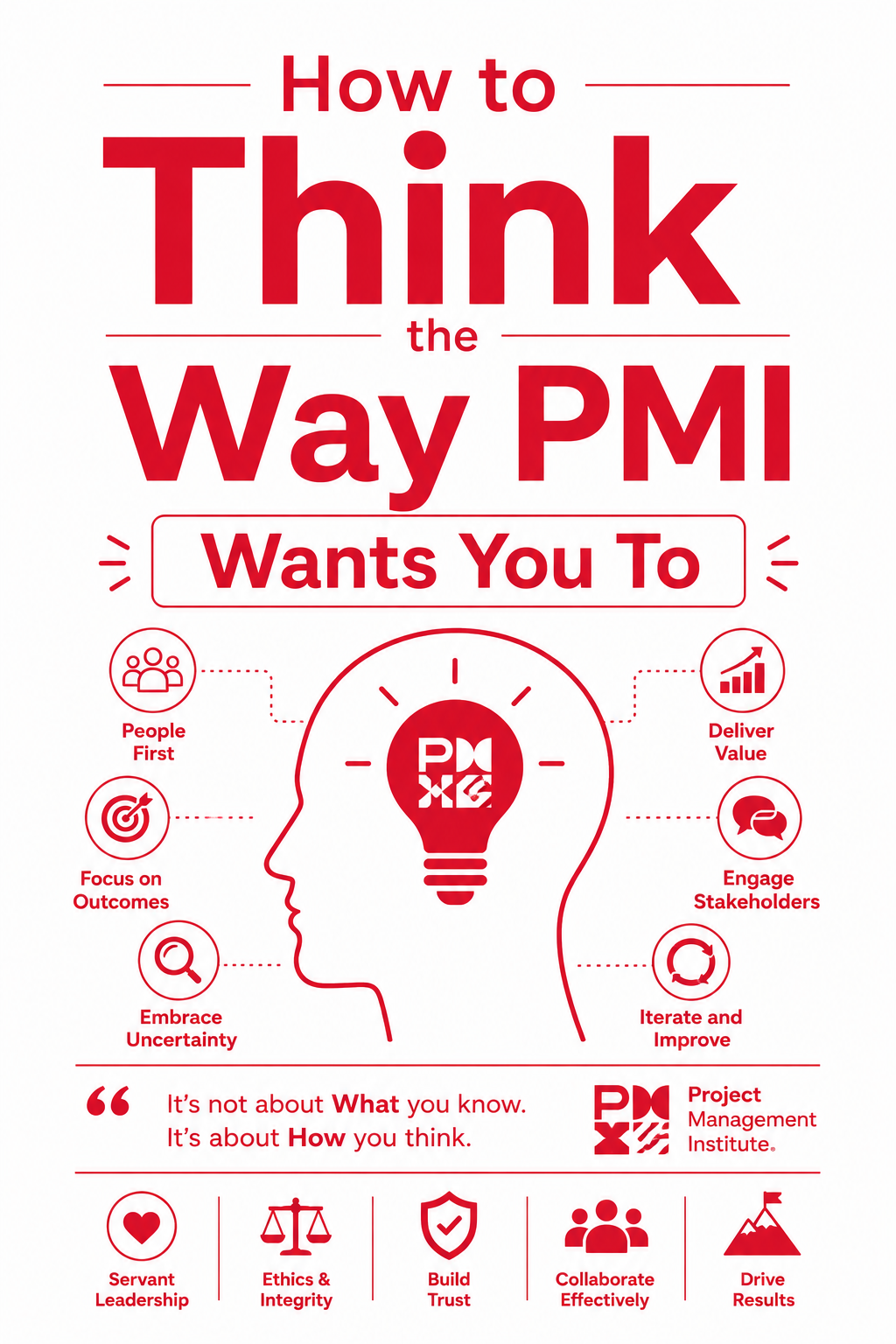
always. The PMI mindset is a specific, idealised version of project management, and
learning to think that way while setting aside my real-world instincts took deliberate
practice.
This is something no study guide ever told me clearly. I learned it the hard way through
practice questions.
How Your Background Affects Your Study Time
Not every candidate starts from the same place, and your prep time should reflect that.
If you come from a traditional Waterfall or predictive project management
background: You likely have a solid grasp of the process-heavy content — project charters,
WBS, critical path, earned value. Your weak spot will be the Agile content, which now
represents half the exam. Budget extra time specifically for the Agile Practice Guide and
Agile situational questions.
If you come from an Agile or Scrum background: The situation is reversed. You’ll handle
the Agile questions comfortably, but the predictive PM content — particularly procurement,
formal risk registers, and earned value calculations — may need more attention than you
expect.
If you come from a software engineering or technical background (as I do): You’ll likely
pick up the conceptual content quickly and find the Agile section manageable. Your
challenge will be the people and stakeholder management questions, which are heavily
scenario-based and require you to think like a leader rather than a technical expert.
If it’s been a long time since your formal training: If, like me, there’s been a significant
gap between your initial PMP training and your actual exam preparation, plan an additional
15–20 hours just to reorient yourself. Project management frameworks and best practices
have shifted significantly, especially with the integration of Agile. Don’t assume your older
notes are still accurate — check them against the current PMBOK 7th Edition
The Biggest Time Wasters to Avoid
In a preparation period of 3–4 months, every hour matters. Here are the things that waste
candidates’ time without improving their exam readiness.
Memorising the PMBOK Guide. The current exam does not reward rote memorisation. It
rewards judgment. Read the PMBOK to understand principles, not to recite process groups.
Doing practice questions without reviewing wrong answers. Quantity without quality is
worthless. Every wrong answer should tell you something about how PMI thinks. If you can’t
explain why the correct answer was correct — not just why your answer was wrong — you
haven’t learned from that question.
Studying topics equally regardless of exam weighting. Remember: People domain is
42%, Process is 50%, Business Environment is 8%. Don’t spend equal time on all three. The
Business Environment section should get proportionally less of your attention.
Waiting until you feel “ready” to start practice exams. Many candidates delay full-length
practice exams because they feel they need to finish reading first. Don’t do this. Start
practice questions from week one. Early exposure to the question format, even when you
get most of them wrong, accelerates your understanding of the PMI mindset dramatically.
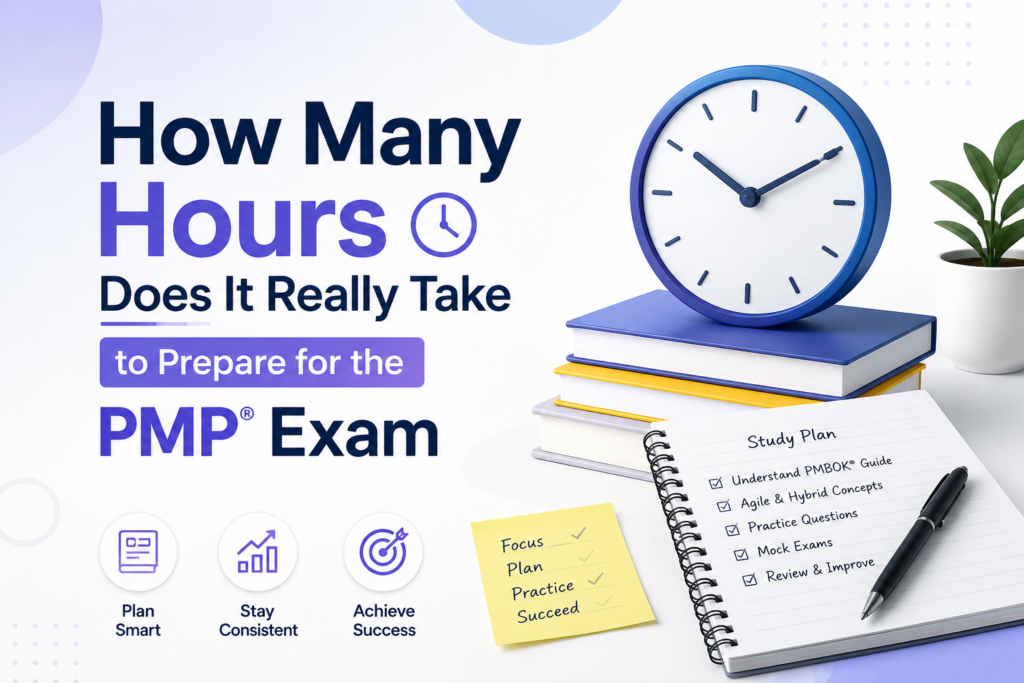
A Realistic Study Schedule for Working Professionals
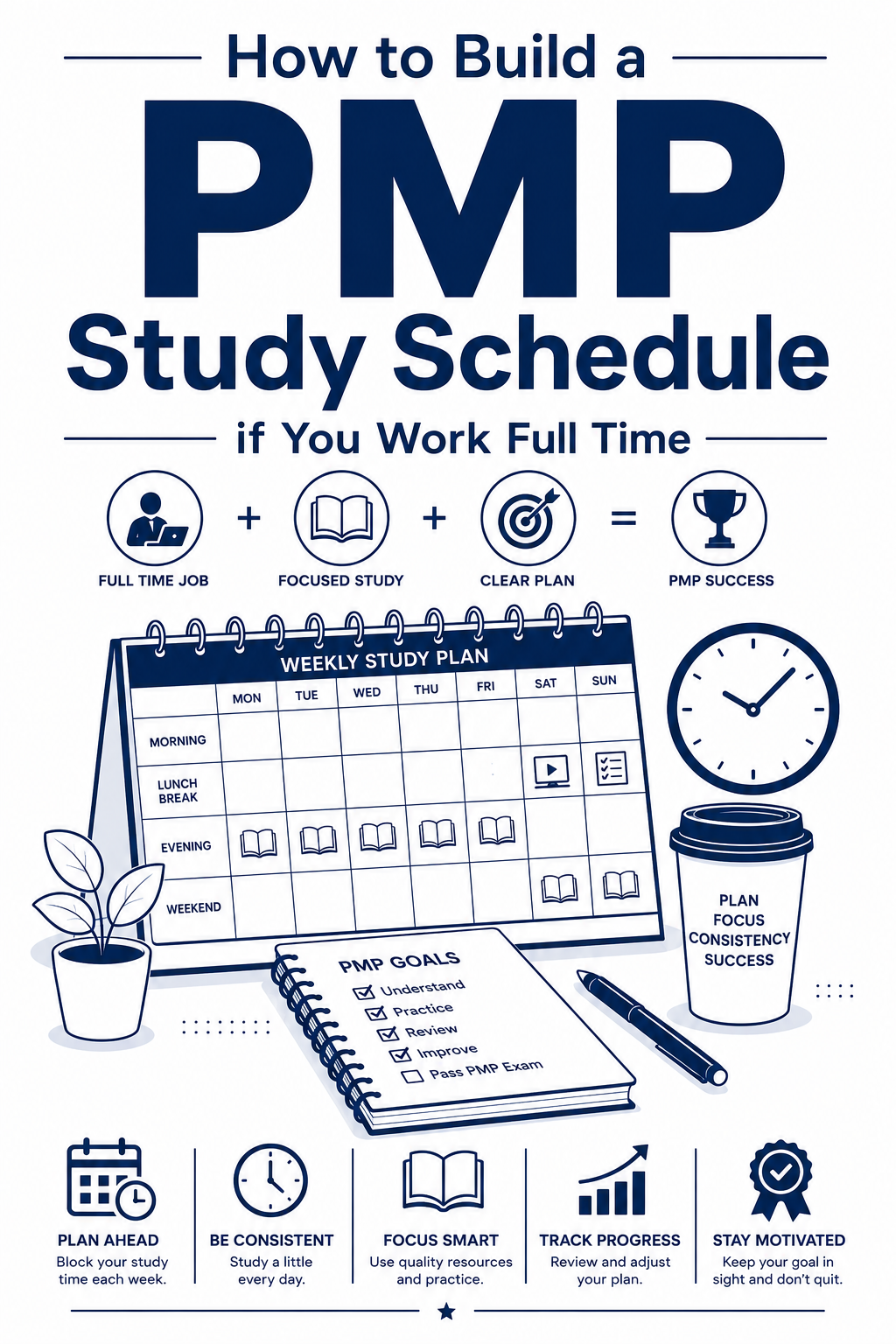
If you’re working full-time and can commit to 2–3 hours per day, here is a realistic
breakdown.
Month 1 — Foundation Read through your chosen prep book or complete your video
course. Read the Agile Practice Guide in parallel, one chapter at a time. Do 30–40 practice
questions per day from the moment you start, even before you’ve finished reading. Use
these early questions diagnostically — they’ll tell you where your knowledge gaps are.
Month 2 — Deep Practice Begin the PMBOK Guide 7th Edition. Continue daily practice
questions, increasing to 50–60 per day. Focus specifically on your weak areas identified in
Month 1. By the end of Month 2 you should have completed at least 800–1,000 practice
questions.
Month 3 — Mock Exams and Consolidation Take one full-length 180-question mock exam
per week. Review every wrong answer thoroughly. Spend remaining daily study time on
revision of weak areas. In the final week, ease off new content and focus entirely on
consolidation and rest.
Book your exam date at the start of Month 1, not at the end. Having a fixed date creates
accountability. Candidates who book their exam date first and study toward it consistently
outperform candidates who study until they feel ready and then book.
One Last Thing: Stop Waiting
The single most common reason working professionals take nine years — or five years, or
three years — between their PMP training and their actual exam is not lack of preparation
time. It’s the feeling that they’re not quite ready yet, that they need a little more time, that
the exam can wait until things are less busy at work.
Things will never be less busy at work.
If you have your 35 contact hours and your project management experience documented,
you are eligible to sit the exam. The preparation takes three to four months of consistent
evening study. The exam costs $405 for PMI members. The average salary premium for
PMP certification in the US is 20–25%.
The math is simple. The commitment is manageable. The only thing stopping most people is
starting.
Start today.
About the Author: Rahul Dhakate is a PMP-certified software project manager based in
Nagpur, India, with over 10 years of experience managing software development projects.
He completed his PMP classroom training and — like many working professionals — took
nearly nine years before finally sitting and passing the exam. He writes at LearnXYZ.in to
help other working professionals avoid the same delay and pass on their first attempt.
Next Article: PMP Exam Eligibility Requirements 2026 — A Simple Checklist Related Reading: PMP Exam 2026: What Has Changed and What You Actually Need to Know