

![[keyword]](https://learnxyz.in/wp-content/uploads/2026/02/McDonalds-milkshake-healthier-polar-bears-and-more.jpg)
Hey people!
Polar bears are often the first animals that come to mind when we talk about climate change. And over the years, melting Arctic ice has led scientists to discover something strange about them.
See, polar bears have a pretty specific eating rhythm. Winter is their festival season. That’s when the sea ice is thick and stable and seals hang around the ice to rest, raise their young and shed their fur. For polar bears, this is the best hunting time.
They prey on signals, especially the bacon, and convert all those calories into fat. Those fat reserves are crucial because summer is basically a long fast for them. With less ice around, hunting becomes difficult, food becomes scarce, and polar bears can lose up to 40% of their body weight just surviving on what they used to store.
This is why climate change causes trouble. As ice melts and sea levels change, polar bears may have to swim longer distances to find food or spend more time on land, slowly burning through their reserves.
But researchers studying polar bears noticed something unexpected around Svalbard in Norway. Despite the region losing sea ice twice as fast as many other polar bear habitats, these bears are actually getting fatter.
So what’s going on?
One thing is diet. These polar bears may have started eating more land animals than they used to. Reindeer, for example, have made a strong comeback after recovering from years of overhunting by humans. Traditionally, reindeer were just an additional meal – something polar bears turned to in the summer when they weren’t hunting seals. But with longer ice-free periods, those backup options are used more frequently.
There is also another possible explanation. With less ice overall, signals compress around the few remaining patches of ice. This means instead of being spread out, they are packed closer together, which can actually make hunting for polar bears easier in the short term.
But just because polar bears are adapting to climate change, does that mean they are doing well?
Well, not really.
Polar bears are built for Arctic sea ice. They need it to hunt, breed, den and survive. So when ice retreats, the problem isn’t just for bears. It affects the entire food chain. Seals depend on ice. Fish that seals eat depend on plankton. Plankton that eat fish feed on algae. And algae only thrives when there is a lot of ice.
Take away the ice, and the whole system begins to collapse
So yes, polar bears may be getting fatter now. But that’s not really a good sign. This is a sign that they are improvising. But there may come a point when even adaptation will not be enough, as the food chain they rely on begins to disappear.
Here’s a soundtrack to get you in the mood…
Reh Gaya by Pratik Gangavane, Gaurav Chatterji and Aasa Singh
You can thank our reader Ujjwal Kumar for this awesome rack. And if you’d like your recommendation too, send them our way, especially hidden gems from underrated Indian artists that many of us haven’t discovered yet. We can’t wait to hear them!
What caught our eye this week
The McDonald’s milkshake that was never about milkshake
McDonald’s once faced a surprisingly stubborn problem. His milkshake sales were flat, and none of the obvious fixes seemed to work.
The company did what most large organizations do when a product underperforms. It asked customers what they wanted, because you know, the customer is always right.
McDonald’s asked them if the milkshakes were too thin and if they needed better flavors or different mixes, etc. Customers eagerly answered these questions, and McDonald’s responded to the feedback. But it barely comes out inches above.
And it caught the attention of Clayton Christensen. He was a Harvard Business School professor who believed that companies often ask completely the wrong questions. So, instead of relying on surveys and opinions, he encouraged researchers to observe what customers actually did.
And in this case, one of his colleagues spent an entire day in a McDonald’s store looking at who bought milkshakes, when they bought them, and whether they consumed them inside the restaurant or took them to go, and what else they ordered.
Before long, he began to notice a pattern that no customer survey had ever revealed.
About 40% of McDonald’s milkshakes were sold in the early morning. These customers usually came alone, bought just one milkshake, took it with them, and then immediately drove off.
The next morning the researcher returned to speak with these clients. However, this time the questions were different. Instead of asking what they liked about the milkshake, he asked why they chose it at that particular moment. And it revealed a very different story.
These customers were dealing with long, boring commutes. They weren’t hungry when they left home, but they knew they would be by mid-morning. They wanted something that could be consumed with one hand, that wouldn’t spill or make a mess, that would last the whole ride and keep them full until lunch.
Thus, given this context, McDonald’s milkshake did not compete with other fast food items. It competed with bagels that were dry and crumbly, bananas that were juicy, donuts that left sticky fingers, and even the monotony of the commute itself.
Once this became clear, the implications for the product were clear. If the milkshake was meant to last through a long drive, it needed to be thicker. If it was meant to remain attractive over time, it needed more texture, like pieces of fruit. And if morning commuters were the primary customers, the experience needed to be optimized for quick and easy pickup.
Once these changes were implemented, milkshake sales skyrocketed 7x than it was before. And it also explained why all the earlier fixes failed.
McDonald’s tried to improve the milkshake as a product. But the customers bought it, not as a milkshake, but as a solution to an unrelated problem. Once the company understood the underlying problem that people were trying to solve at that moment, the right changes became almost obvious.
People don’t wake up craving milkshakes after all. We wake up dreading long commutes, empty stomachs and boring mornings. The milkshake happened to be the most convenient way to make that situation a little better.
This eventually became one of Clayton Christensen’s most influential ideas. And today it is known as the Work that needs to be done framework taught in business schools worldwide.
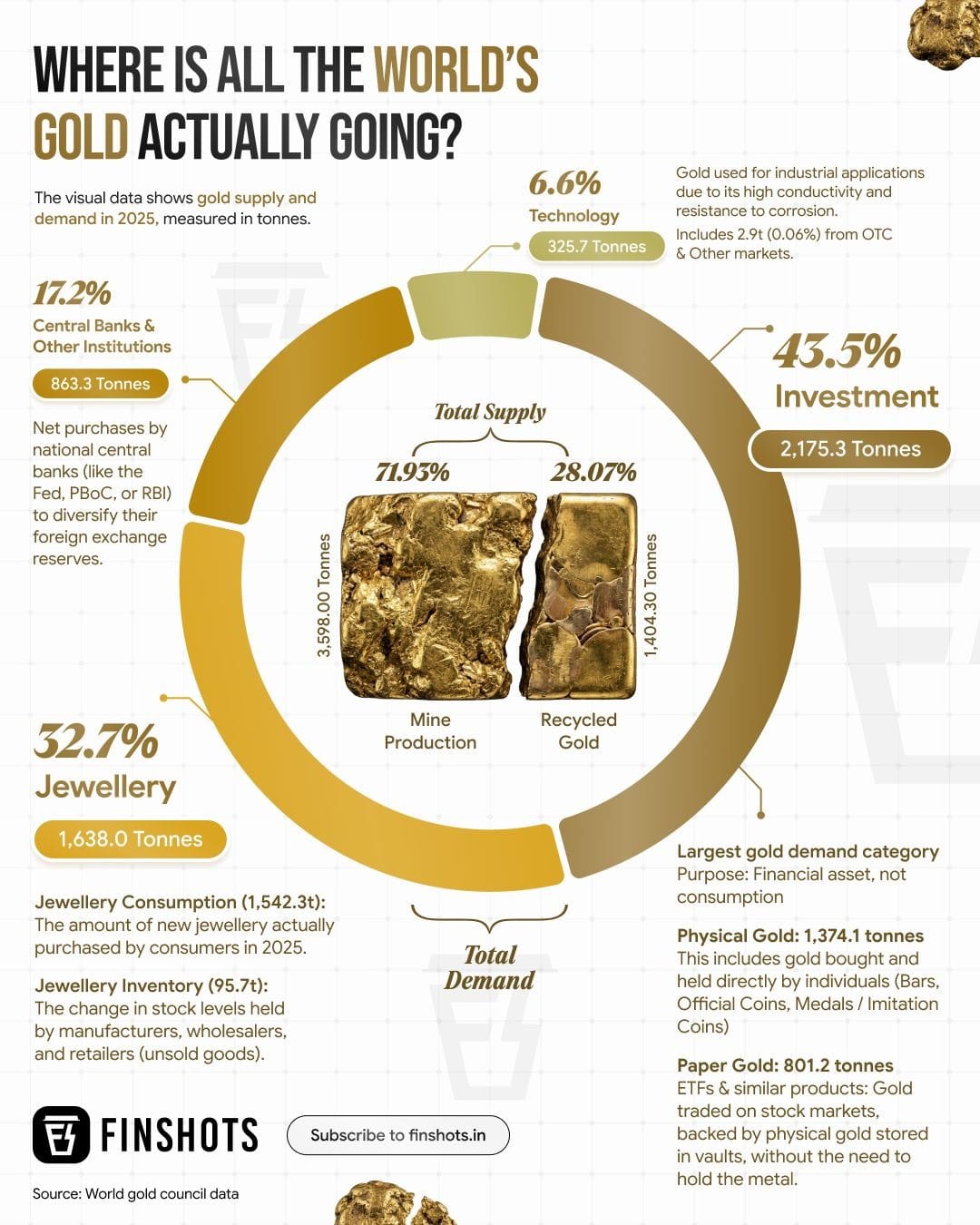
Infographics
While we often associate gold with glittering jewellery, the data reveals that in 2025 the bulk of demand actually came from investors looking for a safe haven for their wealth.
Readers recommend
This week our reader Atul Sharma recommends reading Nuclear War: A Scenario by Annie Jacobsen.
It imagines what would happen in the minutes and hours after a nuclear missile is launched at the United States.
Through interviews with military and civilian experts, it shows how quickly events can develop into a full-scale nuclear war and how little time there is to stop a disaster once the process begins.
Thanks for the recommendation, Atul!
That’s it from us this week. See you next Sunday!
Until then, send us your book, music, business movie, documentary or podcast recommendations. We will feature them in the newsletter! Also, don’t forget to tell us what you thought of today’s edition. Just click reply on this email (or if you’re reading it on the web, send us a message at morning@finshots.in).


![[keyword]](https://learnxyz.in/wp-content/uploads/2026/03/चीन-पर्याप्त-तेल-की-बात-कर-रहा-है-क्योंकि-ट्रम्प.jpeg)
![[keyword]](https://learnxyz.in/wp-content/uploads/2026/03/ब्लू-आउल-ऋण-सॉफ्टवेयर-निजी-ऋण-में-एक-और-भूकंप.jpeg)