

![[keyword]](https://learnxyz.in/wp-content/uploads/2026/02/Measure-business-impact-with-Dashboard-and-Analytics.jpg)
Artificial intelligence (AI) is reshaping every industry, but in highly regulated sectors, success is measured not only by accuracy, but also by trust. Public agencies, healthcare providers, and financial institutions face a common challenge to deliver the benefits of AI while complying with frameworks such as FedRAMP, HIPAA, PCI DSS, and NIST 800-53.
These standards set the rules for encryption, access control, auditing and data handling. They also introduce operational constraints that limit where and how AI works.
Red Hat OpenShift AI helps bridge that divide, enabling organizations to build and deploy protected AI where the data lives, across data centers, public clouds and edge environments.
Move the platform to the data
Regulatory data often cannot move freely. Privacy laws, jurisdictional boundaries, and internal risk policies typically dictate how and where clinical records, payment data, and sensitive telemetry can be used. The immobility of the data gravity challenge is one of the main obstacles to the adoption of AI in the enterprise.
OpenShift AI reverses that equation.
Instead of moving data to cloud AI services, OpenShift AI brings the AI platform to the data. As OpenShift AI runs consistently across on-premise, cloud and edge environments, organizations can train and serve models near sensitive data sets, maintain compliance, while using flexible computing resources as they see fit.
Each platform layer reinforces this trust boundary: encryption, role-based access control (RBAC), network isolation, and continuous compliance scanning. With OpenShift AI, teams can operationalize AI workloads by deploying their model inference and training closer to their data, overcoming the data gravity challenges often caused by compliance.
Compliance as the foundation for scalable AI
Many AI projects never leave the lab because the production environment supporting the solution cannot meet regulatory expectations. Shifting models that handle personal health information, financial transactions, or mission data requires an infrastructure designed for continuous authentication, policy enforcement, and cryptographic assurance as a first-class citizen.
OpenShift AI provides that foundation. It inherits the proven security position of Red Hat Enterprise Linux and Red Hat OpenShiftintegrating controls aligned with multiple compliance frameworks, not as isolated checkboxes, but as a unified operational standard for hybrid platforms.
- FedRAMP Moderate and High: Consistent encryption, auditing and identity management across government and contractor environments.
- HIPAA: Built-in data segregation, at-rest and transport encryption, and granular access control for systems that process protected health information.
- PCI DSS 4.0: Role-based access enforcement, network segmentation and continuous monitoring for financial data protection.
- NIST 800-53/ISO 27001: A comprehensive control framework for system integrity, configuration management and continuous assessment.
No trust by design
Modern AI systems cannot rely on perimeter security. Data flows across clusters, pipelines span clouds, and inference requests can originate anywhere. OpenShift AI is built on zero-trust architecture principles, which assume no implicit trust between users, workloads, storage and networks.
- Strong identity everywhere: Each API, pod, and service can be operated with verifiable credentials enforced by service accounts and federated enterprise identity systems when enabled.
- Policy-driven access: RBAC and security context restrictions enforce least privilege, and NetworkPolicies and AdminNetworkPolicy enforce microsegmentation between namespaces and services.
- Encrypted Communication: Mutual TLS across the control plane and service network protects every connection when enabled.
- Continuous validation: Consistently check configurations and workloads against approved baselines, use Red Hat Advanced Cluster Security for Kubernetes and the Compliance Operator.
Zero trust turns compliance from a static document into an active operational discipline that verifies every interaction, every time.
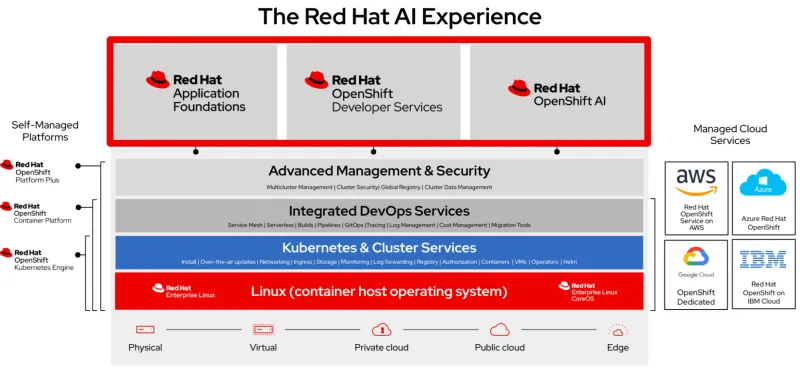
End-to-end security capabilities across the stack
Each layer of OpenShift AI contributes to robust regulatory alignment, a crucial aspect for organizations operating in scrutinized industries. This comprehensive alignment helps verify that all components, from infrastructure to application, meet the necessary compliance standards. By building on this foundation, organizations can deploy AI solutions with more confidence while mitigating regulatory risks.
- Operating system layer: Red Hat Enterprise Linux CoreOS provides immutability, SELinux enforcement, and encryption services that meet system hardening requirements under FedRAMP, DISA STIG, and CIS benchmarks.
- Platform layer: Red Hat OpenShift offers configuration buffers, isolated namespaces, encrypted etc storage, and policy-based deployment controls aligned with NIST 800-53 and PCI DSS.
- Application layer: AI pipelines and model services inherit these protections, enabling protected handoffs between data ingestion, training, and inference.
- Data layers: Red Hat OpenShift Data Foundation provides encrypted persistent volumes and integrates with enterprise key management systems to meet HIPAA and PCI data-at-rest requirements.
This layered approach helps align every component, from the node operating system to the AI model API, with compliance application.
Ongoing compliance and management
Audits used to take place once a year. In AI environments, this must happen continuously. OpenShift AI automates that process throughout:
- Compliance Operator: Continuously scan cluster configurations against benchmarks such as FedRAMP, PCI DSS and CIS Kubernetes.
- Red Hat Advanced Cluster Security: Monitors for runtime anomalies, unpatched vulnerabilities, or unauthorized privileges in AI workloads.
- Red Hat Advanced Cluster Management for Kubernetes: This type of governance adapts and enforces consistent policies across multi-cluster or hybrid environments, so compliance follows workloads wherever they run.
Together, these tools transform compliance from a reactive event into a continuous validation cycle, reducing audit overhead while improving security posture.
Protect the AI software supply chain
AI does not exist in isolation. Models, libraries and pipelines depend on large open source and industry ecosystems. Red Hat Trusted Software Supply Chain integrate with OpenShift AI to bring greater transparency and traceability to those components:
- Red Hat Trusted Artifact Signer: Cryptographically sign and verify container and model artifacts.
- Red Hat Trusted Profile Analyzer: Provides insight into vulnerabilities and licensing risks across AI components.
- Red Hat Quay: Scan and save signed images with full provenance history.
- Red Hat Advanced Cluster Security Policy Enforcement: Enforce robust security policies to help prevent the deployment of unsigned or non-compliant artifacts so that only trusted and verified components are integrated into the system. This helps reduce unauthorized or tampered software risks.
These capabilities align with NIST 800-218 (Secure Software Development Framework) and the US Executive Order 14028, giving organizations an auditable chain of custody for their AI assets.
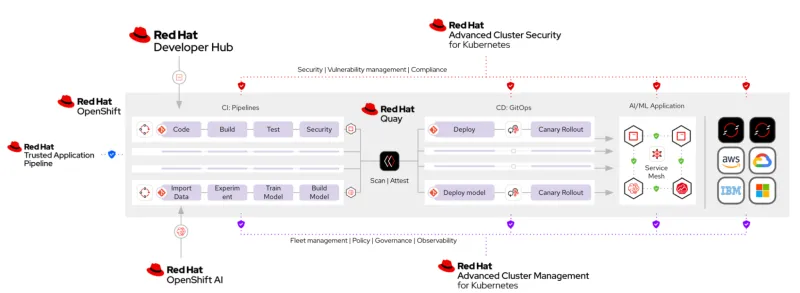
Hybrid cloud consistency and compliance, built with choice in mind
OpenShift AI’s architecture maintains policy parity across environments, so the same compliance and security controls apply whether workloads run in a private data center, on a certified public cloud like AWS GovCloud or Azure Government, or on edge devices in a disconnected operating model.
This consistency greatly reduces duplicate certification efforts and facilitates compliance reporting. Organizations can scale AI workloads globally while maintaining a single, verifiable compliance baseline, enabling distributed training, cross-region attrition and federated learning within the same operational framework.
How Compliance Enables AI Innovation
Compliance frameworks are often seen as barriers, but they help enable hybrid AI innovation. They provide the rules of trust, encryption standards, audit requirements and access controls that enable organizations to process sensitive data with confidence.
By meeting and exceeding these standards, OpenShift AI becomes more than a container platform for AI—it’s a compliance-ready foundation for innovation. FIPS validation, FedRAMP alignment, HIPAA safeguards, and PCI DSS controls all work together so that AI systems remain protected, verifiable, and auditable throughout their lifecycle.
Trust is the currency of AI in the hybrid cloud
Red Hat OpenShift AI combines decades of open source security expertise with the compliance frameworks that govern today’s regulated industries. Its zero-trust architecture, multi-standard compliance alignment and consistent hybrid deployment model allow organizations to overcome data gravity and bring AI to where it delivers the most value.

![[keyword]](https://learnxyz.in/wp-content/uploads/2026/02/Test-Update-2026-01-03-COSMIC-101-Budgie-NVIDIA-Driver-Assistant.jpeg)
![[keyword]](https://learnxyz.in/wp-content/uploads/2026/02/How-to-Setup-and-Connect-OpenVPN-Access-Server-on-Ubuntu.png)