
![[keyword]](https://learnxyz.in/wp-content/uploads/2026/02/1771344354_As-exams-come-Chandigarh-admn-deploys-helplines-for-students.jpg)
With the Class 10 and 12 board exams beginning on February 17, anxiety among students across the city is palpable.
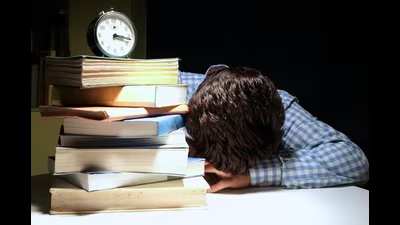
For some, the concern centers on unfinished revisions; for others, it’s about managing time efficiently, tackling the paper strategically or simply staying calm and composed in the exam room.
Recognizing the growing pressure, the UT Education Department stepped in with dedicated exam helplines for the city’s 96 state schools – deploying 18 lecturers, TGTs and counselors from various state schools to guide students through the most stressful period of the academic year.
Aimed at guiding students through last-minute doubts, exam strategies and stress management, the initiative offers both academic support and emotional reassurance.
The helplines will be operational until 10 April 2026 between 15:00 and 19:30. The list of counsellors, with their telephone numbers, has been distributed among the 54 Government High Schools and 42 Government Senior Secondary Schools (GMSSS) in Chandigarh, with directions to display it on their premises for easy access.
Overall, nearly 18,000 students are expected to appear for the Class 10 exam, while around 20,000 students will take the Class 12 board exams from both government and private schools.
Neeraj Sharma, an English lecturer at GMSSS-18, who is one of the counselors on board, said, “Most students want to know how to manage time during the exam and how to deal with stress.”
Some even asked for notes on subjects other than English. “In such cases, I connect them with the respective TGTs for accurate guidance,” she added.
Science, this year, is a particular source of confusion. Jasjit Kaur, TGT (Science) at GMSSS-37-B, who also provides guidance, said many students were unsure about how to attempt the paper as per the revised pattern. “The exam will now be classified into biology, chemistry and physics, unlike previous years. We help them understand how to structure answers accordingly,” she said.
The anxiety, she noted, can peak near the exam. “A student recently called me and explained how he wanted to score more than 90% but felt unprepared,” she recalls.
In addition to subject inquiries, counselors experience emotional distress. Monika Sharma, counselor at GGMSSS-20-B, said she has received nearly 50 calls and messages in recent weeks. “Students say they feel anxious, overwhelmed and unable to focus,” she said.
Her advice is practical – practice sample papers, and use memory tools such as mnemonics and abbreviations.
“Most importantly, see the exam as a celebration of your preparation rather than a burden,” she said. Recalling an incident from last year when a student had a panic attack before his exam and was after GMCH 32, Sharma stressed on early intervention.
Dr Adarsh Kohli, a former professor of clinical psychology at PGIMER’s department of psychiatry, said students should follow an organized daily plan and tackle difficult chapters first. “Revise by writing and speaking key points. Practice deep breathing and avoid overthinking to build confidence. Stay positive and calm,” she said, adding that consistent parental support also made a big difference.
Two board exams for Class 10: CBSE explained
Last year, CBSE announced that from 2026 onwards, Class 10 students will be allowed to take board exams on up to two occasions during any given school year, one main exam and one for improvement, if desired.
CBSE has now clarified that the first Class 10 board exam will be compulsory while the second will function only as a limited enhancement or compartment opportunity, not as a replacement.
Furthermore, students can opt for improvement in maximum of three subjects. Those who are absent in three or more subjects will be placed in the “Essential Repetition” category.

![[keyword]](https://learnxyz.in/wp-content/uploads/2026/03/1772407190_बीमाउथ-1-1-सुंदरलैंड.jpg)
![[keyword]](https://learnxyz.in/wp-content/uploads/2026/03/Joan-Laporta-re-elected-Barcelona-president-beating-Victor-Font.jpg)