

![[keyword]](https://learnxyz.in/wp-content/uploads/2026/02/1771453273_After-SIR-134-deletions-in-Gujarat-menu-Indian-news.jpg)
New Delhi/Ahmedabad
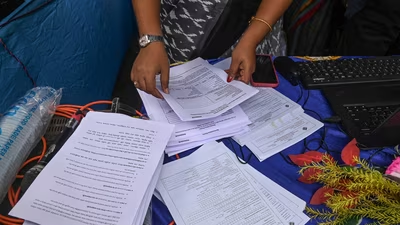
The Election Commission of India (ECI) on Tuesday published the final rolls for Gujarat after nearly three-and-a-half months of the Special Intensive Revision (SIR) exercise, reflecting an overall deletion of 13.4% compared to the electoral roll before the controversial exercise.
On October 27, before SIR began, there were 50.84 million people on Gujarat’s electoral roll. This number shrank to 43.47 million in the draft list published after the enumeration phase on 19 December. The final list published on Tuesday – after the claims and objections phase – had 44.03 million voters.
After the draft list was released, ECI saw 956,121 additions and 395,555 deletions, with the electorate increasing by a net 560,566 voters
The net addition in the claims and objections phase did not change the district-wise trend in deletions seen in the draft roll. Urban districts had more removals than rural districts. For example, Surat, Ahmedabad and Vadodara showed the highest percentage of deletions compared to the pre-SIR roll, and Dang, Chota Udepur and Narmada the least. This was also the case in the draft phase, although Narmada and Chota Udepur swapped places.
The net scrapping in Surat, Ahmedabad and Vadodara compared to pre-SIR rolls stood at 25.3%, 21.5% and 17.4% respectively. These numbers were 25.7%, 23.2% and 18.7% respectively at the draft stage.
In Dang, Chota Udepur and Narmada, the role shrank by 3.5%, 5.9% and 6.4% respectively compared to pre-SIR levels. The deletions in these districts were 5.5%, 7.8% and 7.4% respectively at the draft stage.
In absolute numbers, Ahmedabad recorded the highest net addition of 105,607 voters, taking its electorate to 4,912,548. Vadodara added 34,890 voters to reach 2,220,095, and Rajkot recorded a net increase of 33,421 voters, taking the total to 2,088,779. Surat added 15,844 voters, with its electorate rising to 3,639,042.
Surendranagar was the only district to record a marginal net decrease of 99 voters. In south Gujarat, Navsari added 6,887 voters, Valsad 4,698 and Tapi 5,195, while Dang recorded a net increase of 4,092 voters and Botad 10,136.
Chief Electoral Officer Hareet Shukla said the exercise was completed within the stipulated time with wide public participation. He said 34 district election officers, 182 election registration officers, 855 assistant election registration officers and 50,963 booth level officers were involved in the process, along with volunteers and representatives of political parties.
SIR involved door-to-door verification across the state, during which CAAs distributed enumeration forms, mapped and matched voter data, and identified names for deletion due to death, permanent migration and duplicate registration.
Before the exercise began, Gujarat’s election database contained 50,843,436 names. During the review, 43,470,109 summary forms were received and fully digitized. Claims and objections relating to the inclusion, deletion and correction of voter details were accepted between 19 December 2025 and 30 January 2026 and were verified and disposed of by 10 February 2026.
One possible reason for high deletions in more urban districts may be economic migration. There is a strong correlation between a district’s share of total statewide deletions in SIR and the district’s share of voter growth between 2012 (the earliest available voter count after the 2008 delimitation exercise) and 2025. These districts with high growth between 2012 and 2025, and high deletions in SIR, are generally among the more urban districts.
Apart from Gujarat, SIR started on November 4 in 11 other regions – Madhya Pradesh, Chhattisgarh, Rajasthan, Uttar Pradesh, West Bengal, Tamil Nadu, Kerala, Goa, Puducherry, Andaman and Nicobar Islands and Lakshadweep. Out of these, the final rolls were published in Puducherry – where the rolls shrank by 7.6% compared to the pre-SIR roll – and Lakshadweep, where the rolls shrank by 0.4%. These numbers are lower than the 10.1% and 2.5% cuts seen in the two UTs in the draft list, respectively.

![[keyword]](https://learnxyz.in/wp-content/uploads/2026/02/Aus-vs-Ind-2025-2026-Disappointed-Ashleigh-Gardner-to-go.jpg)
![[keyword]](https://learnxyz.in/wp-content/uploads/2026/03/1772309196_FBI-हमले-के-बीच-LAUSD-ने-अधीक्षक-के-खिलाफ-बड़ा.jpg)
![[keyword]](https://learnxyz.in/wp-content/uploads/2026/03/1774612280_Punjab-AAP-to-launch-a-nationwide-campaign-to-celebrate-four.jpg)