

![[keyword]](https://learnxyz.in/wp-content/uploads/2026/04/1776877872_UK-bans-a-generation-of-children-from-smoking-How-it.jpg)
The United Kingdom has passed a landmark law that will make it illegal for anyone born after 2008 to ever buy tobacco products.
On Tuesday, the House of Lords – the British Parliament’s upper house – approved the Tobacco and Vapes Bill, which passed the House of Commons.
Health advocacy groups have hailed the new law as the first time an entire generation of young people will never be allowed to buy cigarettes or vapes.
The government says it is tackling one of the UK’s leading causes of preventable death, disability and ill health.
Introducing the bill to the House of Lords on Monday, the parliamentary secretary of state for the Department of Health and Social Care, Gillian Merron, told the chamber: “This is in fact the biggest public health intervention in a generation and I can assure all noble Lords that it will save lives.”
Following the approval of the Bill, Wes Streeting, Secretary of State for Health and Social Care, said: “Children in the UK will be part of the first smoke-free generation, protected from a lifetime of addiction and harm.
“Prevention is better than cure – this reform will save lives, ease pressure on the NHS and build a healthier Britain.”
Here’s what we know about the UK’s new smoking law.
What does the bill say and how will it work?
It is currently illegal to sell tobacco products to anyone under the age of 18 in the UK. Starting in 2027, the legal age for the sale of tobacco products will increase by one year each year, meaning that individuals born since January 1, 2009 will never be able to purchase them.
The government said up to 1.7 million fewer people would smoke by 2075 as a result of this bill.
The law only applies to those who sell tobacco products – people will not be penalized for buying, possessing or using them, regardless of their age.
As well as inside public and commercial buildings, vaping will be banned in playgrounds, outside schools and in hospitals, as well as in cars transporting children. The smoking of cigarettes is already prohibited in all these areas.
Like smoking, vaping will still be allowed at outdoor venues such as pub gardens, and no one will be banned from smoking in their own homes. Vaping outside hospitals will also continue to be allowed to help people trying to quit smoking, the government said.
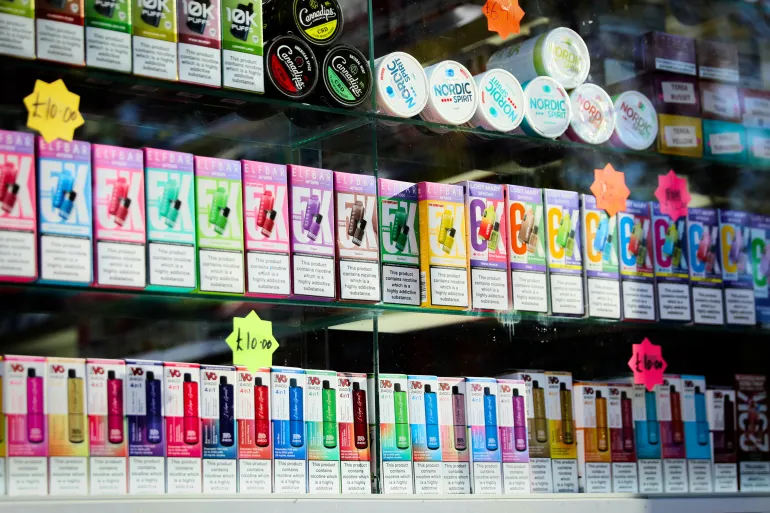
The bill also prohibits vapes and other consumer nicotine products, such as nicotine pouches, from being branded and advertised to appeal to children.
UK ministers will have new powers to regulate tobacco, vaping and nicotine products, including their flavors and packaging.
How did the British public react to the new law?
People in the UK overwhelmingly support a ban on smoking.
A poll carried out in 2024 by YouGov for Action on Smoking and Health (ASH), a public health charity, suggested that 78 per cent supported the idea of creating a smoke-free generation in the UK, while 52 per cent of smokers supported raising the age of sale by one year each year.
A statement from ASH at the time of the poll said: “The policy has broad cross-party support with 70 per cent of those who voted Conservative in 2019, 74 per cent who voted Labour, and 75 per cent of those who voted Lib Dem. A majority of smokers also support raising the age of sale, more than double the proportion (24% per cent) opposed.”
What are health advocates saying about this bill?
Anti-smoking lobby groups and health advocates welcomed the new law.
According to ASH, the anti-smoking lobby group, “it could prevent 115,000 cases of serious illness (eg stroke, heart disease, lung cancer) annually and save billions in health and care costs”.
“Smoking is responsible for 80,000 deaths a year in the UK, and one in four of all cancer-related deaths. No other consumer product kills up to two thirds of its users,” ASH said.
The lobby group said its research showed there was almost one hospital admission every minute caused by smoking, and as many as 75,000 GP appointments every month due to smoking-related illnesses.
“The direct cost of smoking to UK public finances in 2023 was 21.9 billion pounds ($29.6 billion),” ASH said. “This is mainly made up of lost economic productivity and NHS and social care costs. This is more than double the 8.4 billion pounds ($11.3 billion) the Treasury raised through tobacco tax revenue. This means less money left for essential public services.”
However, some say the bill does not go far enough and should include new measures to help existing smokers.
Sarah Sleet from Asthma + Lung UK told the BBC: “Now that this ground-breaking bill has finally passed, we have a chance to go further to protect public health and hold the tobacco industry to account.”
She called on the government to improve stop-smoking support, which currently varies widely from area to area. “At the moment we have a postcode lottery, so the tobacco industry needs to pay through a levy to reduce the harm they cause by funding these vital services across the UK,” she said.
Dr David Crane, founder of Smoke Free, an app which helps smokers quit, told industry magazine Healthcare Management: “The Government’s ambition to create a smoke-free generation is absolutely right – preventing young people from ever starting to smoke is essential. But we must not forget the 6m adults in the UK who already smoke, putting their health at risk every day and putting huge pressure on the NHS.”
How did the industry and others respond?
During the debate in the House of Lords, Lord Naseby, a former Conservative MP, said the bill “upset a lot of people in that industry”, including retailers. “What we really need is a proper understanding of how we educate people not to smoke.”
Responding to Lord Naseby, Health Secretary Merron said: “I can reassure Lord Naseby in general, as I have done on a number of occasions, about how closely we have worked with retailers, and we will continue to do so.”
Dan Marchant, director of Vape Club, told UK industry magazine Healthcare Management: “While we have seen an overall national decline in smoking rates, which have reached the lowest points since records began, it is worrying that only 25 per cent of UK authorities are on track to meet the UK Government’s smoke-free 2030 target.
“To reverse the trend seen in the latest national statistics, we need to focus on clear and fact-based education about the relative risks between vaping and smoking. Without this, we risk not only falling short of the smoke-free target, but also seeing a disturbing trend of people returning to smoking.”

![[keyword]](https://learnxyz.in/wp-content/uploads/2026/03/स्कूल-की-फीस-भरने-के-लिए-बैंकर-के-संघर्ष-की.jpg)
![[keyword]](https://learnxyz.in/wp-content/uploads/2026/04/चीन-सौदे-पर-विवाद-के-बाद-न्यूजीलैंड-ने-कुक-आइलैंड्स.jpg)
![[keyword]](https://learnxyz.in/wp-content/uploads/2026/03/मुझे-गर्भवती-होने-से-नफरत-है-और-फिर-मुझे-इस.jpg)