West Bengal lost 8.9 million voters from its pre-SIR electorate
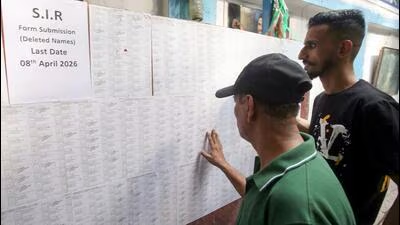
West Bengal had 76.6 million voters before the SIR process started in the state. HT’s calculation using the data released by ECI on Monday and Tuesday puts the number of voters currently at 67.7 million voters. This represents a loss of 8.9 million voters in absolute terms: 6.2 million of these were deleted during the SIR process (as carried out in other states) and another 2.7 million in the assessment process that followed (which is unique to the exercise in West Bengal). To be sure, this number could change for the entire state, as the state’s 142 constituencies voting in the second phase could add new voters and depending on the fate of 22,163 still under the assessment process. How does the change in Bengal’s pre-SIR and post-review voter strength compare to other states that have undergone SIR or Special Review (Assam)? Before the assessment exercise, it saw a loss of 8.1% voters, putting it in the middle of the pack. With that number now 11.6%, West Bengal ranks only behind Gujarat and Chhattisgarh among large states, neither of which will vote until 2027. To be sure, Uttar Pradesh is yet to complete its SIR process. (See Chart 1)
West Bengal saw a slight weakening in the correlation between urbanization and post-allocation deletion
Ever since the SIR exercise began with Bihar in June 2025, conspiracy theorists have attributed ulterior motives to it. These pages refrained from theorizing before facts and were proven right. In almost all large states, deletions were higher in districts that had a greater share of urban population. We attributed this to migrants who were registered as voters in more than one place and ended up choosing their place of birth when the SIR process forced them to make a choice. West Bengal still fits this pattern even after adjudication, but largely due to the changes in the electoral roll prior to the adjudication process, with the correlation between the two numbers now weaker. Deletions under the assessment process have a very weak correlation with urban population share across districts. (See maps 2A and 2B)
What is even more remarkable is the strong correlation between Muslim population share and allocation process
Muslim voters bearing the brunt of the SIR process has been a major concern in West Bengal and many other states. Data up to and including the completion of the SIR (advance allotment in West Bengal) process did not support such fears. District-wise deletions had a very weak correlation with the share of Muslims in the population. This is not the case as far as the assessment process is concerned. Not only were precincts with a greater proportion of Muslims more likely to see a greater proportion of voters placed under assessment, they also saw a greater proportion of deletions as a proportion of the pre-assessment roll. This should of course be read with the caveat that we do not know the actual religious identity of people on the electoral roll. (See maps 3A and 3B)
How does the new electoral roll for West Bengal fit into the 2024 election math?
One can no longer avoid this question, given the strong correlation between deletions between the pre- and post-assessment roll and the share of Muslims across districts. After all, Muslims are unlikely to vote for the Bharatiya Janata Party (BJP) in what is a completely polarized contest between the BJP and the Trinamool Congress (TMC). The data, even after the post-assessment deletions, still shows no district-wise correlation between voters deleted and assembly constituents (AC) won by the TMC across districts in 2024. However, this could also be a result of lack of granular data on number of Muslim voters or AC-wise deletions and the signal being lost in the noise of district.
For example, anecdotal reports, such as one published by HT, show that an overwhelming section of Muslims are being scrapped in the Nandigram AC. But at the district level, Purba Medinipur district in which Nandigram is located saw the lowest deletions in percentage. This is exactly what Hindustan Times warned against in an editorial published on March 3: “State capacity and institutional trust are key in shaping narratives about the state of democracy in India. When these are found to be lacking, alarmists always sound more credible than they are.”


![[keyword]](https://learnxyz.in/wp-content/uploads/2026/04/1775628549_Making-sense-of-West-Bengal-poll-rolls-to-SIR-assessment.jpg)

![[keyword]](https://learnxyz.in/wp-content/uploads/2026/04/1775021606_Igor-Tudor-Croatian-leaves-Tottenham-Hotspur-by-mutual-consent-after.jpg)
![[keyword]](https://learnxyz.in/wp-content/uploads/2026/02/1771995792_Liverpools-physicality-a-concern-as-Oliver-Glasner-looks-to-mend.jpg)
![[keyword]](https://learnxyz.in/wp-content/uploads/2026/03/फ़ुटबॉल-कुछ-शिन-पैड-इतने-छोटे-क्यों-होते-हैं.jpg)