

![[keyword]](https://learnxyz.in/wp-content/uploads/2026/02/What-will-it-take-to-bring-F1-back-to-India.jpg)
In today’s Finshots, we tell you about the Adani Group’s bid to bring F1 back to India and what it will actually take to make it happen.
The Story
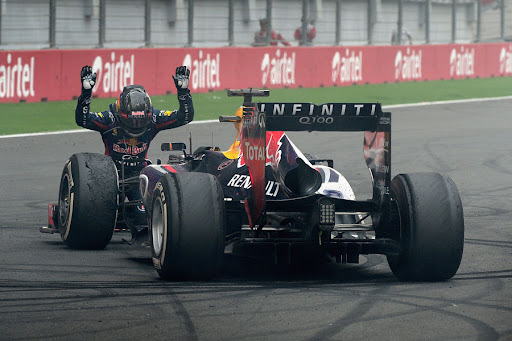
On October 27, 2013, Sebastian Vettel stepped out of his Red Bull, fell to his knees and in front of his RB9 racing car on the main street of the Buddh International Circuit in Noida. It was his fourth consecutive world championship. And this moment has since been known as Bow to the Bull.
The crowd roared as the sun set behind the stands. And for a brief moment, India was at the center of Formula 1.
This image still circulates among the OG F1 fans – Vettel kneeling in front of his car at a circuit carved out of Greater Noida, designed by Hermann Tilke, the architect behind many of Formula 1’s global venues.
Drivers loved the sweeping Turn 10–11–12 complex. Crews praised the elevation changes. And the FIA (FIA stands for Fédération Internationale de l’Automobilewhich is the governing body for motorsport) also had no major complaints about the safety or the layout. By all sporting measures, the Indian Grand Prix worked.
So why did it disappear after just three races?
You see, it was mainly because of tax problems. The Jaypee Group, which built and staged the race at Buddh International Circuit, found itself navigating a minefield of regulations. First, the event was classified as “entertainment” rather than “sport”, causing heavy tax liabilities. In addition, payments made to Formula 1 management have been dragged into withholding tax disputes, where authorities argue that tax should have been deducted before the host fee was paid abroad.
There were also disputes over customs duties on imported equipment and questions over whether Formula One management had a taxable presence in India.
Add in infrastructure costs and increasing legal uncertainty, and the financial model quickly became unsustainable. What looked like a sporting triumph on television was behind the scenes a balance sheet under strain. We wrote about this in a previous story here.
However, the story may not be over.
With the Jaypee group going bankrupt and the Adani group looking to take over, new interest in the Indian Grand Prix has emerged. In fact, Karan Adani recently said that talks have taken place with stakeholders about the possibility of bringing Formula 1 back to India.
Meanwhile, Formula 1 is not the same sport as it was in 2013. Netflix’s Drive to survive and the most recent F1: The movie The sport’s global audience expanded drastically. F1 cracked the US market with races in Miami, Austin and Las Vegas. Middle Eastern governments also treat F1 as a ‘strategic asset’. So, the bar for entry is actually higher now.
So what would it really take to bring F1 back to India?
The first and most obvious issue is economics. F1 races are not self-sustaining ticket events. Governments or sovereign wealth funds usually underwrite this because the hosting fee alone can cost $20-60 million. Saudi Arabia, Qatar, Abu Dhabi and Singapore view F1 as an investment for tourism and soft power rather than a commercial event expected to make a profit on ticket sales alone.
So, if India wants F1 back, we cannot just rely on a private promoter hoping to recover costs through ticketing and sponsorship. Either the central government or a state government will have to treat the opportunity as strategic infrastructure, similar to how other countries approach it. Without that support, the financial risk remains too concentrated.
Second is taxes. As we mentioned earlier, the Indian Grand Prix was disbanded earlier due to tax issues. This has since been cleared up, with motorsport acting as a sport rather than entertainment. Even though indirect taxes have since evolved under GST, clarity on profit attribution and logistical exemptions will be essential before organizers recommit.
To understand this, remember what happened the first time. Authorities argued that Formula 1’s presence created a ‘permanent establishment’ in India because the race was “held in India”, making it liable to domestic tax. Crews bringing in cars and other equipment also encountered complex customs issues at our ports. The result was regulatory uncertainty and unpredictability.
Any revival will require a clean legal and tax framework. GST treatment must be predictable, direct tax liabilities must be clearly defined, and there must be protection against future litigation reopening settled cases.
Private capital will not commit to multi-year contracts without this stability. Because Formula 1 contracts are usually for three to ten years. If the regulatory environment can shift mid-cycle, the risk becomes just too high.
However, we can see that the government is also keen to bring back the sport. Minister of Sports Mansukh Mandaviya recently spoke to officials of the Yamuna Expressway Industrial Development Authority (YEIDA), which now controls the circuit. He said that the long-term management of the Buddh International Circuit could be handed over to a professional sports management company.
This opens the door for Adani Sportsline, the sports arm of the Adani Group. They have experience in managing large-scale sports properties and come with deep capital. A group like this is structurally better positioned for the operational complexity that Formula 1 requires.
This in turn will also cover how the asset is handled on paper. Previously, the circuit was promoted and operated by a property developer whose core business was not global sports event management. This addresses the tax part, as income will now be treated as ‘Income from Operations’, rather than ‘Other Income’, which led to the tax confusion in the first place.
The third issue is infrastructure.
Formula 1 today is a weekend-long spectacle built around hospitality, concerts, luxury tourism and corporate networking. Cities like Las Vegas and Miami have integrated the race into urban planning by not just providing a track. They created an experience around it.
India already has a world class track. So, the physical race surface is not the bottleneck. What matters now is the surrounding infrastructure. Airport capacity, seamless transport corridors, five-star hotel availability, corporate hospitality suites and high-end tourism connectivity all form the commercial viability of the event. The race must fit into a wider tourism and branding strategy, and not operate in isolation.
This is exactly where a conglomerate like the Adani Group can bring leverage, given its footprint across airports, logistics, hospitality and urban infrastructure. The ability to integrate transportation, premium experiences and corporate partnerships under one ecosystem could significantly strengthen India’s direction towards Formula 1.
That said, the fourth edition is the F1 calendar itself.
Formula 1 now runs a 24-race calendar. Crews have repeatedly raised concerns about logistical strain and travel fatigue. Adding a race requires either expanding the calendar further or relocating an existing venue. To justify inclusion, India must offer either a compelling financial package or strategic geographic value.
Here’s a possible angle. An Indian Grand Prix could anchor an Asian leg alongside Singapore and Japan, reducing travel friction and strengthening the sport’s presence in the region. But this requires coordination with Formula 1’s wider scheduling priorities, over which we have no direct control.
The fifth issue is commercial viability, which is the most important part.
Corporate India must see tangible value in associating with the opportunity. Domestic brands, technology firms, financial institutions and conglomerates will need to anchor sponsorship deals. Because without good local sponsorship, the financial burden falls disproportionately on the government or promoter. In successful markets, F1 is embedded in a network of corporate partnerships that extend beyond race weekend to branding and activation throughout the year.
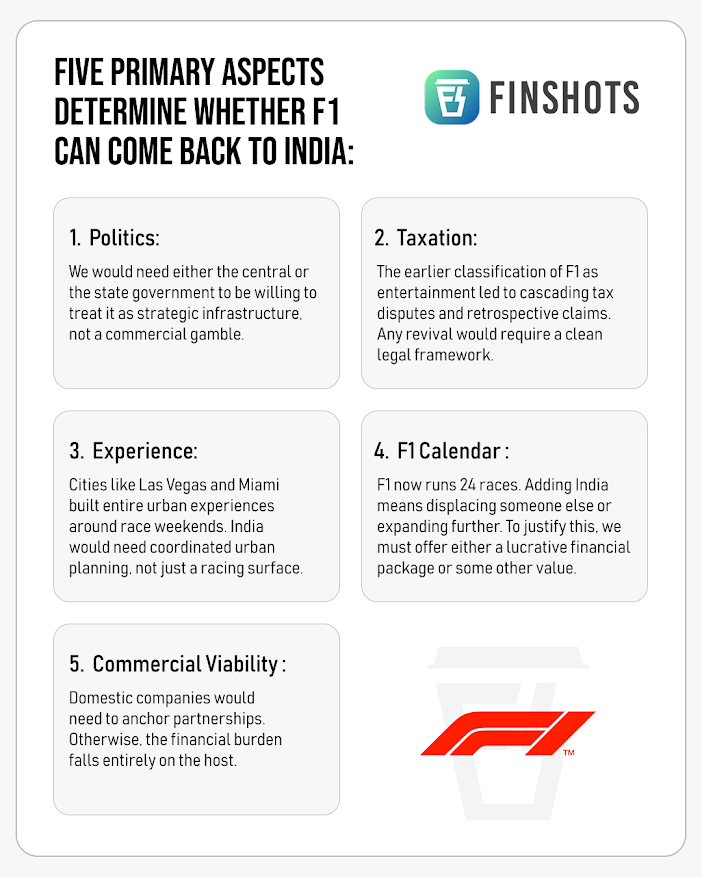
Taken together, these issues show that bringing F1 back is not about audience or taxes. It is about adapting government policy, capital, logistics and strategy.
The audience exists. Motorsport viewership in India has grown, especially among younger demographics. What is required is coordinated intent and a willingness to commit long term.
If structured correctly, F1 can boost tourism, create global visibility and signal soft power. It can also strengthen India’s sports ecosystem by creating avenues for local motorsport development and attracting additional industries.
So, while the Adani Group has the intent and some of the key ingredients needed to make F1 work, there are still a few hurdles to overcome before it can bring F1 back to India.
But if the model resembles 2011 to 2013, even with a private promoter like the Adani Group bearing most of the financial risk amid political uncertainty, the outcome is likely to repeat itself.
Until then…
If you found this story about the Indian Grand Prix interesting, feel free to share it with your friends, family or even strangers WhatsApp, LinkedIn or x.
How strong is your financial plan?
You’ve probably ticked off mutual funds, savings, and maybe even some added pressure. But if Life Insurance is not part of it, your financial pyramid is not as safe as you think.
Life insurance is the crucial foundation that holds all your wealth together. This ensures that your family remains financially protected when something unpredictable happens.
If you are unsure where to start, Ditto’s IRDAI certified insurance advisors can help. Book a FREE consultation and get honest, unbiased advice. No spam, no pressure.

![[keyword]](https://learnxyz.in/wp-content/uploads/2026/03/1772493464_सीईओ-के-रूप-में-बफेट-के-अंतिम-कदम-में-बर्कशायर.jpg)
![[keyword]](https://learnxyz.in/wp-content/uploads/2026/02/1771342400_STT-hike-the-Union-Budget-and-more….jpg)